
surrey-nlp/Cyberbullying-Detection-CB1
收藏Hugging Face2026-04-01 更新2026-04-05 收录
下载链接:
https://hf-mirror.com/datasets/surrey-nlp/Cyberbullying-Detection-CB1
下载链接
链接失效反馈官方服务:
资源简介:
---
language:
- en
license: unknown
task_categories:
- text-classification
task_ids:
- multi-class-classification
tags:
- cyberbullying
- hate-speech
- social-media
- twitter
pretty_name: Cyberbullying Detection CB1
size_categories:
- 10K<n<100K
dataset_info:
features:
- name: tweet_text
dtype: string
- name: cyberbullying_type
dtype: string
splits:
- name: train
num_bytes: 5559974
num_examples: 35769
- name: validation
num_bytes: 311587
num_examples: 2000
- name: test
num_bytes: 1542394
num_examples: 9923
download_size: 4930386
dataset_size: 7413955
configs:
- config_name: default
data_files:
- split: train
path: data/train-*
- split: validation
path: data/validation-*
- split: test
path: data/test-*
---
# Cyberbullying Detection — CB1
## Dataset Description
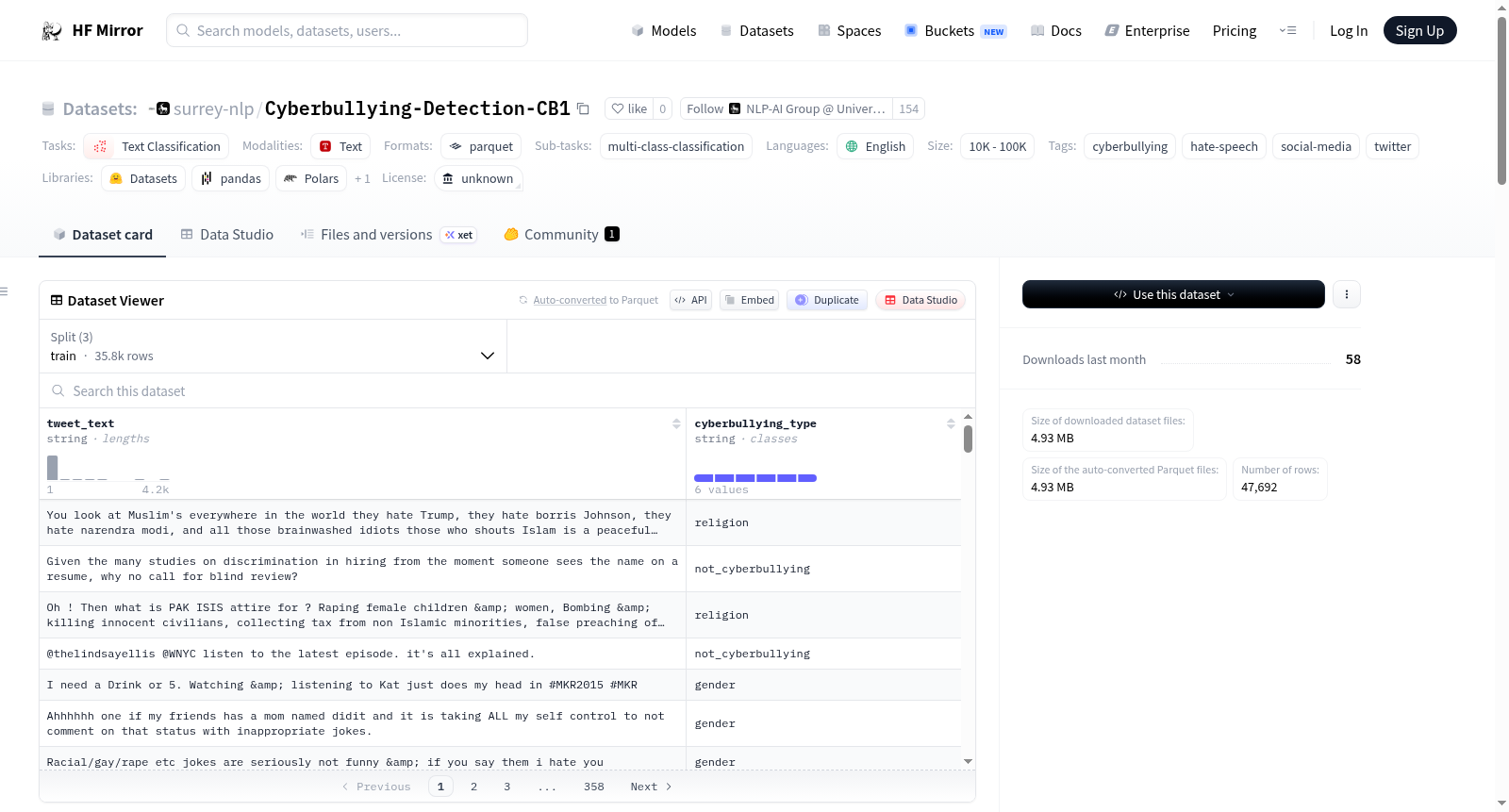
**CB1** is a multi-class text classification dataset for automated cyberbullying detection on social media. Each instance is a single social media post (sourced from Twitter/X) annotated with a cyberbullying category.
This dataset is part of the **Cyberbullying-Detection** collection on Hugging Face.
---
## Dataset Structure
### Data Fields
| Field | Type | Description |
|-------|------|-------------|
| `tweet_text` | `string` | Raw social media post text |
| `cyberbullying_type` | `string` | Cyberbullying category (see label list below) |
### Label Classes
| Label | Description |
|-------|-------------|
| `not_cyberbullying` | Posts that contain no cyberbullying content. Includes general social commentary, opinions, and everyday conversation that may be critical or sarcastic but does not target individuals or groups with harmful intent. |
| `gender` | Posts that target individuals based on gender identity or sexual orientation. Includes harassment related to being male, female, non-binary, gay, lesbian, or transgender, as well as misogynistic and homophobic language. |
| `religion` | Posts that attack, mock, or dehumanise individuals or communities based on their religious beliefs or affiliation. Includes targeting of Christians, Muslims, Hindus, Jews, and other faith groups |
| `ethnicity` | Posts that demean or attack individuals based on their race or ethnic background. Includes the use of racial slurs and derogatory language directed at racial or ethnic minorities |
| `age` | Posts that bully or demean individuals based on their age. Includes harassment targeting young people (e.g. school-age bullying) as well as mockery of older individuals. |
| `other_cyberbullying` | Posts that constitute cyberbullying but do not fit neatly into the above categories. Includes general online harassment, trolling, and hostile behaviour not tied to a specific protected characteristic. |
---
## Dataset Splits
The dataset is split as follows:
| Split | Size | Description |
|-------|------|-------------|
| `train` | 75% of total | Training set |
| `validation` | 2,000 rows | Development / validation set (sampled from the 25% held-out portion) |
| `test` | Remaining ~25% minus 2,000 | Test set |
### Split Methodology
```python
from sklearn.model_selection import train_test_split
# Step 1: 75% train, 25% test+dev
train_df, test_dev_df = train_test_split(df, test_size=0.25, random_state=42)
# Step 2: 2000 rows for dev, rest for test
dev_df = test_dev_df.sample(n=2000, random_state=42)
test_df = test_dev_df.drop(dev_df.index)
```
---
## Usage
```python
from datasets import load_dataset
dataset = load_dataset("Washii/Cyberbullying-Detection-CB1")
# Access splits
train = dataset["train"]
validation = dataset["validation"]
test = dataset["test"]
# Example
print(train[0])
# {'text': '...', 'label': 'ethnicity/race'}
```
---
## Source Data
The original data is sourced from **"[Cyberbullying Detection](https://www.kaggle.com/datasets/andrewmvd/cyberbullying-classification)"** dataset in Kaggle, containing tweets annotated for cyberbullying across multiple categories. The full raw file is `CB1.csv`.
---
## Citation
If you use this dataset, please cite the original source appropriately.
---
## Dataset Card Authors
Uploaded and curated by [Washii](https://huggingface.co/Washii).
提供机构:
surrey-nlp
搜集汇总
数据集介绍
构建方式
在社交媒体内容分析领域,CB1数据集的构建遵循了系统化的数据采集与标注流程。该数据集源自Kaggle平台上的原始推文集合,通过精心设计的标注框架,将每条推文归类为特定的网络欺凌类别。构建过程中采用了分层抽样策略,确保各类别样本的均衡性,并利用随机分割方法将数据划分为训练集、验证集和测试集,其中训练集占总量的75%,验证集固定为2000条样本,其余部分作为测试集,从而为模型训练与评估提供了可靠的数据基础。
特点
CB1数据集在内容分类领域展现出鲜明的多维度特征。其标注体系涵盖了性别、宗教、种族、年龄及其他网络欺凌行为等多个敏感维度,并包含“非网络欺凌”类别,形成了精细化的分类框架。数据规模介于一万至十万条之间,具备足够的统计代表性,且所有文本均来源于真实的社交媒体平台,保留了原始的语言风格与语境信息。这种结构化的标注方案不仅支持多类别分类任务,还为研究网络欺凌的细分模式提供了丰富的语义资源。
使用方法
在自然语言处理应用中,CB1数据集可通过Hugging Face平台便捷加载。使用者只需调用`load_dataset`函数并指定数据集名称,即可访问训练、验证与测试三个子集。每个数据实例包含推文文本及其对应的欺凌类型标签,可直接用于文本分类模型的训练与评估。该数据集兼容常见的机器学习框架,支持端到端的模型开发流程,为网络欺凌检测算法的性能比较与优化提供了标准化的基准环境。
背景与挑战
背景概述
随着社交媒体平台的普及,网络欺凌现象日益凸显,对用户心理健康与社会安全构成严峻威胁。在此背景下,Cyberbullying-Detection-CB1数据集应运而生,由研究人员Washii基于Kaggle平台原始数据整理并发布于Hugging Face平台,专注于多类别文本分类任务。该数据集创建于社交媒体内容分析需求高涨的时期,核心研究问题在于自动化识别推特等平台中涉及性别、宗教、种族、年龄等维度的欺凌内容,旨在为自然语言处理领域提供标准化的评估基准,推动网络内容安全技术的发展,对计算社会科学与在线行为研究产生了显著影响。
当前挑战
网络欺凌检测领域面临诸多挑战,首要问题在于欺凌文本的语义模糊性与上下文依赖性,例如讽刺或隐喻表达常与普通言论混淆,导致模型误判。此外,数据标注过程需处理主观性与文化差异,标注者可能对欺凌意图存在分歧,影响标签一致性。构建数据集时,从原始社交媒体数据中筛选代表性样本并平衡各类别分布亦具难度,同时需确保用户隐私与数据合规性,避免敏感信息泄露。这些挑战共同制约了检测模型的准确性与泛化能力,亟待更精细的标注框架与跨领域方法突破。
常用场景
经典使用场景
在社交媒体内容安全分析领域,Cyberbullying-Detection-CB1数据集被广泛应用于多类别文本分类任务。研究者利用该数据集训练机器学习模型,以自动识别推特平台上的网络欺凌内容,涵盖性别、宗教、种族、年龄等具体欺凌类型。这一经典场景不仅推动了自然语言处理技术在有害内容检测方面的进展,还为在线社区管理提供了数据驱动的决策支持。
实际应用
在实际应用层面,该数据集支撑了社交媒体平台的实时内容审核系统开发。科技公司可基于训练模型自动过滤涉及性别歧视、种族仇恨等有害推文,辅助人工审核团队提升处理效率。教育机构亦利用相关技术监测校园网络环境,早期干预青少年网络欺凌事件,构建更安全的数字交流空间。
衍生相关工作
围绕该数据集衍生了多项经典研究工作,包括基于BERT的迁移学习模型CyberBERT、融合图神经网络的跨平台欺凌检测框架。这些工作不仅提升了多类别欺凌识别的准确率,还拓展至跨语言检测场景。部分研究进一步将标注体系与法律规范对接,为网络内容治理政策的制定提供了量化依据。
以上内容由遇见数据集搜集并总结生成



