Realmbird/nla-thought-anchors-hash_activations-step1
收藏资源简介:
该数据集名为nla-thought-anchors-hash,是nla-thought-anchors项目的一部分,旨在复制和扩展Ryan Greenblatt关于自然语言自动编码器(NLA)的研究。它包含从Qwen2.5-7B-Instruct模型提取的GSM8K测试集激活向量和NLA语言化描述,具体在模型第20层(0索引)的####标记处提取,该标记是模型生成最终答案数字前的最后一个令牌。数据集分为两个文件:correct.parquet(模型答案与标准答案匹配的708个样本)和incorrect.parquet(模型答案不匹配的611个样本)。激活向量在模型完整生成思维链响应后,通过第二次前向传递在完整序列(提示+响应)上捕获,此时模型已完成所有推理并即将输出答案。NLA描述由演员模型kitft/nla-qwen2.5-7b-L20-av通过SGLang输入嵌入注入生成。数据集的列包括问题文本、标准答案、模型响应、正确性标志、激活向量(长度为3584的float32列表)、原始GSM8K测试集索引和NLA描述。研究发现,在正确样本中,NLA描述包含数值答案的比例为14.3%,低于原始研究中的80%,这归因于演员模型在分布外数据(训练于竞赛数学问题)和小模型容量上的限制。该数据集可用于分析NLA在提取模型内部表示方面的效果,并验证####令牌携带答案特定信息的机制主张。
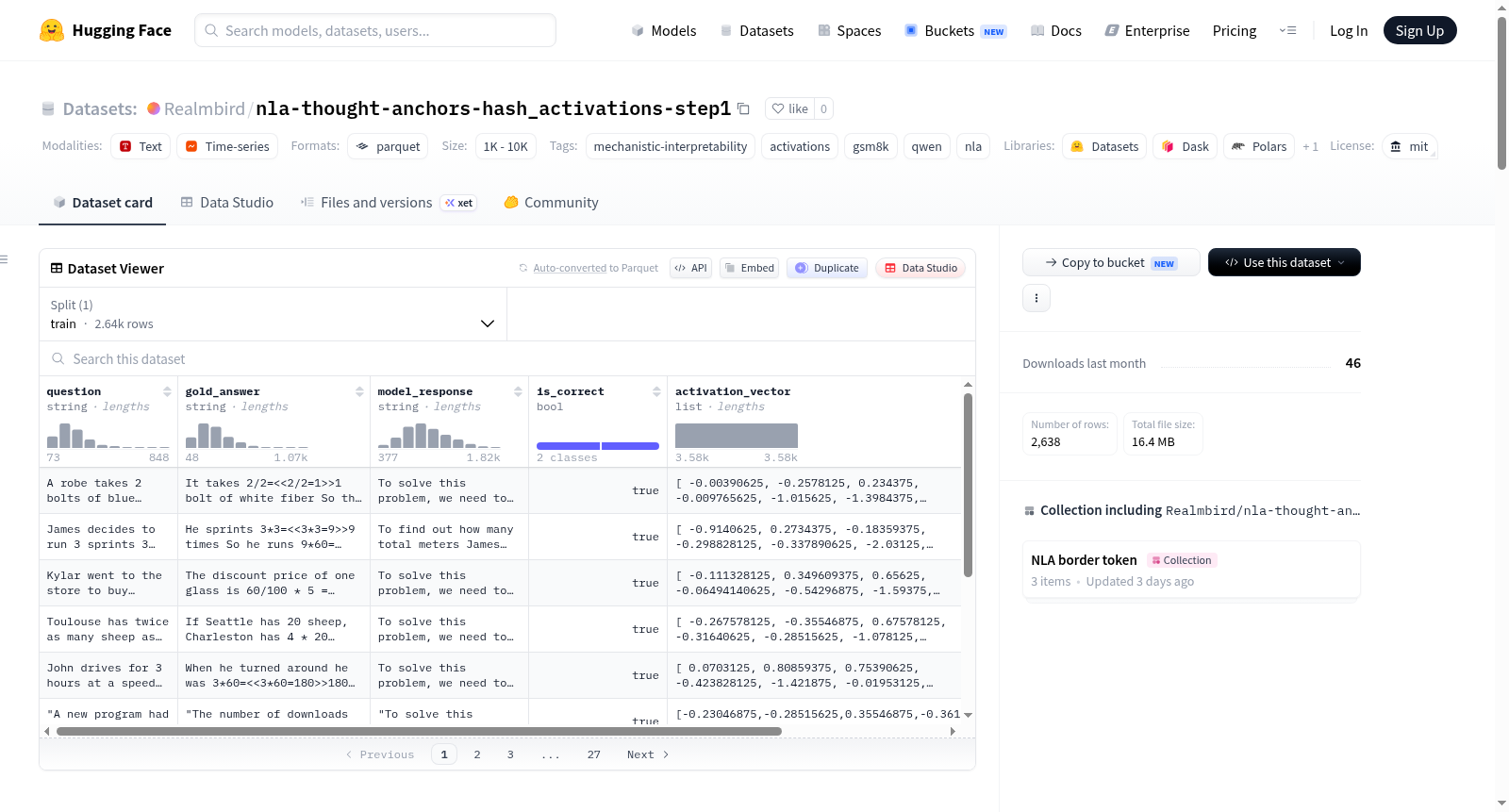
This dataset, named nla-thought-anchors-hash, is part of the nla-thought-anchors project, which aims to replicate and extend Ryan Greenblatt's research on Natural Language Autoencoders (NLA). It contains activation vectors and NLA verbalized descriptions of the GSM8K test set extracted from the Qwen2.5-7B-Instruct model, specifically at the #### token in layer 20 (0-indexed) of the model, which is the final token immediately before the model generates the final numeric answer. The dataset is split into two files: correct.parquet (708 samples where the model's answer matches the reference standard answer) and incorrect.parquet (611 samples where the model's answer does not match the reference). The activation vectors are captured via a second forward pass over the full sequence (prompt + response) after the model has fully generated the chain-of-thought response, right before the model is about to output the final answer. NLA descriptions are generated via SGLang input embedding injection using the actor model kitft/nla-qwen2.5-7b-L20-av. The dataset columns include: question text, reference standard answer, model response, correctness flag, activation vector (a float32 list of length 3584), original GSM8K test set index, and NLA description. The study found that only 14.3% of correct samples contain numerical answers in their NLA descriptions, which is lower than the 80% reported in the original study. This discrepancy is attributed to limitations of the actor model, including out-of-distribution data (trained on competition math problems) and small model capacity. This dataset can be used to analyze the effectiveness of NLA in extracting internal model representations, and to validate the mechanistic claims that the #### token carries answer-specific information.