
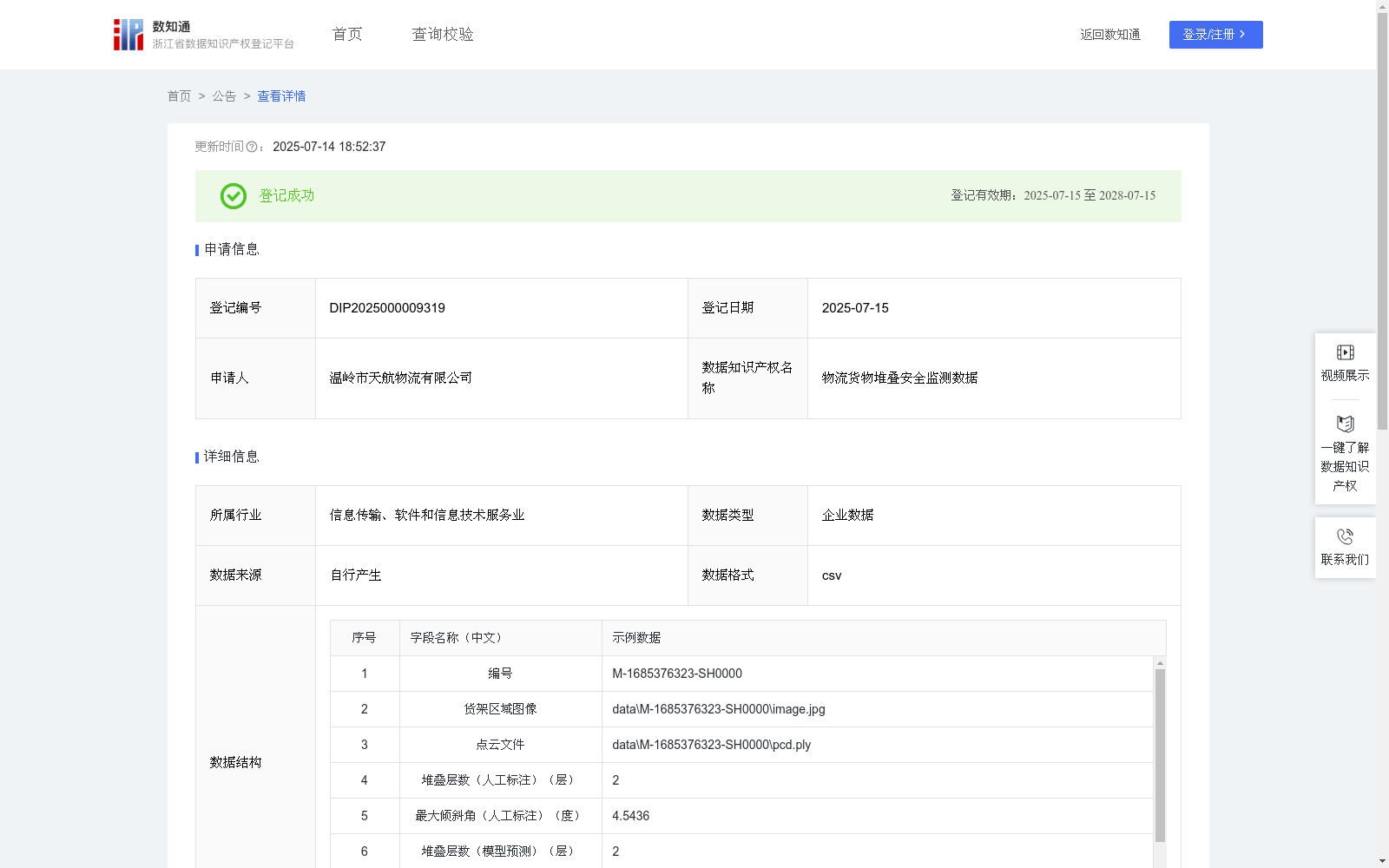
物流货物堆叠安全监测数据
收藏浙江省数据知识产权登记平台2025-07-14 更新2025-07-15 收录
下载链接:
https://www.zjip.org.cn/home/announce/trends/148733
下载链接
链接失效反馈官方服务:
资源简介:
该数据在仓储货物堆叠安全监测中具有重要的应用价值。能够提供毫米级精度的空间体积测量,更精确地识别不规则形状货物的堆叠姿态,帮助仓库管理员进行实时安全预警。这项技术在自动化立体仓库、零担物流中转场和电商分拣中心具有广泛应用,特别是托盘货物倾斜检测、散货堆叠高度预警和装卸碰撞风险预测,能够提高库存空间利用率,降低货损率,提供7×24小时不间断安全监控能力。数据收集:
通过部署在仓库立柱的6组RGB-D摄像头阵列,以10fps频率同步采集货架区域的多视角图像和深度信息。每个数据样本包含:货架区域图像:原始RGB矩阵数据;点云文件:通过深度相机获得;堆叠层数(人工标注):人工标注的货物堆叠层级;最大倾斜角(人工标注):激光测量仪获取的基准值;结构安全系数:力学仿真软件计算的稳定性参数
数据预处理:
1. 多视角配准:采用ICP算法对齐6个视角的点云数据,公式:minΣ||(R·p_i + T) - q_i||²,其中R为旋转矩阵,T为平移向量。
2. 体素降采样:将点云转换为0.5cm³体素网格,保留密度特征。
3. 表面重建:使用泊松重建算法生成三角网格表面,公式:∇·∇Φ = ρ,其中Φ为指示函数,ρ为点云密度。
模型构建:
采用基于PointNet++的改进型网络架构,网络包含4个层级特征提取模块和1个安全评估头。关键算法公式:L_total = αL_class + βL_reg + γL_geo
其中:L_class = -Σ(y_true·log(y_pred)) 用于堆叠层数分类;L_reg = smoothL1(θ_pred - θ_true) 用于倾斜角回归;L_geo = ||F(pcd) - F(mesh)||² 保障点云与重建网格的几何一致性α,β,γ为0.5,0.3,0.2的加权系数,网络输入为预处理后的点云,网络公式表达为output=PointNet++(pcd),其中pcd表示点云,output表示输出,包含堆叠层数(预测)、最大倾斜角(预测)和结构安全系数计算,处理时间通过轻量化网络架构优化获得。有了量化的结构安全系数和最大倾斜角,一旦任一指标的实时监测值突破阈值,系统会立即触发高级别警报,通过声光、短信、WMS系统消息等方式通知仓库管理员,并锁定高风险货位,防止人工继续操作,实现对迫在眉睫风险的即时响应。
This dataset holds significant application value in safety monitoring of stacked goods in warehouses. It enables millimeter-level accurate spatial volume measurement, allows more precise recognition of stacking poses of irregularly shaped goods, and assists warehouse managers in conducting real-time safety early warnings.
This technology has wide applications in automated three-dimensional warehouses, LTL (less-than-truckload) logistics transfer hubs, and e-commerce sorting centers, particularly in pallet cargo tilt detection, bulk cargo stacking height early warning, and loading and unloading collision risk prediction. It can improve inventory space utilization, reduce cargo damage rates, and provide 24/7 uninterrupted safety monitoring capabilities.
### Data Collection:
Multi-view images and depth information of the shelf area are synchronously collected at a frequency of 10 fps via 6 sets of RGB-D camera arrays deployed on warehouse columns. Each data sample includes:
1. Shelf area images: original RGB matrix data;
2. Point cloud files: obtained via depth cameras;
3. Stacking layers (manually annotated): manually annotated stacking levels of goods;
4. Maximum tilt angle (manually annotated): reference values obtained via laser measuring instruments;
5. Structural safety coefficient: stability parameters calculated by mechanical simulation software.
### Data Preprocessing:
1. Multi-view Registration: The Iterative Closest Point (ICP) algorithm is adopted to align point cloud data from 6 viewpoints, with the formula: $minsum||(Rcdot p_i + T) - q_i||^2$, where $R$ is the rotation matrix and $T$ is the translation vector.
2. Voxel Downsampling: Point clouds are converted into 0.5 cm³ voxel grids to retain density features.
3. Surface Reconstruction: The Poisson Surface Reconstruction algorithm is used to generate triangular mesh surfaces, with the formula: $
ablacdot
ablaPhi =
ho$, where $Phi$ is the indicator function and $
ho$ is the point cloud density.
### Model Construction:
An improved network architecture based on PointNet++ is adopted, which includes 4 hierarchical feature extraction modules and 1 safety assessment head. The key algorithm formula is:
$$L_{total} = alpha L_{class} + eta L_{reg} + gamma L_{geo}$$
Where:
- $L_{class} = -sum(y_{true}cdotlog(y_{pred}))$ for stacking layer classification;
- $L_{reg} = smoothL1( heta_{pred} - heta_{true})$ for tilt angle regression;
- $L_{geo} = ||F(pcd) - F(mesh)||^2$ to ensure geometric consistency between the point cloud and the reconstructed mesh.
The weighting coefficients $alpha$, $eta$, $gamma$ are set to 0.5, 0.3, and 0.2 respectively. The network takes preprocessed point clouds as input, and the network expression is $output = PointNet++(pcd)$, where $pcd$ represents the point cloud, and $output$ includes predicted stacking layers, predicted maximum tilt angle, and structural safety coefficient calculation. The inference time is optimized via a lightweight network architecture.
With the quantified structural safety coefficient and maximum tilt angle, once the real-time monitoring value of either indicator exceeds the threshold, the system will immediately trigger a high-level alert, notify warehouse managers via audible and visual alarms, SMS, WMS system messages, etc., lock high-risk cargo locations to prevent manual continued operations, and achieve immediate response to imminent risks.
提供机构:
温岭市天航物流有限公司
创建时间:
2025-06-25
搜集汇总
数据集介绍
以上内容由遇见数据集搜集并总结生成



