
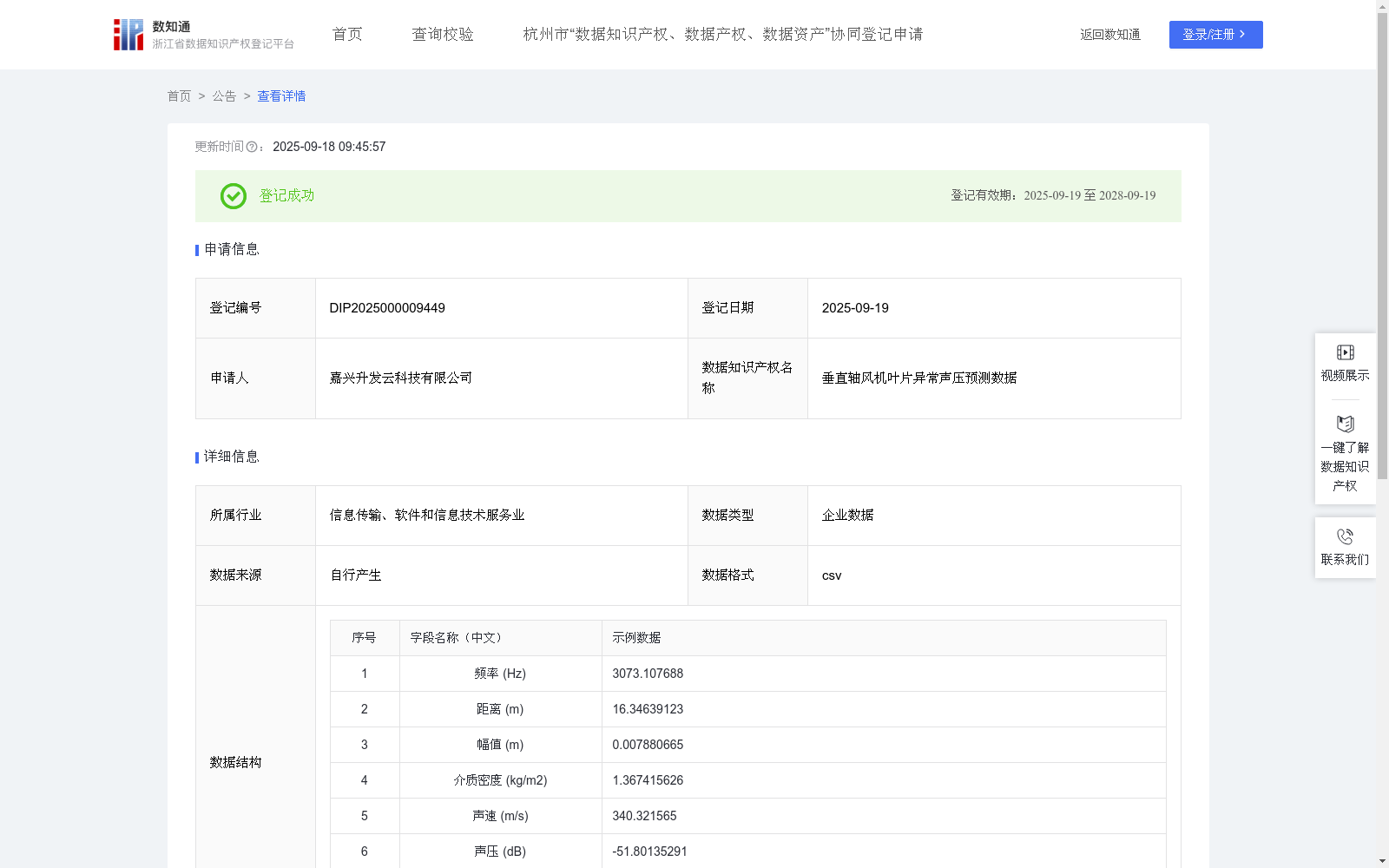
垂直轴风机叶片异常声压预测数据
收藏浙江省数据知识产权登记平台2025-09-18 更新2025-09-19 收录
下载链接:
https://www.zjip.org.cn/home/announce/trends/181745
下载链接
链接失效反馈官方服务:
资源简介:
基于采集的频率、距离、幅值、空气密度及声速等关键参数,可精确计算风机叶片在运行过程中的气动噪声声压值。通过对比预设的气动噪声阈值区间,能够有效识别叶片是否存在异常噪声(如湍流分离、翼型失速或结构损伤)。该技术可实时预警潜在故障,显著提升风电机组运行安全性,并为叶片维护策略提供数据支撑,从而保障风电场的稳定高效发电。1.本算法首先采集垂直轴风机叶片的声学振动信号及对应声压数据作为基础数据集,同时获取频率谱特征、测量距离、振动幅值、空气密度及声速等物理参数。2.数据预处理阶段对各类参数进行归一化和量纲统一处理。3.模型采用XGBoost算法,其目标函数包含损失函数和正则化项,通过迭代优化得到预测结果。4.模型预测:算法中嵌入了气动噪声物理计算模块,利用公式P_pred=K*(ρc³/d²)*∫(A(f)/f)df计算理论声压值,其中K为叶片气动效率系数,通过实验数据拟合获得,反映叶片的几何特性和运行工况;ρ表示空气密度,直接影响空气与叶片相互作用产生的声能强度;c为声速,其立方项体现声波传播过程中的能量转换效率;d是测量距离,遵循平方反比定律描述声压随距离的衰减规律;积分项∫(A(f)/f)df综合评估不同频率振动对噪声的贡献,并与机器学习预测结果进行交叉验证,当相对误差超过15%时触发模型重训练,最终输出声压预测值5.结果分析,当声压值的绝对值在[0,25]之间时,判定为声压稳定,当大于25时候,判定为声压异常。
Based on key collected parameters including frequency, distance, amplitude, air density and sound speed, the sound pressure value of aerodynamic noise generated during the operation of wind turbine blades can be accurately calculated. By comparing with the preset aerodynamic noise threshold range, abnormal noises (such as turbulent separation, airfoil stall or structural damage) of the blades can be effectively identified. This technology can realize real-time early warning of potential faults, significantly improve the operational safety of wind turbines, and provide data support for blade maintenance strategies, thereby ensuring the stable and efficient power generation of wind farms.
1. This algorithm first collects acoustic vibration signals and corresponding sound pressure data of vertical-axis wind turbine blades as the basic dataset, while acquiring physical parameters such as frequency spectrum features, measurement distance, vibration amplitude, air density and sound speed.
2. In the data preprocessing stage, normalization and dimensional unification processing are performed on all types of parameters.
3. The model adopts the XGBoost algorithm, whose objective function includes the loss function and regularization term, and the prediction results are obtained through iterative optimization.
4. Model prediction: An aerodynamic noise physical calculation module is embedded in the algorithm, which uses the formula P_pred=K*(ρc³/d²)*∫(A(f)/f)df to calculate the theoretical sound pressure value. Among them, K is the blade aerodynamic efficiency coefficient, which is obtained through fitting of experimental data and reflects the geometric characteristics and operating conditions of the blade; ρ represents air density, which directly affects the acoustic energy intensity generated by the interaction between air and the blade; c is the speed of sound, whose cubic term reflects the energy conversion efficiency during sound wave propagation; d is the measurement distance, which follows the inverse-square law to describe the attenuation law of sound pressure with distance; the integral term ∫(A(f)/f)df comprehensively evaluates the contribution of vibration at different frequencies to noise, and performs cross-validation with the machine learning prediction results. When the relative error exceeds 15%, model retraining is triggered, and the final sound pressure prediction value is output.
5. Result analysis: When the absolute value of the sound pressure value is between [0, 25], it is judged as stable sound pressure; when it is greater than 25, it is judged as abnormal sound pressure.
提供机构:
嘉兴升发云科技有限公司
创建时间:
2025-06-26
搜集汇总
数据集介绍
背景与挑战
背景概述
该数据集为垂直轴风机叶片异常声压预测数据,包含501条CSV格式记录,涵盖频率、距离、声压等关键参数,用于通过XGBoost算法和物理模型实时预测叶片异常噪声,提升风电机组运行安全性和维护效率。
以上内容由遇见数据集搜集并总结生成



