
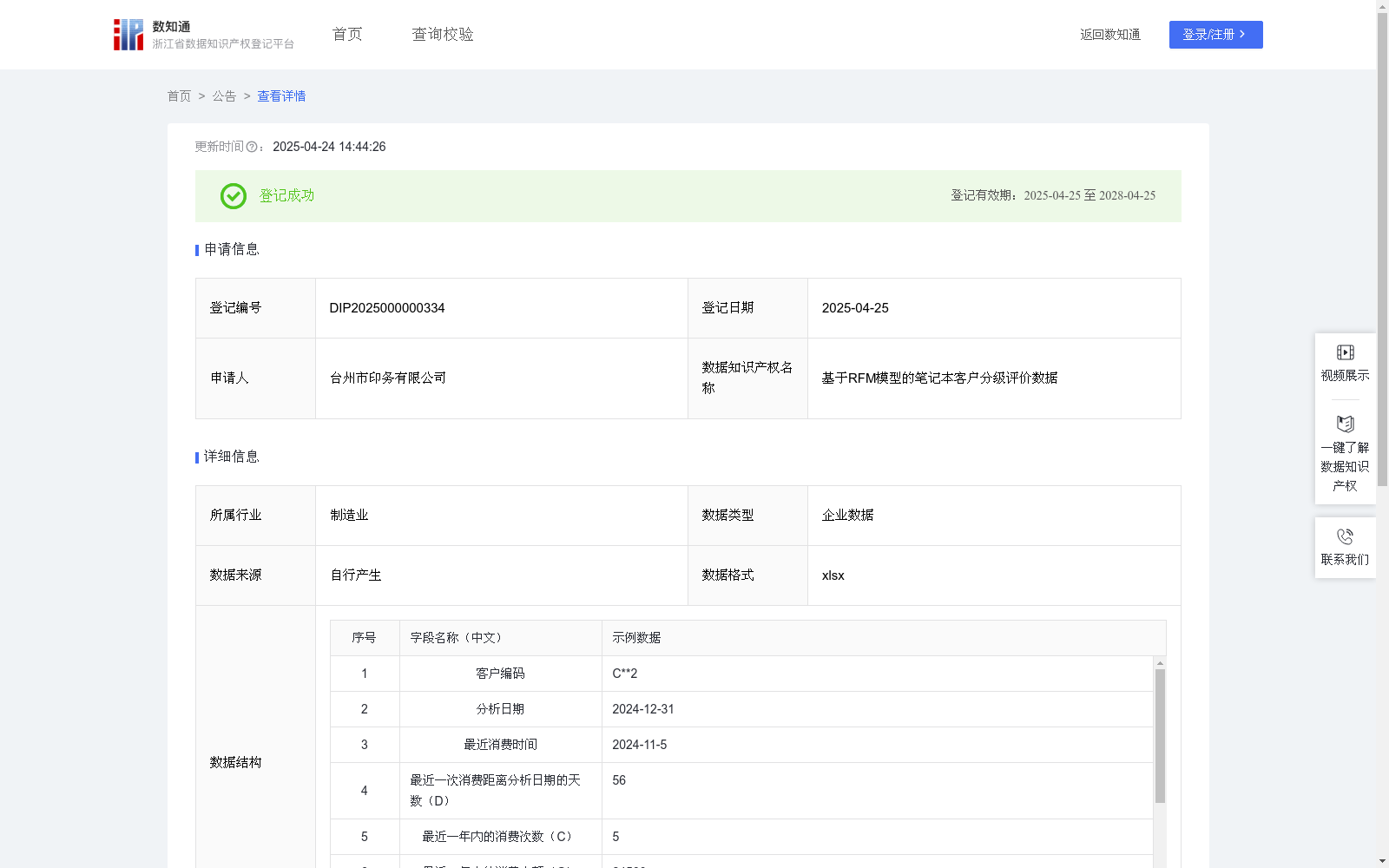
基于RFM模型的笔记本客户分级评价数据
收藏浙江省数据知识产权登记平台2025-04-24 更新2025-04-25 收录
下载链接:
https://www.zjip.org.cn/home/announce/trends/125885
下载链接
链接失效反馈官方服务:
资源简介:
在公司主要产品笔记本的经营销售领域中,为了更好地理解客户采购行为,以提高客户满意度和企业收益。通过收集客户的消费记录,使用RFM客户价值模型,用户最近一次消费时间((Recency)、消费频率(Frequency)和消费金额(Monetary)进行评分,识别不同价值的客户群体。为客户定制个性化的营销和服务方案、提高客户满意度和忠诚度、增加客户留存率和生命周期价值。RFM模型通过计算客户最近一次消费时间(R)、消费频率(F)和消费金额(M)这三个维度来评估用户价值。对于R维度,根据客户最近一次消费距离分析日期的天数(D),划分为5个等级: 0≤D≤30为5分,30<D≤60为4分,60<D≤90 为3分,90<D≤120为2分,D >120为1分;对于F维度,根据用户在最近一年内的消费次数(C),划分为5个等级: C≥8为5分、6≤C≤7为4分、4≤C≤5 为3分、2≤C≤3 为2分、0≤C≤1为1分;对于M维度,根据用户在最近一年内的消费金额(G),划分为5个等级,G≥30000为5分,25000≤G<30000为4分,20000≤G<25000为3分,15000≤G<20000为2分,G<15000为1分。RFM综合评分(X)=R+F+M,再根据RFM综合评分(X)对客户进行分类,0≤X<2为一般客户,2≤X<4为新客户,4≤X<6 为潜力深耕客户,6≤X<8为重要维系客户,X ≥8为高粘度客户,基于消费频次、消费金额等不同维度获得的聚类分组成果,对聚类分组数量和分组阀值、以及维度权重进行人为干预,使客户分类趋于合理。
In the business and sales of the company's main product - laptops, to better understand customers' purchasing behaviors and improve customer satisfaction and corporate revenue. By collecting customers' consumption records and adopting the RFM customer value model, customers are scored based on Recency (time since last purchase), Frequency (purchase frequency) and Monetary (total purchase amount) to identify customer segments with different value levels. This aims to develop personalized marketing and service plans for customers, improve customer satisfaction and loyalty, boost customer retention rate and lifetime value. The RFM model evaluates customer value by three core dimensions: Recency (R), Frequency (F) and Monetary (M). For the Recency (R) dimension: According to the number of days (D) between a customer's last purchase and the analysis date, customers are divided into 5 tiers: 5 points for 0 ≤ D ≤ 30, 4 points for 30 < D ≤ 60, 3 points for 60 < D ≤ 90, 2 points for 90 < D ≤ 120, and 1 point for D > 120. For the Frequency (F) dimension: According to the number of purchase times (C) within the most recent year, customers are divided into 5 tiers: 5 points for C ≥ 8, 4 points for 6 ≤ C ≤ 7, 3 points for 4 ≤ C ≤ 5, 2 points for 2 ≤ C ≤ 3, and 1 point for 0 ≤ C ≤ 1. For the Monetary (M) dimension: According to the total purchase amount (G) within the most recent year, customers are divided into 5 tiers: 5 points for G ≥ 30000, 4 points for 25000 ≤ G < 30000, 3 points for 20000 ≤ G < 25000, 2 points for 15000 ≤ G < 20000, and 1 point for G < 15000. The comprehensive RFM score (X) = R + F + M. Customers are then classified based on their comprehensive RFM score (X): general customers for 0 ≤ X < 2, new customers for 2 ≤ X < 4, potential in-depth customers for 4 ≤ X < 6, key retention customers for 6 ≤ X < 8, and high-viscosity customers for X ≥ 8. Based on the clustering grouping results obtained from various dimensions including purchase frequency and total purchase amount, manual interventions are applied to the number of clustering groups, grouping thresholds and dimension weights to optimize the rationality of customer classification.
提供机构:
台州市印务有限公司
创建时间:
2025-01-17
搜集汇总
数据集介绍
背景与挑战
背景概述
该数据集是基于RFM模型的笔记本客户分级评价数据,包含515条记录,用于评估客户价值并分类,适用于笔记本销售领域的客户行为分析和营销策略制定。
以上内容由遇见数据集搜集并总结生成


