
库帕思高质量教育思维链(Chain-of-Thought)数据集-数学篇(下篇)
收藏国家数据集管理服务平台2026-04-28 更新2026-04-29 收录
下载链接:
https://www.ndsms.cn/dataRetrieval/datasetDetail/?id=3acab4f74130b7b95db45b98b4034c24
下载链接
链接失效反馈官方服务:
资源简介:
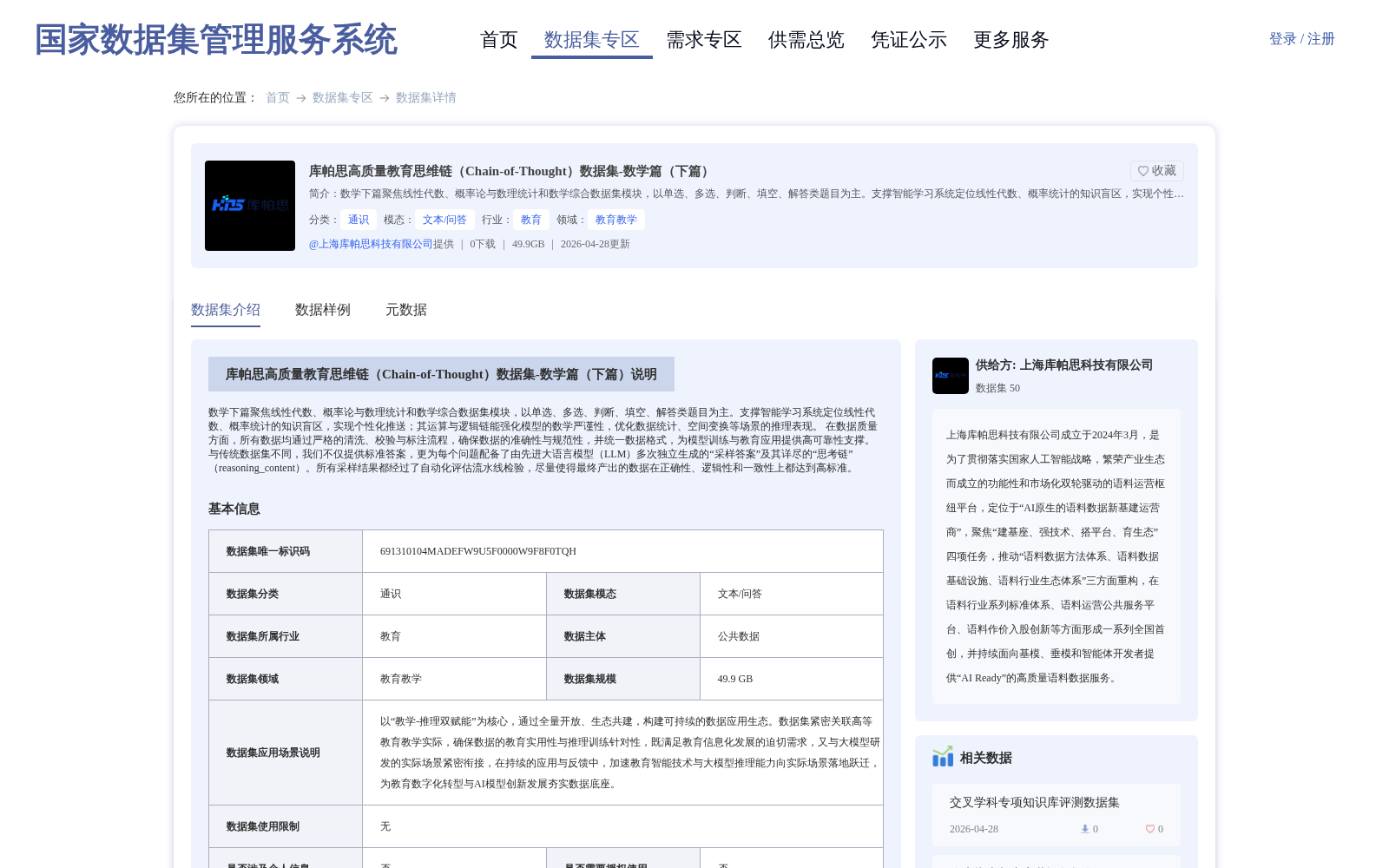
数学下篇聚焦线性代数、概率论与数理统计和数学综合数据集模块,以单选、多选、判断、填空、解答类题目为主。支撑智能学习系统定位线性代数、概率统计的知识盲区,实现个性化推送;其运算与逻辑链能强化模型的数学严谨性,优化数据统计、空间变换等场景的推理表现。
在数据质量方面,所有数据均通过严格的清洗、校验与标注流程,确保数据的准确性与规范性,并统一数据格式,为模型训练与教育应用提供高可靠性支撑。
与传统数据集不同,我们不仅提供标准答案,更为每个问题配备了由先进大语言模型(LLM)多次独立生成的“采样答案”及其详尽的“思考链”(reasoning_content)。所有采样结果都经过了自动化评估流水线检验,尽量使得最终产出的数据在正确性、逻辑性和一致性上都达到高标准。
The second volume of the mathematics dataset focuses on modules covering linear algebra, probability theory and mathematical statistics, as well as comprehensive mathematics, and mainly comprises single-choice, multiple-choice, true-false, fill-in-the-blank, and problem-solving questions. It enables intelligent learning systems to identify knowledge blind spots in linear algebra and probability statistics, and delivers personalized content recommendations. The computational and logical chains embedded in these questions can enhance the mathematical rigor of the model, and improve the reasoning performance in scenarios such as data statistics and spatial transformation.
In terms of data quality, all data has undergone strict cleaning, verification and annotation procedures to ensure its accuracy and standardization, and unifies the data format, providing high-reliability support for model training and educational applications.
Unlike traditional datasets, this resource not only provides standard answers, but also equips each question with "sampled answers" and their detailed "reasoning_content" independently generated multiple times by advanced large language models (LLMs). All sampled results have been inspected through an automated evaluation pipeline, striving to bring the final produced data to high standards in terms of correctness, logicality and consistency.
提供机构:
上海库帕思科技有限公司
创建时间:
2026-04-27
搜集汇总
数据集介绍
背景与挑战
背景概述
该数据集专注于线性代数、概率论与数理统计等数学领域,包含多种题型,旨在辅助智能学习系统进行知识盲区定位和个性化推送。所有数据均经过严格的质量控制流程,确保准确性和规范性。与传统数据集相比,它不仅提供标准答案,还包含由大语言模型生成的采样答案及详细思考链,并通过自动化评估确保高质量。
以上内容由遇见数据集搜集并总结生成


