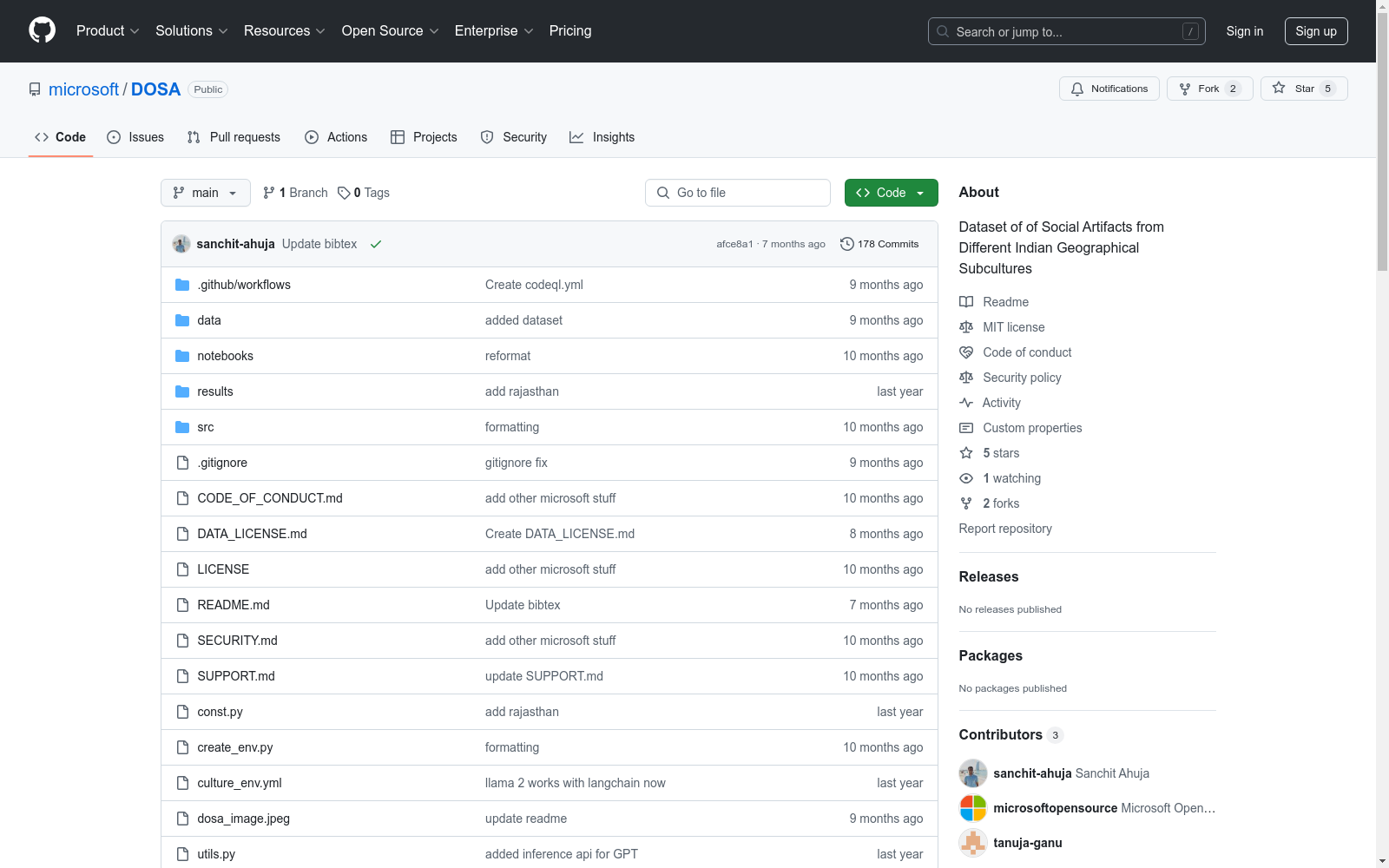
DOSA
收藏数据集概述
名称: DOSA: A Dataset of Social Artifacts from Different Indian Geographical Subcultures
描述: DOSA 是一个包含615个社会文化物品的数据集,这些物品来自印度19个不同的地理亚文化区域。该数据集通过参与式研究方法,与260名参与者合作,使用基于集体意义构建的游戏化框架收集了物品的名称和描述。
数据集用途
该数据集用于评估大型语言模型(LLMs)在不同地区亚文化中的表现,特别是在理解社会文化物品方面的能力。
引用信息
若使用该数据集或相关代码,请使用以下引用格式:
@inproceedings{seth-etal-2024-dosa-dataset, title = "{DOSA}: A Dataset of Social Artifacts from Different {I}ndian Geographical Subcultures", author = "Seth, Agrima and Ahuja, Sanchit and Bali, Kalika and Sitaram, Sunayana", editor = "Calzolari, Nicoletta and Kan, Min-Yen and Hoste, Veronique and Lenci, Alessandro and Sakti, Sakriani and Xue, Nianwen", booktitle = "Proceedings of the 2024 Joint International Conference on Computational Linguistics, Language Resources and Evaluation (LREC-COLING 2024)", month = may, year = "2024", address = "Torino, Italia", publisher = "ELRA and ICCL", url = "https://aclanthology.org/2024.lrec-main.474", pages = "5323--5337", abstract = "Generative models are increasingly being used in various applications, such as text generation, commonsense reasoning, and question-answering. To be effective globally, these models must be aware of and account for local socio-cultural contexts, making it necessary to have benchmarks to evaluate the models for their cultural familiarity. Since the training data for LLMs is web-based and the Web is limited in its representation of information, it does not capture knowledge present within communities that are not on the Web. Thus, these models exacerbate the inequities, semantic misalignment, and stereotypes from the Web. There has been a growing call for community-centered participatory research methods in NLP. In this work, we respond to this call by using participatory research methods to introduce DOSA, the first community-generated Dataset of 615 Social Artifacts, by engaging with 260 participants from 19 different Indian geographic subcultures. We use a gamified framework that relies on collective sensemaking to collect the names and descriptions of these artifacts such that the descriptions semantically align with the shared sensibilities of the individuals from those cultures. Next, we benchmark four popular LLMs and find that they show significant variation across regional sub-cultures in their ability to infer the artifacts.", }