
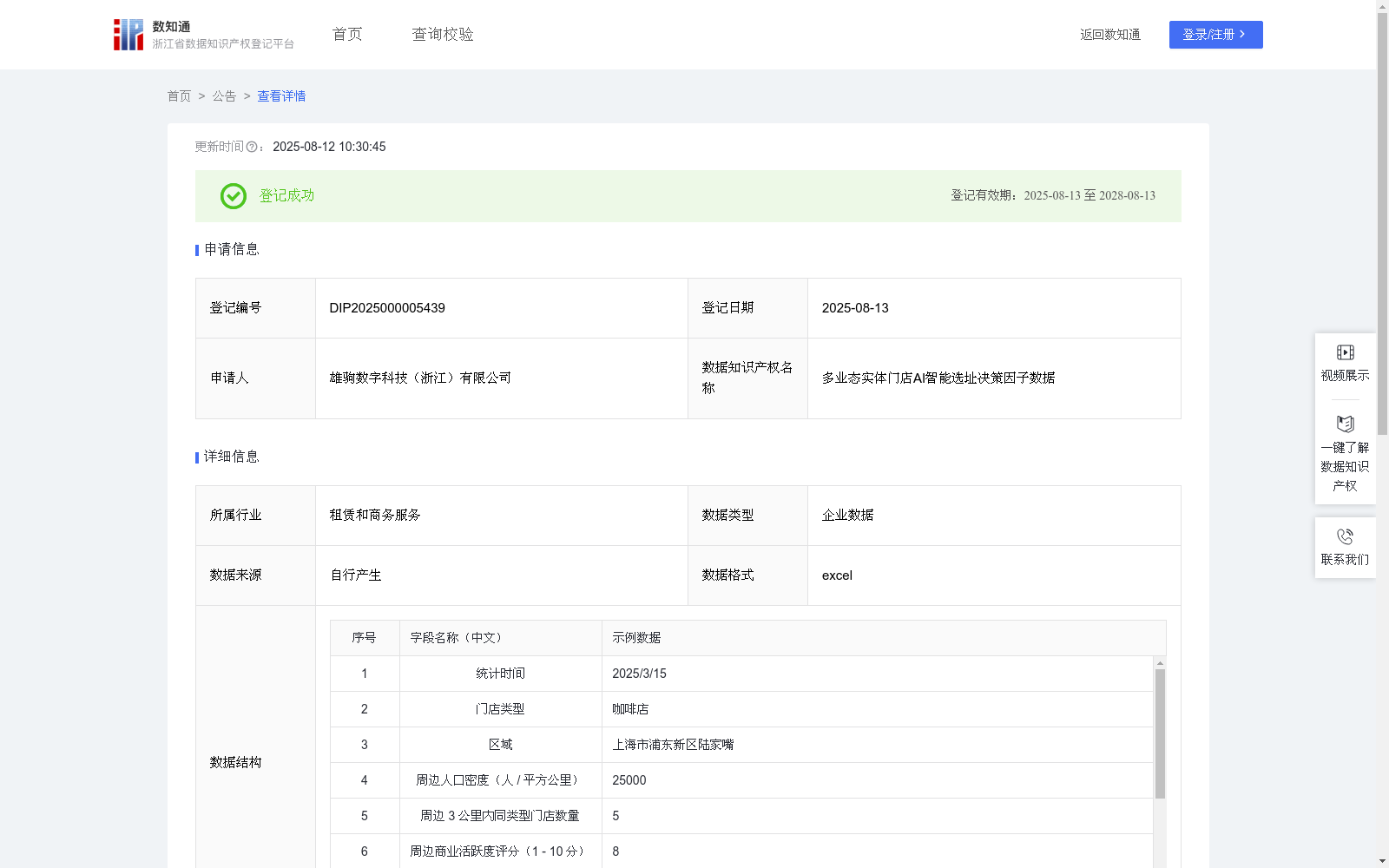
多业态实体门店AI智能选址决策因子数据
收藏浙江省数据知识产权登记平台2025-08-12 更新2025-08-13 收录
下载链接:
https://www.zjip.org.cn/home/announce/trends/163007
下载链接
链接失效反馈官方服务:
资源简介:
本数据集适用于各类多业态实体门店,包括但不限于餐饮、零售、服务行业等在进行新门店选址决策时使用。通过收集和分析多维度的选址决策因子数据,结合 AI 算法,为门店经营者提供科学、精准的选址建议。在数据适用范围内,能够有效帮助企业降低选址风险,提高门店的成功率和盈利能力。例如,对于一家计划新开的咖啡店,可依据这些数据了解某个区域是否适合开店,是否能够满足目标客户群体的需求,以及是否具备良好的商业发展潜力。数据采集:通过自有系统采集数据;
数据处理:对采集到的数据进行清洗,去除重复、错误和无效数据标准化处理:对所有指标进行 0-1 标准化,负向指标进行反向标准化(值越小得分越高);将不同类型、不同量级的数据进行标准化处理,统一数据格式。
算法加工:运用 AI 算法构建选址决策模型。根据行业经验、市场调研以及历史数据的相关性分析,为每个决策因子赋予相应权重。通过公式 “选址综合得分 = 周边人口密度 × 对应权重(0.2) + 周边 3 公里内同类型门店数量 × 对应权重(-0.1) + 周边商业活跃度评分 × 对应权重 (0.2)+ 交通便利度评分 × 对应权重 (0.2)+ 租金水平 × 对应权重(-0.1) + 人流量预估 × 对应权重(0.2) + 消费水平评分 × 对应权重(0.2)” 计算出选址综合得分。
数据分类分级:根据计算出的选址综合得分,将选址建议等级划分为 “优(5000分及以上)”“差(5000 分以下)” 两个级别。
其中,周边商业活跃度评分、交通便利度评分、消费水平评分的评分标准如下:
周边商业活跃度评分(1-10分)
评分逻辑:基于区域内商业设施密度、日均交易频次、客流高峰时段持续时长等核心指标综合计算。
1-3分:商业设施稀疏(如3公里内少于5家大中型商户),日均交易频次低于1000次,高峰时段不足2小时(如偏远居民区)。4-6分:商业设施中等(3公里内5-15家大中型商户),日均交易频次1000-3000次,高峰时段2-4小时(如普通社区商圈)。7-10分:商业设施密集(3公里内超过15家大中型商户),日均交易频次3000次以上,高峰时段4小时以上(如城市核心商圈、交通枢纽商圈)。
This dataset is applicable to various multi-format physical stores, including but not limited to catering, retail, service industries, and other sectors for new store location decision-making. By collecting and analyzing multi-dimensional location decision factor data and combining with AI algorithms, it provides scientific and accurate location suggestions for store operators. Within the applicable data scope, it can effectively help enterprises reduce location risks and improve the success rate and profitability of stores. For example, for a planned new coffee shop, this data can be used to determine whether a certain area is suitable for opening a store, whether it can meet the needs of the target customer group, and whether it has good commercial development potential.
Data Collection: Data is collected via the company's proprietary system;
Data Processing: Clean the collected data, remove duplicates, erroneous and invalid data, and conduct standardization processing: perform 0-1 standardization on all indicators, and perform reverse standardization for negative indicators (smaller value corresponds to higher score); standardize data of different types and magnitudes to unify the data format.
Algorithm Processing: Construct a location decision model using AI algorithms. Assign corresponding weights to each decision factor based on industry experience, market research, and correlation analysis of historical data. Calculate the comprehensive location score using the formula:
Comprehensive Location Score = Surrounding Population Density × Corresponding Weight (0.2) + Number of Same-type Stores within a 3-kilometer Radius × Corresponding Weight (-0.1) + Surrounding Commercial Activity Score × Corresponding Weight (0.2) + Traffic Convenience Score × Corresponding Weight (0.2) + Rental Level × Corresponding Weight (-0.1) + Estimated Foot Traffic × Corresponding Weight (0.2) + Consumption Level Score × Corresponding Weight (0.2)
Data Classification and Grading: Divide location recommendation levels into two categories based on the calculated comprehensive location score: "Excellent (5000 points and above)" and "Poor (below 5000 points)".
The scoring standards for Surrounding Commercial Activity Score, Traffic Convenience Score, and Consumption Level Score are as follows:
Surrounding Commercial Activity Score (1-10 points)
Scoring Logic: Comprehensive calculation based on core indicators including the density of commercial facilities in the region, average daily transaction frequency, and duration of peak passenger flow periods.
1-3 points: Sparse commercial facilities (e.g., fewer than 5 large and medium-sized businesses within 3 km), average daily transaction frequency below 1,000 times, peak passenger flow duration less than 2 hours (e.g., remote residential areas).
4-6 points: Moderate commercial facilities (5 to 15 large and medium-sized businesses within 3 km), average daily transaction frequency between 1,000 and 3,000 times, peak passenger flow duration of 2 to 4 hours (e.g., ordinary community business districts).
7-10 points: Dense commercial facilities (more than 15 large and medium-sized businesses within 3 km), average daily transaction frequency over 3,000 times, peak passenger flow duration over 4 hours (e.g., urban core business districts, transportation hub business districts).
提供机构:
雄驹数字科技(浙江)有限公司
创建时间:
2025-05-15
搜集汇总
数据集介绍
背景与挑战
背景概述
该数据集包含800条多业态实体门店的AI智能选址决策因子数据,涵盖12个关键字段如周边人口密度、同类型门店数量、商业活跃度评分等,适用于餐饮、零售等行业的新门店选址决策。数据通过AI算法处理,提供选址综合得分和建议等级,帮助企业降低选址风险并提高成功率。
以上内容由遇见数据集搜集并总结生成



