
rice blast dataset
收藏Mendeley Data2022-02-10 更新2024-06-27 收录
下载链接:
https://www.doi.org/10.11922/sciencedb.p00001.00003
下载链接
链接失效反馈官方服务:
资源简介:
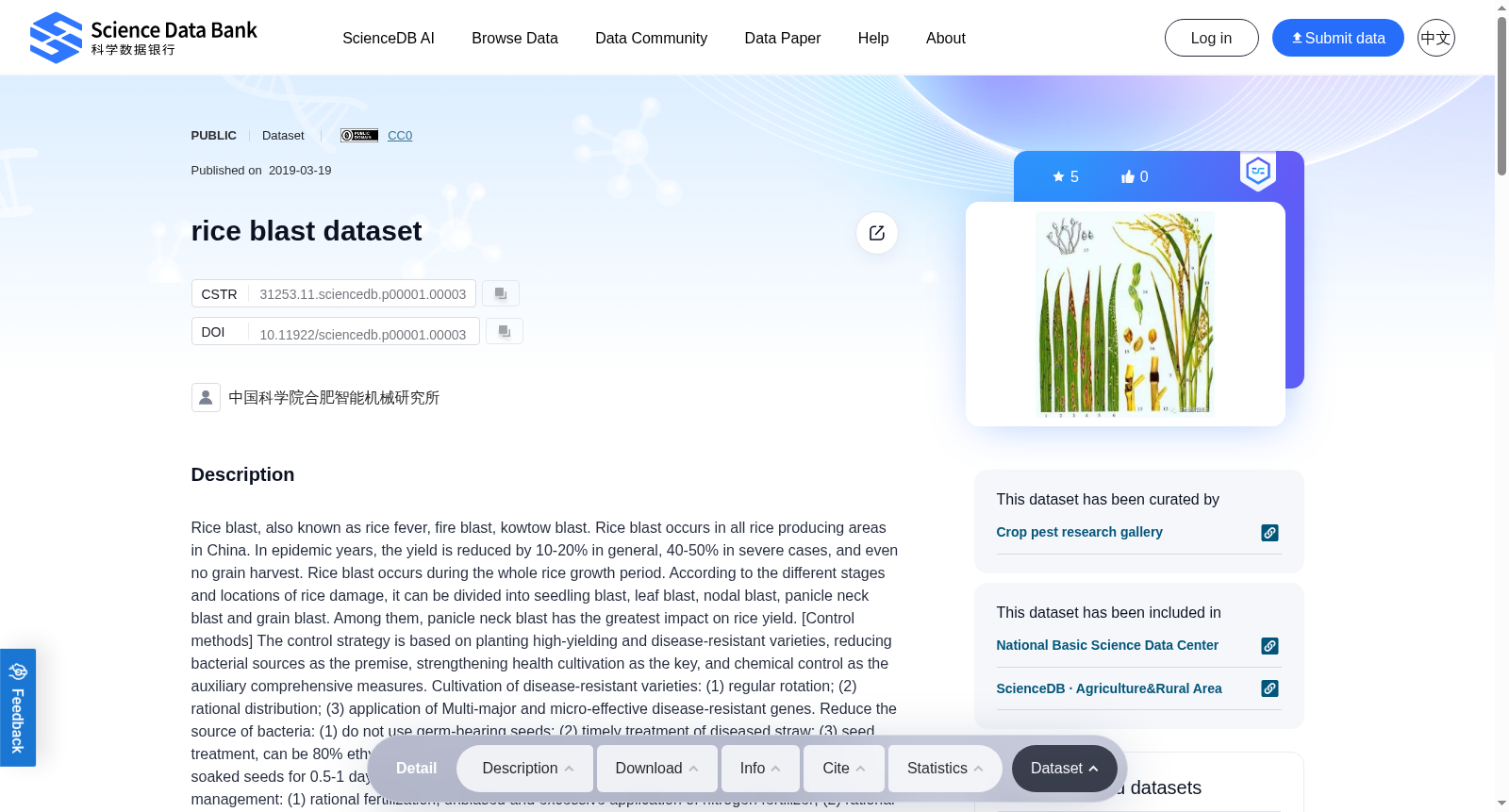
Rice blast, also known as rice fever, fire blast, kowtow blast. Rice blast occurs in all rice producing areas in China. In epidemic years, the yield is reduced by 10-20% in general, 40-50% in severe cases, and even no grain harvest. Rice blast occurs during the whole rice growth period. According to the different stages and locations of rice damage, it can be divided into seedling blast, leaf blast, nodal blast, panicle neck blast and grain blast. Among them, panicle neck blast has the greatest impact on rice yield. [Control methods] The control strategy is based on planting high-yielding and disease-resistant varieties, reducing bacterial sources as the premise, strengthening health cultivation as the key, and chemical control as the auxiliary comprehensive measures. Cultivation of disease-resistant varieties: (1) regular rotation; (2) rational distribution; (3) application of Multi-major and micro-effective disease-resistant genes. Reduce the source of bacteria: (1) do not use germ-bearing seeds; (2) timely treatment of diseased straw; (3) seed treatment, can be 80% ethylallicin solution soaked seeds for 2-3 days or 85% strong chlorine semen soaked seeds for 0.5-1 days. Improve cultivation methods and strengthen water and fertilizer management: (1) rational fertilization, unbiased and excessive application of nitrogen fertilizer; (2) rational irrigation and drainage, water and fertilizer regulation, promotion and control combination. Pesticide control: The control of seedling blast is usually applied at 3-4 leaf stage or 5 days before transplanting; the control of panicle neck blast can be sprayed once from break to earing stage, and then the second pesticide can be applied at full heading stage according to weather conditions. Commonly used medicines are: Chunlaimycin, carbendazim, pyrimidine, cyanamide and so on.
稻瘟病(Rice blast)又称稻热病、火烧瘟、叩头瘟。该病害在中国所有水稻产区均有发生。流行年份一般减产10%~20%,严重时减产40%~50%,甚至绝收。稻瘟病可在水稻整个生育期发生,根据为害时期与部位的不同,可分为苗瘟(seedling blast)、叶瘟(leaf blast)、节瘟(nodal blast)、穗颈瘟(panicle neck blast)与谷粒瘟(grain blast)。其中,穗颈瘟对水稻产量的影响最大。
【防治方法】
防治策略为以种植高产抗病品种为基础、压低菌源为前提、强化健身栽培为核心、辅以化学防治的综合防治措施。
抗病品种培育:(1)定期轮换品种;(2)合理布局品种;(3)聚合多主效与微效抗病基因。
压低菌源:(1)不使用带菌种子;(2)及时处理病稻草;(3)种子处理:可使用80%乙蒜素(ethylallicin)药液浸种2~3天,或使用85%强氯精浸种0.5~1天。
优化栽培措施、强化水肥管理:(1)合理施肥,避免偏施、过量施用氮肥;(2)科学排灌,调控水肥,做到促控结合。
药剂防治:苗瘟防治通常在水稻3~4叶期或移栽前5天施药;穗颈瘟防治可在破口至抽穗期喷施一次药剂,再根据天气情况在齐穗期喷施第二次。常用药剂包括春雷霉素(Chunlaimycin)、多菌灵(carbendazim)、嘧啶类药剂、氰胺类药剂等。
创建时间:
2022-02-10
搜集汇总
数据集介绍
背景与挑战
背景概述
该数据集专注于稻瘟病,提供了病害的详细描述、防治方法及相关研究信息。数据集由中国科学院合肥智能机械研究所发布,旨在支持水稻病害研究和防治工作。
以上内容由遇见数据集搜集并总结生成



