PROVE
收藏资源简介:
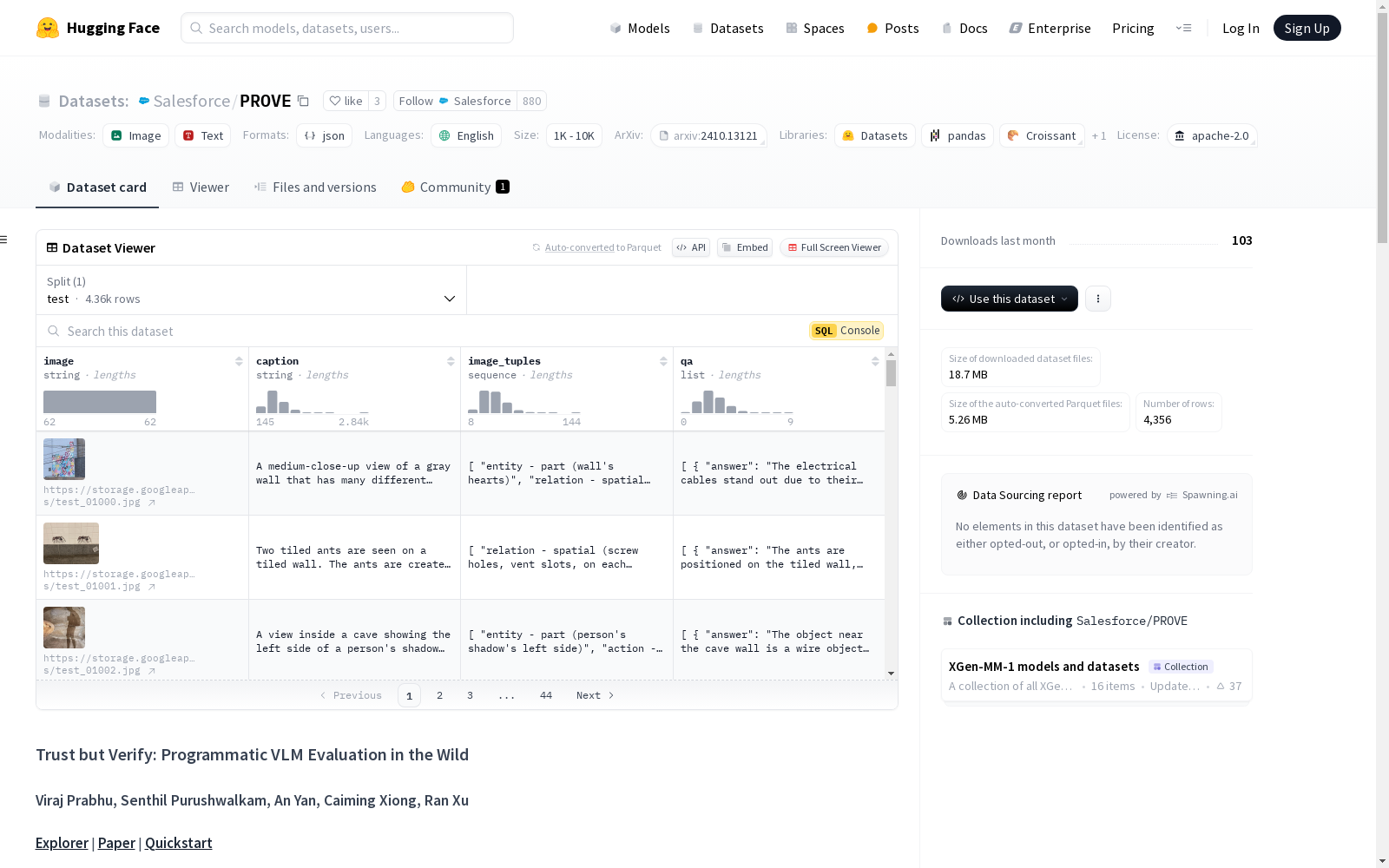
PROVE是一个用于评估视觉语言模型(VLM)对开放式查询响应的基准测试。它通过提供一个大型语言模型(LLM)与高保真场景图表示,生成多样化的问答对和可执行的程序来验证每个问答对,从而构建了一个包含10.5k个具有视觉基础的挑战性问答对的基准。数据集还介绍了如何使用PROVE进行模型评估,并提供了一个排行榜来展示不同模型在PROVE上的表现。
PROVE is a benchmark dedicated to evaluating open-ended query responses of Vision-Language Models (VLMs). It hosts 10.5k visually grounded challenging question-answer pairs, which are generated by leveraging a Large Language Model (LLM) and high-fidelity scene graph representations to produce diverse QA pairs and executable programs for validating each individual QA pair. The dataset also introduces the workflow for utilizing PROVE to evaluate models, and provides a leaderboard to showcase the performance of different models on the PROVE benchmark.
PROVE 数据集概述
基本信息
- 许可证: Apache 2.0
- 语言: 英语
- 配置:
- 名称: default
- 数据文件:
- 分割: test
- 路径: prove.json
数据集描述
- 名称: Programmatic VLM Evaluation (PROVE)
- 目标: 评估视觉语言模型(VLM)对开放式查询的响应,量化响应中的幻觉效应。
- 构建方法: 使用大型语言模型(LLM)生成多样化的问答(QA)对,并通过场景图对象执行程序来验证每个QA对。
- 规模: 包含10.5k个具有视觉基础的挑战性QA对。
评估方法
- 策略: 基于场景图的程序化评估策略,测量响应的有用性和真实性。
- 模型评估: 评估多个VLM在PROVE上的有用性和真实性权衡。
快速开始
-
安装: bash conda create -n prove python=3.10 conda activate prove; pip3 install -r requirements.txt;
-
使用: bash python evaluate.py --vlm <vlm_name> --response_json <response_json_path> --scores_path <output_json_path>
排行榜
| 模型 | hscore | tscore | average |
|---|---|---|---|
| Qwen2 (2b) | 69.36 | 80.64 | 75.0 |
| Intern-VL2 (2b) | 73.96 | 79.51 | 76.74 |
| Phi-3.5-vision (4B) | 73.35 | 82.27 | 77.81 |
| LLaVA-1.5 (7B) | 72.67 | 82.58 | 77.62 |
| llava-next (7b) | 74.28 | 80.03 | 77.15 |
| Intern-VL2 (8b) | 74.55 | 80.56 | 77.56 |
| pixtral (12b) | 73.34 | 82.43 | 77.88 |
| llava-1.5 (13b) | 72.46 | 82.4 | 77.43 |
| Intern-VL2 (26b) | 74.63 | 79.23 | 76.93 |
| claude3.5-sonnet | 71.06 | 77.31 | 74.19 |
| gpt-4o-mini | 73.18 | 79.24 | 76.21 |
| gemini-1.5-flash | 72.73 | 81.74 | 77.23 |
| gpt-4o | 76.53 | 80.92 | 78.72 |
引用
@misc{prabhu2024prove, title={Trust but Verify: Programmatic VLM Evaluation in the Wild}, author={Viraj Prabhu and Senthil Purushwalkam and An Yan and Caiming Xiong and Ran Xu}, year={2024}, eprint={2410.13121}, archivePrefix={arXiv}, primaryClass={cs.CV}, url={https://arxiv.org/abs/2410.13121}, }