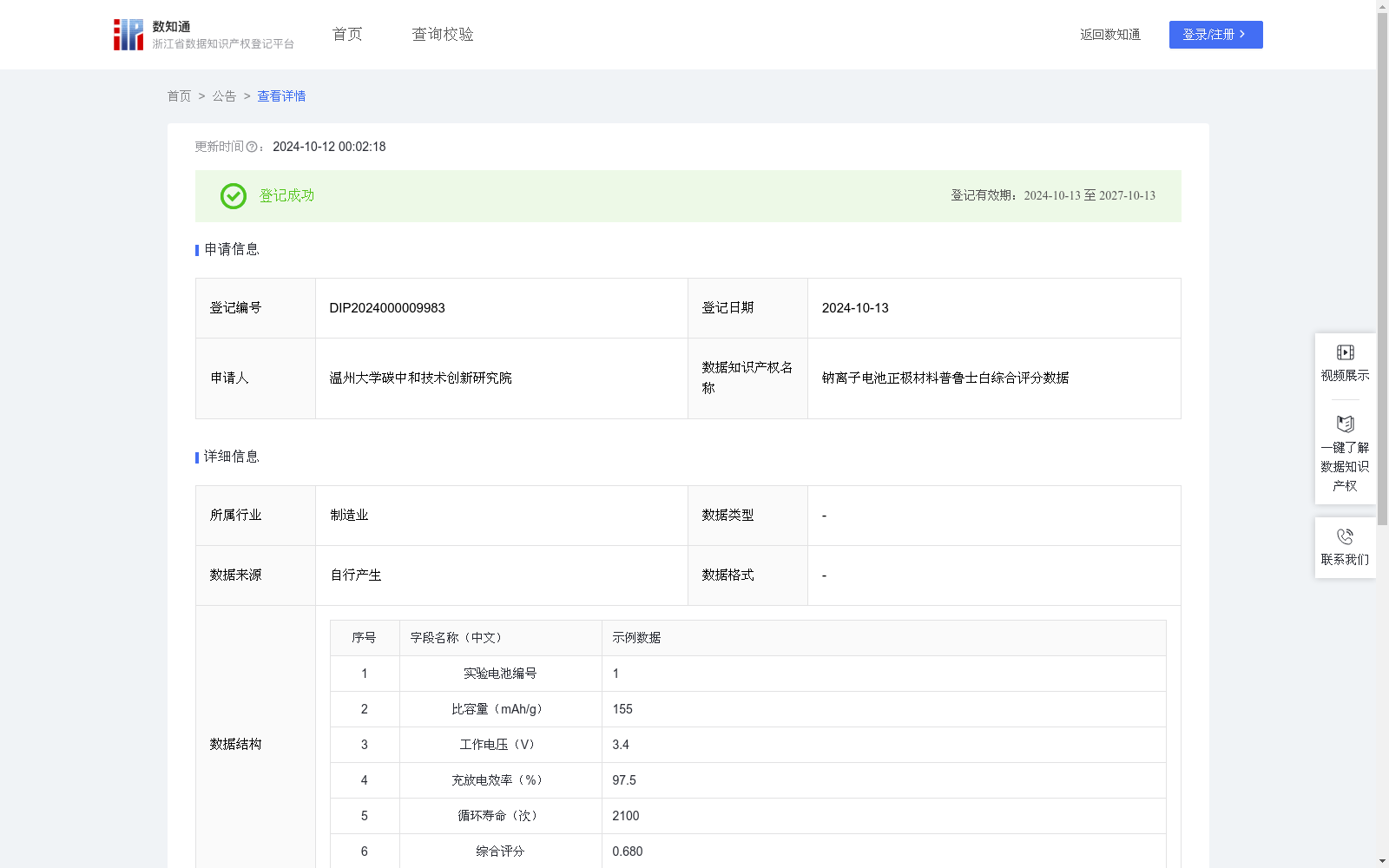
钠离子电池正极材料普鲁士白综合评分数据
收藏资源简介:
针对储能系统、电动汽车、电动两轮车及消费类电子产品等多个应用领域,对钠离子电池的关键组成部分——普鲁士白正极材料的性能进行全面而综合的评估与打分,此举对于企业而言,是挑选出最契合其特定需求与应用场景的普鲁士白正极材料的有效手段。通过细致的性能考量,企业能够做出更加明智的决策,以推动产品性能优化,增强市场竞争力。1.数据采集:实时采集使用普鲁士白作为正极材料的钠离子圆柱电池的比容量,工作电压,充放电效率,循环寿命。2.数据处理:清洗:处理缺失值、异常值和不一致的数据。标准化:对各性能参数进行标准化处理,标准化方法采用最小-最大标准化,将数据值转换到0到1之间。3.综合评分计算:公式:综合评分=比容量×0.3+工作电压×0.2+充放电效率×0.1+循环寿命×0.4,公式中的比容量、工作电压、充放电效率、循环寿命为标准化处理之后的数值。帮助企业在不同场景选择合适的普鲁士白正极材料,若综合评分≥0.6,则推荐应用于储能系统、电动汽车,若0.4≤综合评分<0.6,则推荐应用于低速电动车、两轮车、消费电子产品,若综合评分<0.4,则推荐应用于小型便携设备、物联网设备。
This dataset conducts comprehensive and systematic performance evaluation and scoring of Prussian white cathode materials—the key component of sodium-ion batteries—across multiple application scenarios including energy storage systems, electric vehicles (EVs), electric two-wheelers, and consumer electronics. This serves as an effective approach for enterprises to select Prussian white cathode materials that best match their specific requirements and application scenarios. Through meticulous performance assessment, enterprises can make more informed decisions to optimize product performance and enhance market competitiveness. 1. Data Collection: Real-time collection of specific capacity, operating voltage, charge-discharge efficiency, and cycle life of sodium-ion cylindrical batteries utilizing Prussian white as the cathode material. 2. Data Processing: - Cleaning: Process missing values, outliers, and inconsistent data entries. - Standardization: Perform min-max normalization on all performance parameters to convert data values into the range of 0 to 1. 3. Comprehensive Score Calculation: Formula: Comprehensive Score = Specific Capacity × 0.3 + Operating Voltage × 0.2 + Charge-Discharge Efficiency × 0.1 + Cycle Life × 0.4, where Specific Capacity, Operating Voltage, Charge-Discharge Efficiency, and Cycle Life refer to the values after standardization processing. This dataset assists enterprises in selecting suitable Prussian white cathode materials for different scenarios: materials with a comprehensive score ≥ 0.6 are recommended for energy storage systems and electric vehicles; those with 0.4 ≤ comprehensive score < 0.6 are recommended for low-speed electric vehicles, two-wheelers, and consumer electronics; and materials with a comprehensive score < 0.4 are recommended for small portable devices and IoT devices.