俄罗斯新生代玄武岩全岩Mg-Zn-Fe同位素数据
收藏资源简介:
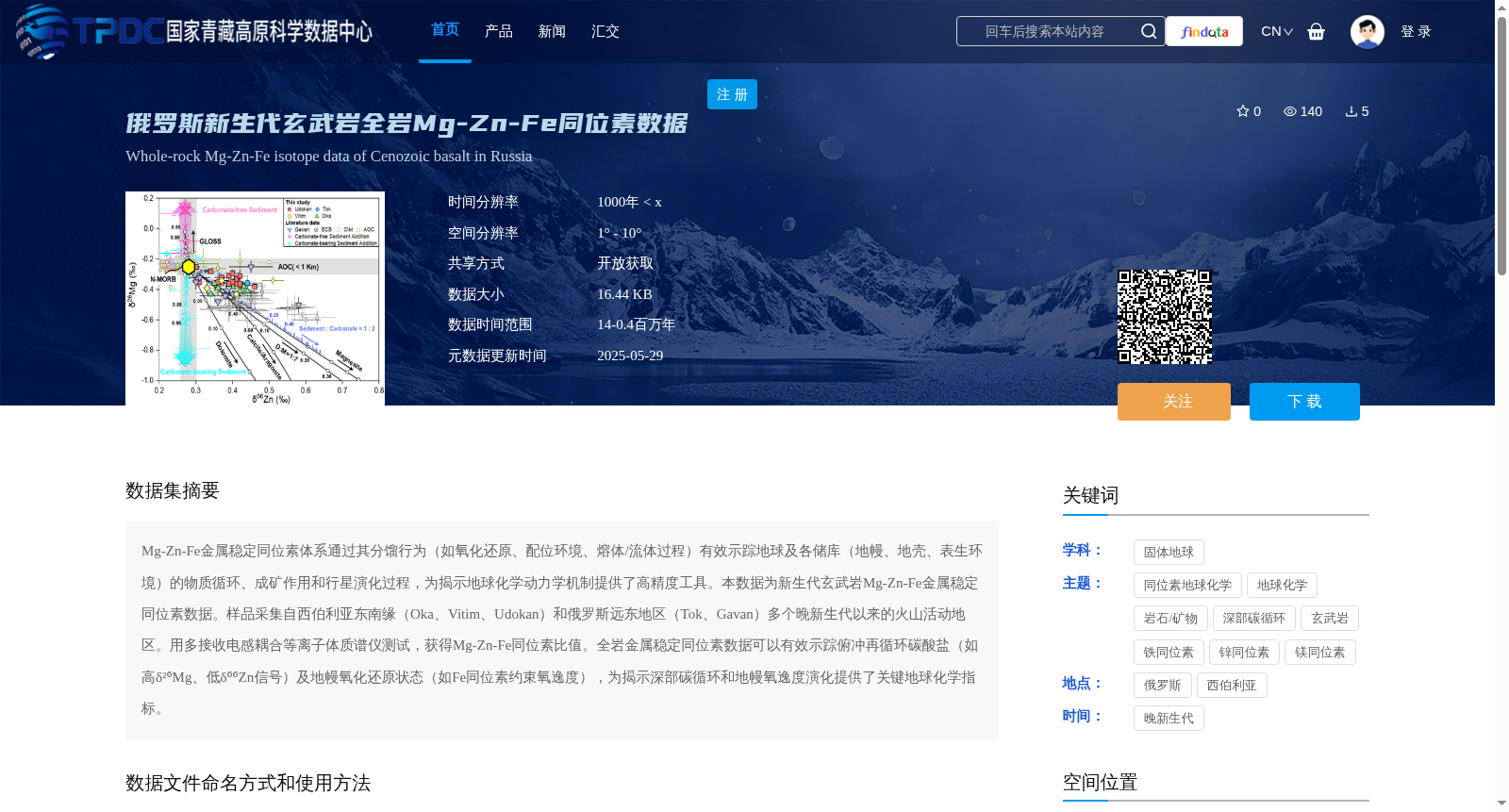
Mg-Zn-Fe金属稳定同位素体系通过其分馏行为(如氧化还原、配位环境、熔体/流体过程)有效示踪地球及各储库(地幔、地壳、表生环境)的物质循环、成矿作用和行星演化过程,为揭示地球化学动力学机制提供了高精度工具。本数据为新生代玄武岩Mg-Zn-Fe金属稳定同位素数据。样品采集自西伯利亚东南缘(Oka、Vitim、Udokan)和俄罗斯远东地区(Tok、Gavan)多个晚新生代以来的火山活动地区。用多接收电感耦合等离子体质谱仪测试,获得Mg-Zn-Fe同位素比值。全岩金属稳定同位素数据可以有效示踪俯冲再循环碳酸盐(如高δ²⁶Mg、低δ⁶⁶Zn信号)及地幔氧化还原状态(如Fe同位素约束氧逸度),为揭示深部碳循环和地幔氧逸度演化提供了关键地球化学指标。
The Mg-Zn-Fe metal stable isotope system effectively traces the material cycling, mineralization, and planetary evolution of the Earth and its various reservoirs (mantle, crust, surficial environments) through its fractionation behaviors such as redox conditions, coordination environments, and melt/fluid processes, providing high-precision tools for unraveling geochemical dynamic mechanisms. This dataset presents Mg-Zn-Fe metal stable isotope data from Cenozoic basalts. Samples were collected from multiple late Cenozoic volcanic regions in the southeastern margin of Siberia (Oka, Vitim, Udokan) and the Russian Far East (Tok, Gavan). Mg-Zn-Fe isotope ratios were measured using multi-collector inductively coupled plasma mass spectrometry (MC-ICP-MS). Whole-rock metal stable isotope data can effectively trace subducted recycled carbonates (e.g., high δ²⁶Mg and low δ⁶⁶Zn signatures) and mantle redox conditions (e.g., Fe isotopes constrain oxygen fugacity), providing key geochemical proxies for unraveling deep carbon cycling and the evolution of mantle oxygen fugacity.