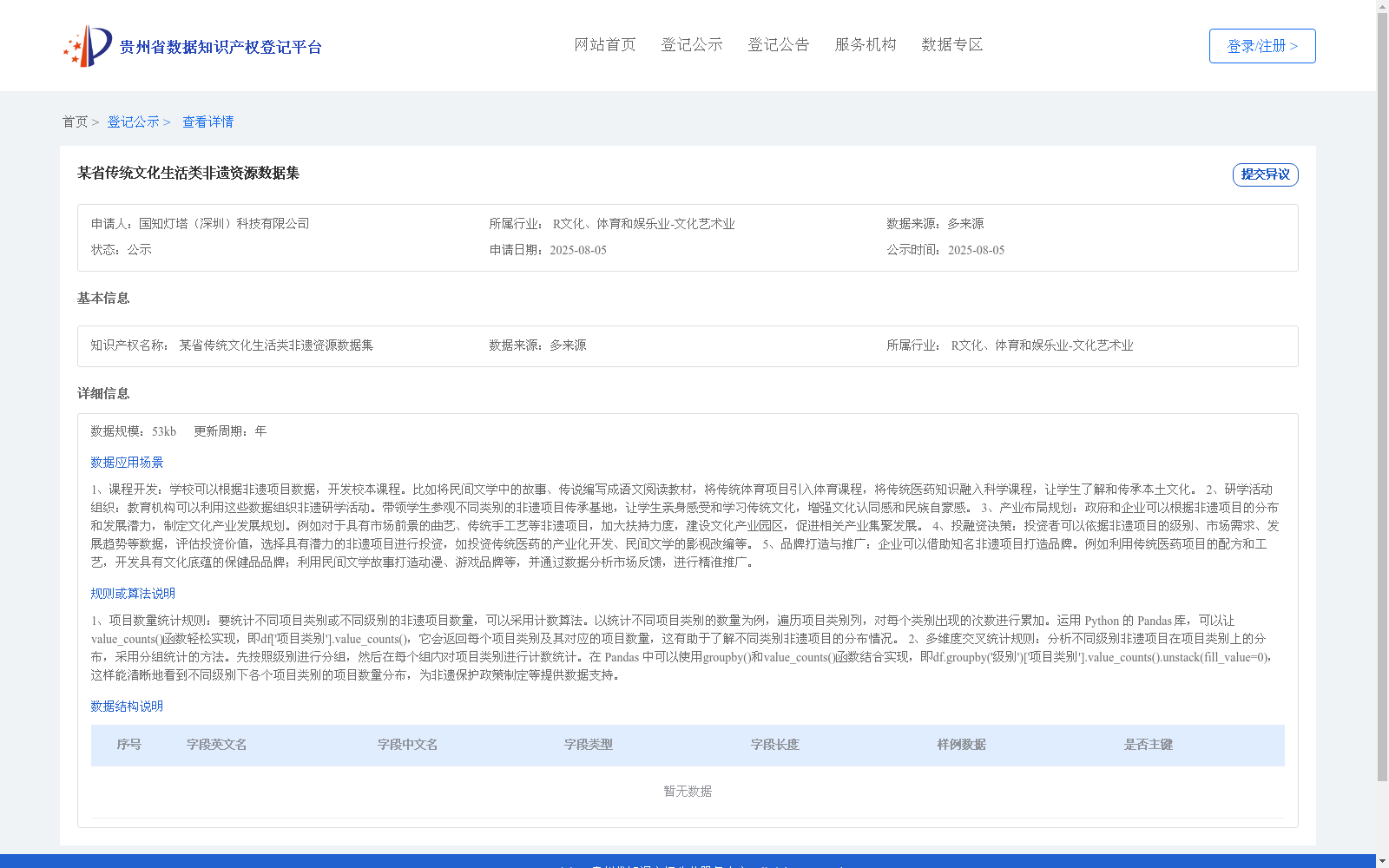
某省传统文化生活类非遗资源数据集
收藏资源简介:
1、项目数量统计规则:要统计不同项目类别或不同级别的非遗项目数量,可以采用计数算法。以统计不同项目类别的数量为例,遍历项目类别列,对每个类别出现的次数进行累加。运用 Python 的 Pandas 库,可以让value_counts()函数轻松实现,即df['项目类别'].value_counts(),它会返回每个项目类别及其对应的项目数量,这有助于了解不同类别非遗项目的分布情况。 2、多维度交叉统计规则:分析不同级别非遗项目在项目类别上的分布,采用分组统计的方法。先按照级别进行分组,然后在每个组内对项目类别进行计数统计。在 Pandas 中可以使用groupby()和value_counts()函数结合实现,即df.groupby('级别')['项目类别'].value_counts().unstack(fill_value=0),这样能清晰地看到不同级别下各个项目类别的项目数量分布,为非遗保护政策制定等提供数据支持。
1. Project Count Statistics Rules: To count the number of intangible cultural heritage (ICH) projects of different categories or different levels, a counting algorithm may be employed. Taking the statistics of the number of different project categories as an example, iterate over the project category column and accumulate the number of occurrences of each category. Leveraging Python's Pandas library, this can be readily achieved via the value_counts() function, i.e., df['project_category'].value_counts(). This function returns each project category along with its corresponding number of projects, which helps gain insights into the distribution of ICH projects across various categories. 2. Multi-dimensional Cross Statistics Rules: To analyze the distribution of ICH projects of different levels across project categories, a grouped statistics approach is utilized. First, group the data by project level, then conduct count statistics on the project categories within each group. In Pandas, this can be implemented by combining the groupby() and value_counts() functions, i.e., df.groupby('level')['project_category'].value_counts().unstack(fill_value=0). This approach clearly presents the distribution of project counts for each category under different levels, providing data support for the formulation of ICH protection policies and related work.