朝鲜古元古代碱性岩和花岗岩SIMS锆石U-Pb年代学数据
收藏资源简介:
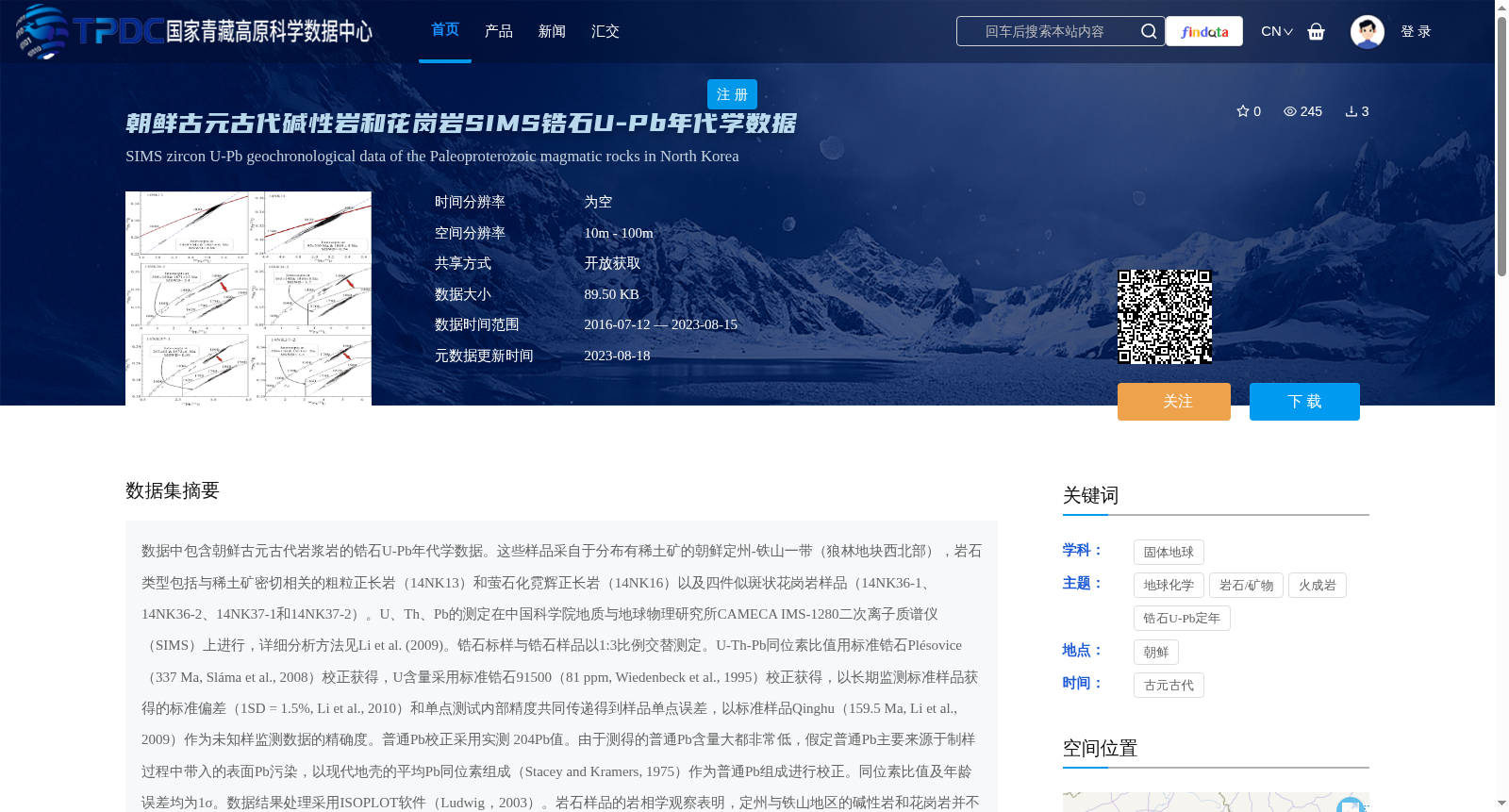
数据中包含朝鲜古元古代岩浆岩的锆石U-Pb年代学数据。这些样品采自于分布有稀土矿的朝鲜定州-铁山一带(狼林地块西北部),岩石类型包括与稀土矿密切相关的粗粒正长岩(14NK13)和萤石化霓辉正长岩(14NK16)以及四件似斑状花岗岩样品(14NK36-1、14NK36-2、14NK37-1和14NK37-2)。U、Th、Pb的测定在中国科学院地质与地球物理研究所CAMECA IMS-1280二次离子质谱仪(SIMS)上进行,详细分析方法见Li et al. (2009)。锆石标样与锆石样品以1:3比例交替测定。U-Th-Pb同位素比值用标准锆石Plésovice(337 Ma, Sláma et al., 2008)校正获得,U含量采用标准锆石91500(81 ppm, Wiedenbeck et al., 1995)校正获得,以长期监测标准样品获得的标准偏差(1SD = 1.5%, Li et al., 2010)和单点测试内部精度共同传递得到样品单点误差,以标准样品Qinghu(159.5 Ma, Li et al., 2009)作为未知样监测数据的精确度。普通Pb校正采用实测 204Pb值。由于测得的普通Pb含量大都非常低,假定普通Pb主要来源于制样过程中带入的表面Pb污染,以现代地壳的平均Pb同位素组成(Stacey and Kramers, 1975)作为普通Pb组成进行校正。同位素比值及年龄误差均为1σ。数据结果处理采用ISOPLOT软件(Ludwig,2003)。岩石样品的岩相学观察表明,定州与铁山地区的碱性岩和花岗岩并不显示明显的岩浆期之后的热液蚀变特征。SIMS锆石U-Pb定年结果显示粗粒正长岩的岩浆结晶年龄为1865 ± 6 Ma,萤石化霓辉正长岩的岩浆结晶年龄为1868 ± 8 Ma,铁山地区的四件似斑状花岗岩的年龄结果分别为1871 ± 13 Ma、1866 ± 8 Ma、1872 ± 6 Ma和1873 ± 7 Ma,这些年龄值一方面代表了岩浆活动时代。
This dataset contains zircon U-Pb geochronological data of Paleoproterozoic magmatic rocks from the Democratic People's Republic of Korea (DPRK). All samples were collected from the Dingzhou-Tieshan area (northwestern Langlin Block) in the DPRK, where rare earth element (REE) deposits are distributed. The rock types include coarse-grained syenite (14NK13) and fluoritized aegirine syenite (14NK16) that are closely associated with REE deposits, as well as four porphyritic granite samples (14NK36-1, 14NK36-2, 14NK37-1, and 14NK37-2). U, Th, and Pb concentrations and isotopic ratios were measured using a CAMECA IMS-1280 secondary ion mass spectrometer (SIMS) at the Institute of Geology and Geophysics, Chinese Academy of Sciences. Detailed analytical procedures are described in Li et al. (2009). Zircon standards and unknown samples were analyzed alternately at a ratio of 1:3. U-Th-Pb isotopic ratios were calibrated using the zircon standard Plésovice (337 Ma, Sláma et al., 2008), while U concentrations were calibrated using the zircon standard 91500 (81 ppm, Wiedenbeck et al., 1995). Single-point uncertainties of the samples were propagated using both the standard deviation from long-term monitoring of reference materials (1SD = 1.5%, Li et al., 2010) and internal precision of individual analyses. The zircon standard Qinghu (159.5 Ma, Li et al., 2009) was used as an unknown sample to monitor the accuracy of the analytical data. Common Pb correction was performed using measured 204Pb values. Since the measured common Pb contents are mostly very low, it was assumed that common Pb mainly originated from surface Pb contamination introduced during sample preparation, and the average Pb isotopic composition of the modern crust (Stacey and Kramers, 1975) was adopted as the common Pb composition for correction. All uncertainties for isotopic ratios and ages are reported at the 1σ level. Data reduction and processing were carried out using the ISOPLOT software (Ludwig, 2003). Petrographic observations of the rock samples indicate that the alkaline rocks and granites from the Dingzhou and Tieshan areas do not show obvious post-magmatic hydrothermal alteration features. SIMS zircon U-Pb dating results show that the magmatic crystallization ages of the coarse-grained syenite (14NK13), fluoritized aegirine syenite (14NK16), and the four porphyritic granite samples from the Tieshan area are 1865 ± 6 Ma, 1868 ± 8 Ma, 1871 ± 13 Ma, 1866 ± 8 Ma, 1872 ± 6 Ma, and 1873 ± 7 Ma, respectively. These ages collectively represent the timing of regional magmatic activity.