
MEG Kyushu
收藏DataCite Commons2025-06-01 更新2024-11-06 收录
下载链接:
https://figshare.com/articles/dataset/MEG_Kyushu/27116590/1
下载链接
链接失效反馈官方服务:
资源简介:
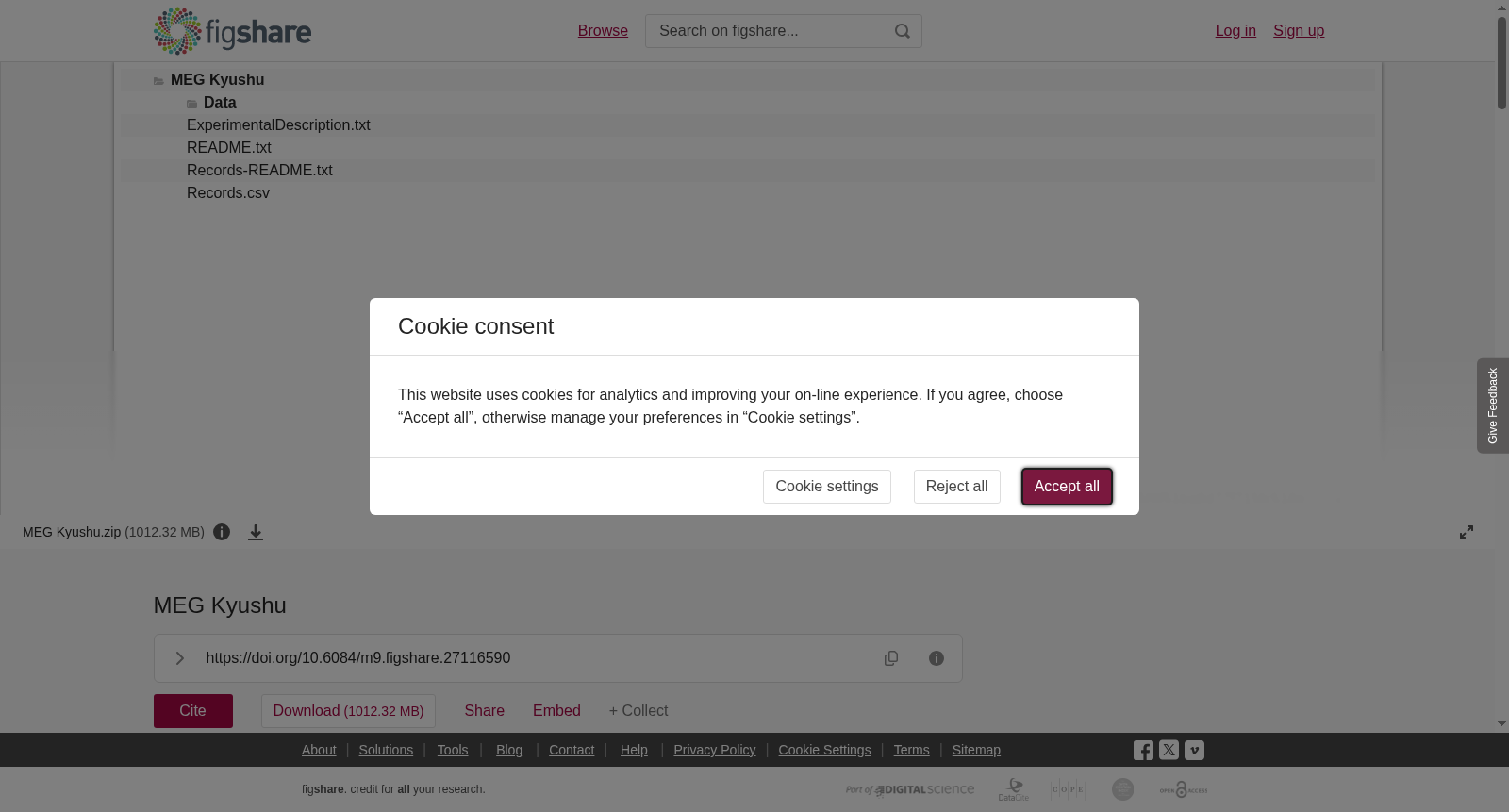
Dream EEG and Mentation (DREAM) dataset=======================================<br><br>Dataset information-------------------<br>- Common name: MEG Kyushu- Full name: N/A- Authors: Yuki Motomura*, Hiroshige Takeichi*, Mochine Ishii, Takashi Tsutsumi, Yuri Kawabata, Naoko Takahashi, Shota Hosogai, Hiroshi Shigeto, Chihiro Hiramatsu- Location: Kyushu University, Fukuoka, Japan- Year: 2023-2024- Set ID: 20- Amendment: 0- Corresponding author ID: 20<br>Previous publications:N/A<br>Correspondence:Chihiro Hiramatsu (email: chihiro@design.kyushu-u.ac.jp)<br><br>Metadata--------<br>- Key ID: 22- Date entered: 2024-08-29T08:16:54+00:00- Number of samples: 31- Number of subjects: 1- Proportion REM: 0%- Proportion N1: 71%- Proportion N2: 6%- Proportion W: 13%- Proportion experience: 77%- Proportion no-experience: 0%- Proportion healthy: 100%- Provoked awakening: Yes- Time of awakening: Evening- Form of response: Structured- Date approved: 2024-09-12T05:51:10+00:00<br><br>How to decode data files------------------------<br>If subjects were already awake when they were awakened, their experience was classified as "Unknown (-4)" in the "Experience" column of the Records.csv file.<br>CSV files, under the "Data/ChannelLocation" directory, give the channel locations of the MEG channels of each corresponding recording, extracted from the original FIFF files. The Elekta/MEGIN/Neuromag MEG system uses four head position indicator coils to measure the exact head position in the helmet, and the coordinates that this measurement provides are stored in FIFF files after a noise-reduction filter (i.e., "maxfilter") is applied. As the head moves (relative to the earth), it is represented as if the sensors move in the head-centered coordinate.<br><br>### Treatment group codes ###<br>N/A<br><br>Experimental description------------------------<br>ParticipantsParticipants between 18 and 40 years old in good mental health were recruited through advertisements on campus. Respondents were excluded from enrolling if they were engaged in night shift work or wearing orthodontic appliances. Participants were asked to wake up early in the morning and not to take caffeinated beverage on the day of the experiment, and received monetary compensation after the experiment. The study was approved by the Ethics Review Committee of the Faculty of Design, Kyushu University (approval no. 598-1), and written informed consent was obtained from all participants.<br>ProcedureThe experiment was conducted in the evening in a magnetically shielded room for magnetoencephalography (MEG) measurement at Kyushu University Hospital. Participants lay down and started their nap around 7 pm. The participants’ sleep stage was monitored by EEG and EOG. Upon observing continuous theta range slow waves for approximately 8 seconds or detecting solitary vertex sharp wave dominantly at the Cz electrode, the experimenter awakened the participants promptly by a brief beep sound, followed by an approximately three-minute semi-structured interview regarding their conscious experiences before awakening through a patient intercom. (The interview questions are described in the file "List of questions.docx".) Specifically, any recalled experience, along with their modalities and details—such as the appearance of people, objects, landscapes, colors, motion, words, strangeness, and emotions—was recorded. The participants were requested to fall back to sleep at the end of each interview, which was also marked as the sleep onset. This process was repeated to obtain verbal reports in multiple hypnagogic transients. Participants were also requested to report spontaneously whenever they had subjective experience in the absence of the awakening beep sound, by squeezing a cuff-balloon connected to a whistle outside the shielded room. There was an interval of at least 60 seconds between the sleep onset and the subsequent awakening. However, when sleep rapidly progressed to deeper stages, in which experience tended to be hard to recall and the subjective reports ambiguous, the participants were awakened with an interval shorter than 60 seconds. Most awakenings occurred during the N1 or N2 stages, and the final sleep stage was categorized through manual classification. The experiment continued for up to two hours from the beginning of the nap. Most participants took part in the experiment for two separate days, while some participated for three or more days. The detailed mental reports are not included in the dataset at present but will be uploaded in the future as the research progresses.<br><br>### DREAM categorization procedure ###<br>We defined "dreams" as any mental experience during sleep and categorized dreams following the classification of the DREAM database as follows<br>* 2 = Experience* 1 = Experience without recall* 0 = No experience* -1 = Experience with or without recall* -2 = No experience or Experience without recall* -3 = Experience or No experience* -4 = Unknown<br><br>Technical details-----------------<br>The columns for information regarding MEG data, "MEG sample rate" and "Number of MEG channels," were added to the Records.csv file. The Neuromag system has two sensor types: magnetometer and gradiometer. Channel labels with xxx1 indicate magnetometers, and channel labels with xxx2 or xxx3 indicate gradiometers. The channel unit (physical dimension) for magnetometers is "T," while that for gradiometers is "T/m." If a particular MEG channel did not respond well during the experiment, it is indicated in the "Remarks" column of the Record.csv file as "MEGxxxx was a bad channel".<br><br>### Data acquisition ###<br>MEG signals were measured with the Neuromag system (Elekta/MEGIN, 306 channels). Electroencephalography (EEG) signals were also measured from Fz, Cz, and Pz following the international 10-20 system, and eye movements were monitored using electrooculography (EOG, left and right) with passive electrodes. The ground electrode was attached to the forehead, and the EEG and EOG signals were referenced to the left earlobe. The impedance of the electrodes was checked to be below 15 kOhms prior to the recording. MEG, EEG, and EOG data were recorded simultaneously by the MEG system. All data were recorded at 1000 Hz. The head location relative to the MEG sensors was recorded by four head position indicator (HPI) coils attached above the left and right eyebrows and the left and right mastoids.<br><br>### Data preprocessing ###<br>Maxfilter (Elekta, version 2.2) was applied to the MEG raw data fif files to mitigate external magnetic interference. No other preprocessing was performed. Raw data may be requested from the corresponding author.
提供机构:
figshare
创建时间:
2024-10-03
搜集汇总
数据集介绍
背景与挑战
背景概述
MEG Kyushu数据集是一个包含脑磁图(MEG)和脑电图(EEG)数据的研究数据集,记录了受试者在睡眠期间的意识体验。数据集由九州大学团队采集,包含31个样本,主要关注N1和N2睡眠阶段,数据经过Maxfilter预处理以消除外部干扰。
以上内容由遇见数据集搜集并总结生成



