
Data from: Trait variation and performance across varying levels of drought stress in cultivated sunflower (Helianthus annuus L.)
收藏Mendeley Data2024-06-11 更新2024-06-29 收录
下载链接:
https://datadryad.org/stash/dataset/doi:10.5061/dryad.xgxd254np
下载链接
链接失效反馈官方服务:
资源简介:
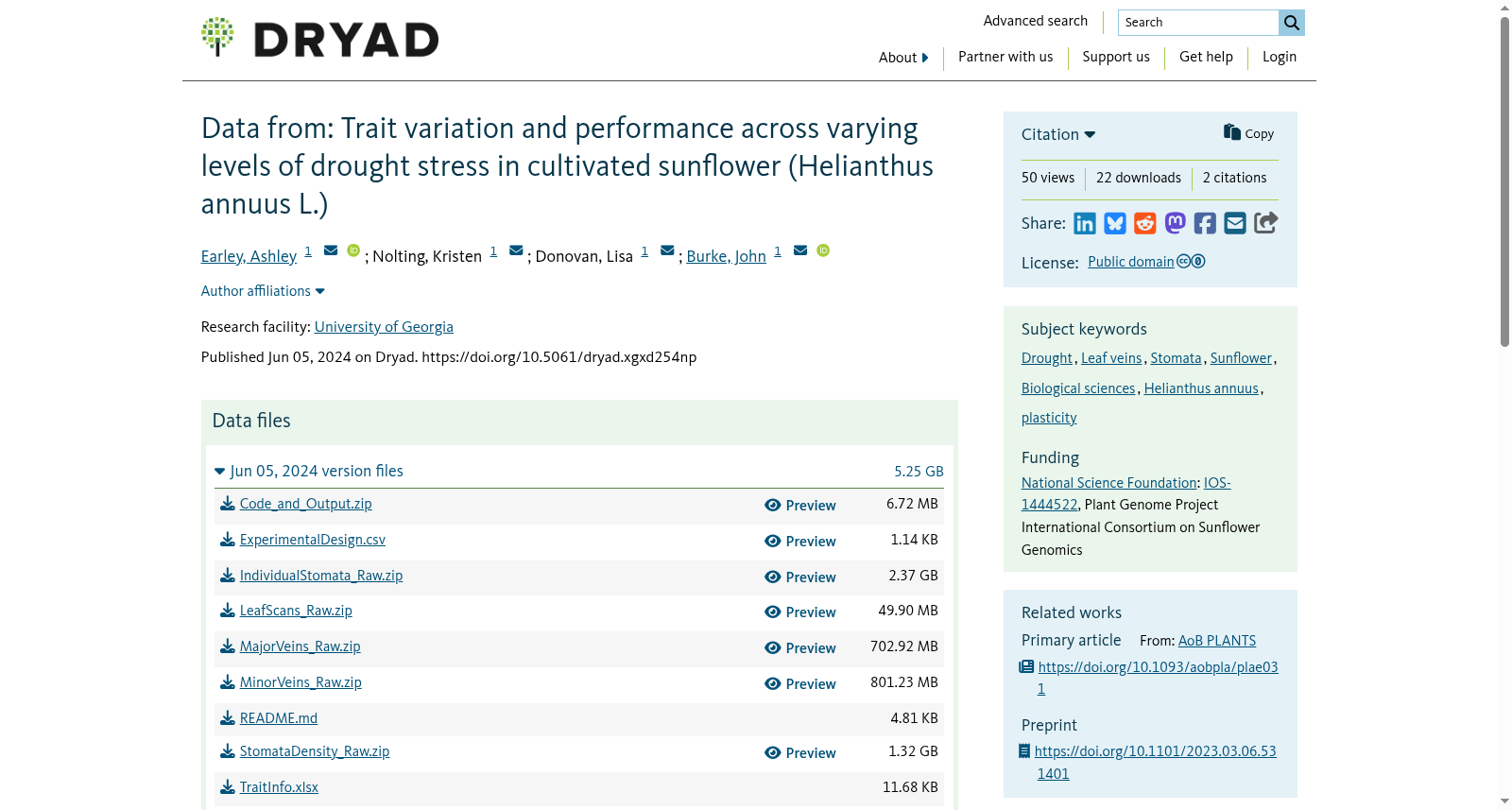
# Leaf traits predict performance under varying levels of drought stress in cultivated sunflower (Helianthus annuus L.) Journal: AoB Plants Corresponding author: John Burke - [jmburke@uga.edu](mailto:jmburke@uga.edu) ## Description of the data and file structure **Experimental Design.csv** File listing genotypes (SAM lines), blocks and treatments for all 64 plants **TraitInfo.xlsx** Table listing all traits and units (also Table 1 in manuscript) *Code_and_Output -> Data **DataAvg.csv** Plant level data for all traits (see file TraitInfo.xlsx for traits and units) **DataAvg_2.csv** Processed data (processing shown in script 01_Data_Wrangling.R) **Watering_BeforeAfter_Per.csv** Table with percentages of field capacity for watering each day (before and after watering) **RDPI_for_plots.csv** Plant level data used for plasticity (RDPI) analyses in manuscript Figure 2 *Code_and_Output -> Code* *R scripts used for all analyses ##### 01\_Data\_Wrangling.R Reformatting dataframe to be used in downstream analysis and figures ##### 02\_ANOVAs.R Two-way ANOVAs with interaction on ranked scale data to determine any significant treatment, genotype, and treatment x genotype interactions. Output reported in Tables 2 and S1, and used to determine posthoc treatment differences in Figure 1. ##### 03\_Boxplots.R Code for creating Figure 1, boxplots on a subset of the traits presented in Table 1. Treatment differences follow ANOVA results in Tables 2 and S1. ##### 04\_RDPI\_plotting.R Code for creating Figure 2, depicting RDPI (i.e., plasticity) for traits in each drought treatment relative to the well-watered control. Traits are grouped into functional groupings following Table 1 (each trait group was saved individually, and collated into a single figure using a graphics editor). See main text for how RDPI was calculated using estimated genotypic means (marginal means) for each treatment. ##### 05\_Corr\_Mats.R Code for creating Figure 3B (correlation matrix across all treatments) and Figures 4B,D,F,H (correlation matrices within each treatment) using all traits from Table 1, except using averages for stomatal density, stomatal pore length, and stomatal guard cell width. Additionally, code for mantel tests comparing each within treatment correlation matrix against each other. ##### 06\_PCAs.R Code for creating Figure 3A (PCA across all treatments; first 2 PC axes) and Figures 4A,C,E,G (PCAs within each treatment; first 2 PC axes) using all traits from Table 1, except using averages for stomatal density, stomatal pore length, and stomatal guard cell width (with trait loadings for PCs 1-3 reported in Table S2). Additionally, code for Hotelling's t tests comparing each within treatment against each other in Figure 3A, using the first 2 PC axes. ##### 07\_Trait\_Performance\_Regressions.R Code to perform the trait-performance multiple regression analyses using the Bayesian package 'brms'. See main text for details on model fits. Additionally, code to create Figure 5 and Tables S3 & S4 (which report estimated associations for each trait and biomass within each treatment along with credible intervals), and S5 which reports the model comparison results from the models with and without leaf area. ##### 08\_WateringData\_Plot.R Code for creating Supplemental Figure 1, showing percent water content across the experiment across all treatments. \**Code_and_Output -> Output* *mod_brm_1 and mod_brm_2: Saved brms model files \***StomataDensity_Raw** Images taken to measure stomatal density. File Names = -, ex: 1-B1 for pot 1 and bottom stomata density image 1 Scale: 20X, 5.87 px/um \***IndividualStomata_Raw** Includes images of individual stomata used for stomatal size measurements. Images were taken on two difference microscopes, designated 1 and 2 File names = -S, ex: 1-BS1 is Pot 1, Bottom Stomata image 1 Microscope 1 Scale: 100X, 29.45 px/um Microscope 2 Scale: 40X, 15.96 px/um \***LeafScans_Raw** Images of scans taken on flatbed scanner at 300dpi for measurement of LMA and leaf area File Names = Pilot_, ex: Pilot1_1 for pot 1, image 1 \***MinorVeins_Raw** Images taken with light microscope and used in neural network to calculate VLA. File Names = -, ex: 1-1 is pot 1, image 1 Microscope 1 Scale: 5X, 1.4688 px/um \***MajorVeinsScans_Raw** Images taken on flatbed scanner at 2400 dpi for measurement of second and major veins *Note:* \**Any missing values (NAs) in the dataframes indicate either the plant died during the experiment or accurate measures could not be made from the images taken. ## Code and Software Analyses were conducted using R v43.24.13 and RStudio v1.3.1093. All scripts are in folder Code_and_Output -> Code
# 叶性状可预测栽培向日葵(Helianthus annuus L.)在不同干旱胁迫水平下的表现
期刊:AoB Plants
通讯作者:约翰·伯克(John Burke) - <jmburke@uga.edu>
## 数据与文件结构说明
**Experimental Design.csv**:列出全部64株供试植株的基因型(SAM品系)、区组与处理信息的文件
**TraitInfo.xlsx**:收录所有性状及其单位的表格(亦为本论文的表1)
---
*Code_and_Output → 数据*
**DataAvg.csv**:包含所有性状的植株水平数据(性状与单位详见**TraitInfo.xlsx**文件)
**DataAvg_2.csv**:经过预处理的数据(预处理流程见脚本01_Data_Wrangling.R)
**Watering_BeforeAfter_Per.csv**:记录每日灌溉前后田间持水量百分比的表格
**RDPI_for_plots.csv**:用于本论文图2的RDPI(即表型可塑性)分析的植株水平数据
---
*Code_and_Output → 代码*
以下为所有分析所用的R脚本:
##### 01_Data_Wrangling.R
用于重构数据框以支持后续分析与绘图的脚本
##### 02_ANOVAs.R
对秩变换数据开展含交互项的双因素方差分析,以检测处理、基因型以及处理×基因型交互作用的显著性;分析结果见于表2与附表S1,并用于确定图1中的事后多重比较差异
##### 03_Boxplots.R
用于绘制图1的脚本,基于表1中的部分性状绘制箱线图,处理间差异检验结果参照表2与S1的方差分析结果
##### 04_RDPI_plotting.R
用于绘制图2的脚本,展示各干旱处理相对于正常浇水对照组的性状RDPI(即表型可塑性)。性状按照表1划分为功能类群(每个性状组单独保存,后通过图形编辑软件拼接为单幅图)。RDPI的计算方法详见正文,即基于各处理的估计基因型均值(边际均值)进行计算
##### 05_Corr_Mats.R
用于绘制图3B(所有处理间的相关矩阵)以及图4B、D、F、H(各处理组内的相关矩阵)的脚本,使用表1中的所有性状,但气孔密度、气孔孔长和气孔保卫细胞宽度采用平均值。此外,该脚本还用于开展曼特尔检验,以比较各处理组内的相关矩阵之间的差异
##### 06_PCAs.R
用于绘制图3A(所有处理间的主成分分析(Principal Component Analysis, PCA),前2个主成分轴)以及图4A、C、E、G(各处理组内的主成分分析,前2个主成分轴)的脚本,使用表1中的所有性状,但气孔密度、气孔孔长和气孔保卫细胞宽度采用平均值(主成分1-3的性状载荷详见附表S2)。此外,该脚本还用于开展霍特林t检验,以比较图3A中各处理组内的前2个主成分轴的差异
##### 07_Trait_Performance_Regressions.R
用于使用贝叶斯软件包`brms`开展性状-表现多重回归分析的脚本。模型拟合细节详见正文。此外,该脚本还用于绘制图5以及附表S3、S4(分别报告各性状与生物量在各处理中的估计关联值及其置信区间),以及附表S5(比较包含与不包含叶面积的模型的结果)
##### 08_WateringData_Plot.R
用于绘制补充图1的脚本,展示整个实验期间各处理组的含水量百分比
---
*Code_and_Output → 输出*
`mod_brm_1`与`mod_brm_2`:保存的brms模型文件
---
### 原始图像数据集
**StomataDensity_Raw**:用于测量气孔密度的图像。文件名格式为「-」,例如`1-B1`代表盆1的底部气孔密度图像1
放大倍数:20×,像素换算比例:5.87 px/μm
**IndividualStomata_Raw**:包含用于测量气孔大小的单张气孔图像。图像分别在两台不同的光学显微镜下拍摄,编号为1和2
文件名格式为「-S」,例如`1-BS1`代表盆1底部气孔图像1
显微镜1:放大倍数100×,像素换算比例29.45 px/μm
显微镜2:放大倍数40×,像素换算比例15.96 px/μm
**LeafScans_Raw**:使用平板扫描仪以300dpi扫描得到的叶片图像,用于测量叶面积干重比(Leaf Mass per Area, LMA)与叶面积
文件名格式为`Pilot_`,例如`Pilot1_1`代表盆1的图像1
**MinorVeins_Raw**:使用光学显微镜拍摄的图像,用于通过神经网络计算单位面积叶脉长度(Vein Length per Area, VLA)
文件名格式为「-」,例如`1-1`代表盆1的图像1
显微镜1:放大倍数5×,像素换算比例1.4688 px/μm
**MajorVeinsScans_Raw**:使用平板扫描仪以2400dpi扫描得到的主叶脉图像,用于测量二级及主叶脉性状
---
*注:数据框中的缺失值(NAs)代表该植株在实验期间死亡,或无法从拍摄的图像中获取准确测量结果*
## 代码与软件说明
本研究所有分析均基于R v43.24.13与RStudio v1.3.1093完成,所有脚本均存放于`Code_and_Output → Code`文件夹中
创建时间:
2024-06-07
搜集汇总
数据集介绍
背景与挑战
背景概述
该数据集研究了栽培向日葵(Helianthus annuus L.)在四种不同干旱胁迫水平下叶片性状的变异和表现,包括气孔密度、叶脉密度、生物量等关键性状的测量数据。数据集包含原始图像文件(如气孔和叶脉扫描)和实验设计文件,总大小约5.25 GB,旨在分析干旱响应中叶片解剖性状的作用和表型可塑性。研究结果揭示了性状与生物量之间的关联,为培育耐旱向日葵品种提供了数据支持。
以上内容由遇见数据集搜集并总结生成


