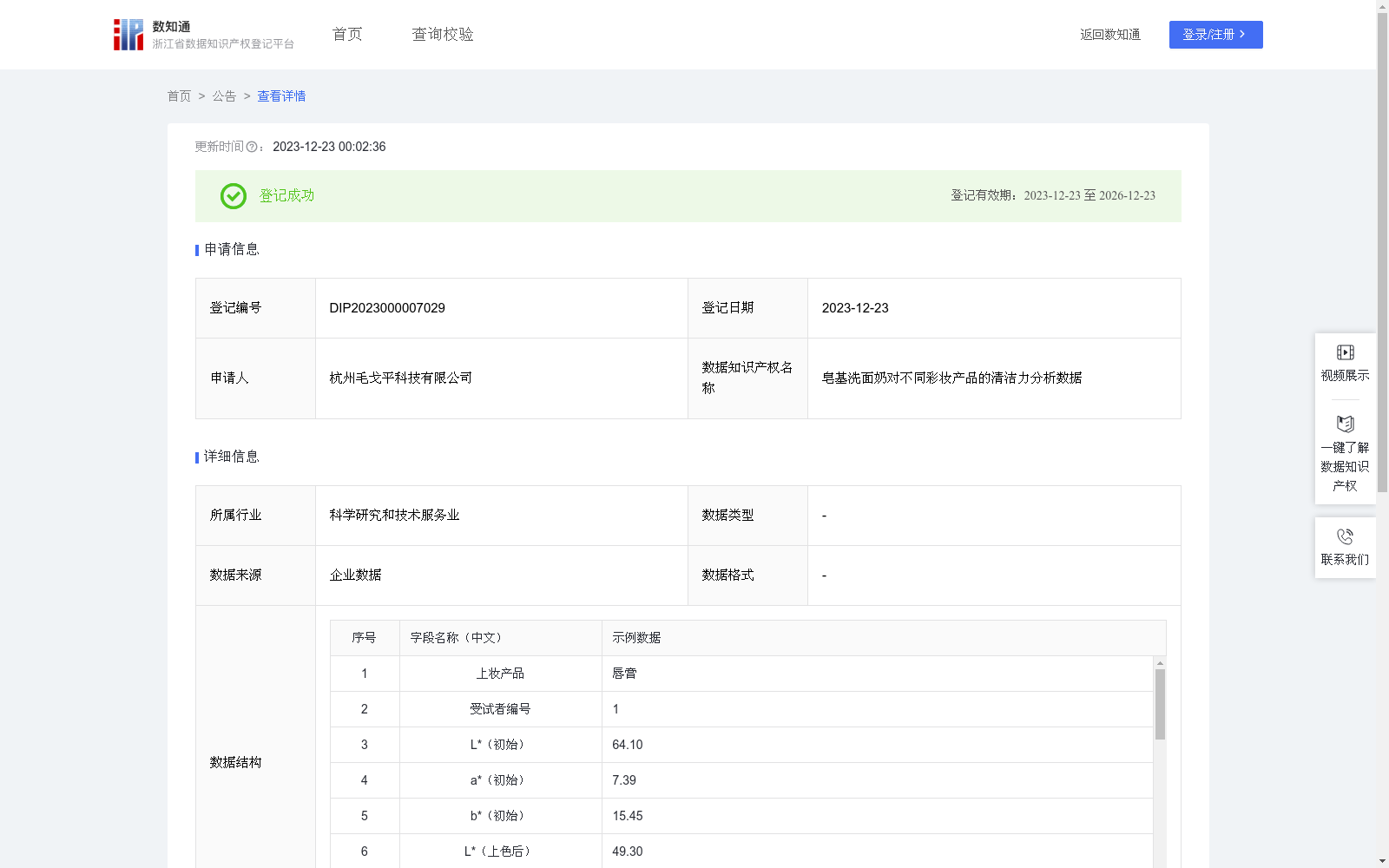
皂基洗面奶对不同彩妆产品的清洁力分析数据
收藏资源简介:
化妆已成为女性日常生活中必不可缺少的一环,卸妆时往往先使用卸妆产品来卸除彩妆和油脂,再搭配洗面奶进一步清洁毛孔中的灰尘污垢和残留的卸妆产品,避免残留的卸妆产品对肌肤造成不必要的刺激。然而过多清洁产品的叠加使用对皮肤屏障造成了较大的负担,而洗面奶是市面上最常见的洁面产品,因此开发一种对彩妆有较好清洁效果的洗面奶就有较大的意义。洗面奶中起清洁作用的是表面活性剂,其主要分为皂基、SLS/SLES(月桂醇硫酸酯钠/月桂醇聚醚硫酸酯钠)和氨基酸表面活性剂。当前选取了具有典型代表的皂基表面活性剂(硬脂酸、肉豆蔻酸、棕榈酸)20%、月桂醇聚醚硫酸酯钠2%和常规基质制成的洗面奶,对3种不同彩妆的清洁力进行了测量。通过该次试验数据分析,了解洗面奶对不同配方体系彩妆的清洁效果,后续调整表面活性剂的种类和比例,对开发具有较好清洁彩妆效果的洗面奶有指导作用。主要包括以下几个方面:1、数据采集:采用皮肤色度仪分别获取皮肤的初始状态、不同彩妆产品上色后和使用洗面奶清洁后的L*、a*和b*值,分别标记为L*、a*和b*值的初始、上色后和清洁后指标。2、算法加工:清洁力=(∆E1-∆E2)/∆E1×100%。其中∆E=(∆L*^2+∆a*^2+∆b*^2)^1/2,∆E1是每位受试者在彩妆产品上色后与初始相比的色差,∆L1*、∆a1*、∆b1*分别是每位受试者在彩妆上色后的L*、a*和b*值减去相应的初始数值;∆E2是每位受试者使用洗面奶清洁彩妆产品后与初始相比的色差,∆L2*、∆a2*、∆b2*分别是每位受试者在使用洗面奶清洁后的L*、a*和b*值减去相应的初始数值。清洁力平均值是每种彩妆的所有受试者清洁力的平均值。清洁力平均值达到95%以上(含)认为清洁力效果非常满意,90%以上(含)认为清洁力效果比较满意,80%(含)-90%认为清洁力效果一般,低于80%认为清洁力效果较差。
Makeup has become an indispensable part of women's daily lives. During makeup removal, people usually use makeup remover products first to remove makeup and excess sebum, then combine with facial cleanser to further clean dust, dirt in pores and residual makeup remover, so as to avoid unnecessary skin irritation caused by residual makeup remover. However, the overlapping use of excessive cleaning products imposes a considerable burden on the skin barrier. As facial cleanser is the most common facial cleansing product on the market, developing a facial cleanser with good makeup removal effect is of great practical significance. The cleaning effect of facial cleanser comes from surfactants, which are mainly divided into three categories: soap-based surfactants, sodium lauryl sulfate (SLS)/sodium laureth sulfate (SLES), and amino acid surfactants. In this study, a facial cleanser was prepared with 20% typical soap-based surfactants (stearic acid, myristic acid, palmitic acid), 2% sodium laureth sulfate, and conventional base matrix, and its cleansing power against 3 different types of makeup was measured. By analyzing the experimental data, we can understand the cleansing effect of the facial cleanser on makeup products with different formulation systems, and the subsequent adjustment of the types and proportions of surfactants will provide guiding significance for the development of facial cleansers with excellent makeup removal effects. The main contents include the following two aspects: 1. Data Collection: A skin colorimeter was used to obtain the CIELAB L*, a*, and b* values of the skin in its initial state, after applying different makeup products, and after cleansing with the facial cleanser. These values are respectively marked as the initial, post-application, and post-cleansing indices of L*, a*, and b*. 2. Algorithm Processing: Cleansing Power = [(ΔE1 - ΔE2)/ΔE1] × 100%. Where ΔE = (ΔL*² + Δa*² + Δb*²)^(1/2). ΔE1 refers to the color difference between the skin state after makeup application and the initial state for each participant; ΔL1*, Δa1*, and Δb1* are the L*, a*, and b* values of each participant after makeup application minus their corresponding initial values respectively. ΔE2 refers to the color difference between the skin state after cleansing with the facial cleanser and the initial state for each participant; ΔL2*, Δa2*, and Δb2* are the L*, a*, and b* values of each participant after cleansing minus their corresponding initial values respectively. The average cleansing power is the mean value of the cleansing power of all participants for each type of makeup. The cleansing effect is considered very satisfactory when the average cleansing power is ≥95%, relatively satisfactory when ≥90%, average when 80% ≤ average cleansing power < 90%, and poor when the average cleansing power is < 80%.