
Oden Arctic Technology Research Cruise (OATRC 2015) - Meteorological, Oceanographic and Ship Data Collected Onboard Icebreaker Oden during 18 September to 1 October 2015
收藏DataCite Commons2026-03-23 更新2024-07-13 收录
下载链接:
https://researchdata.se/catalogue/dataset/ecds0208-1/1.0
下载链接
链接失效反馈官方服务:
资源简介:
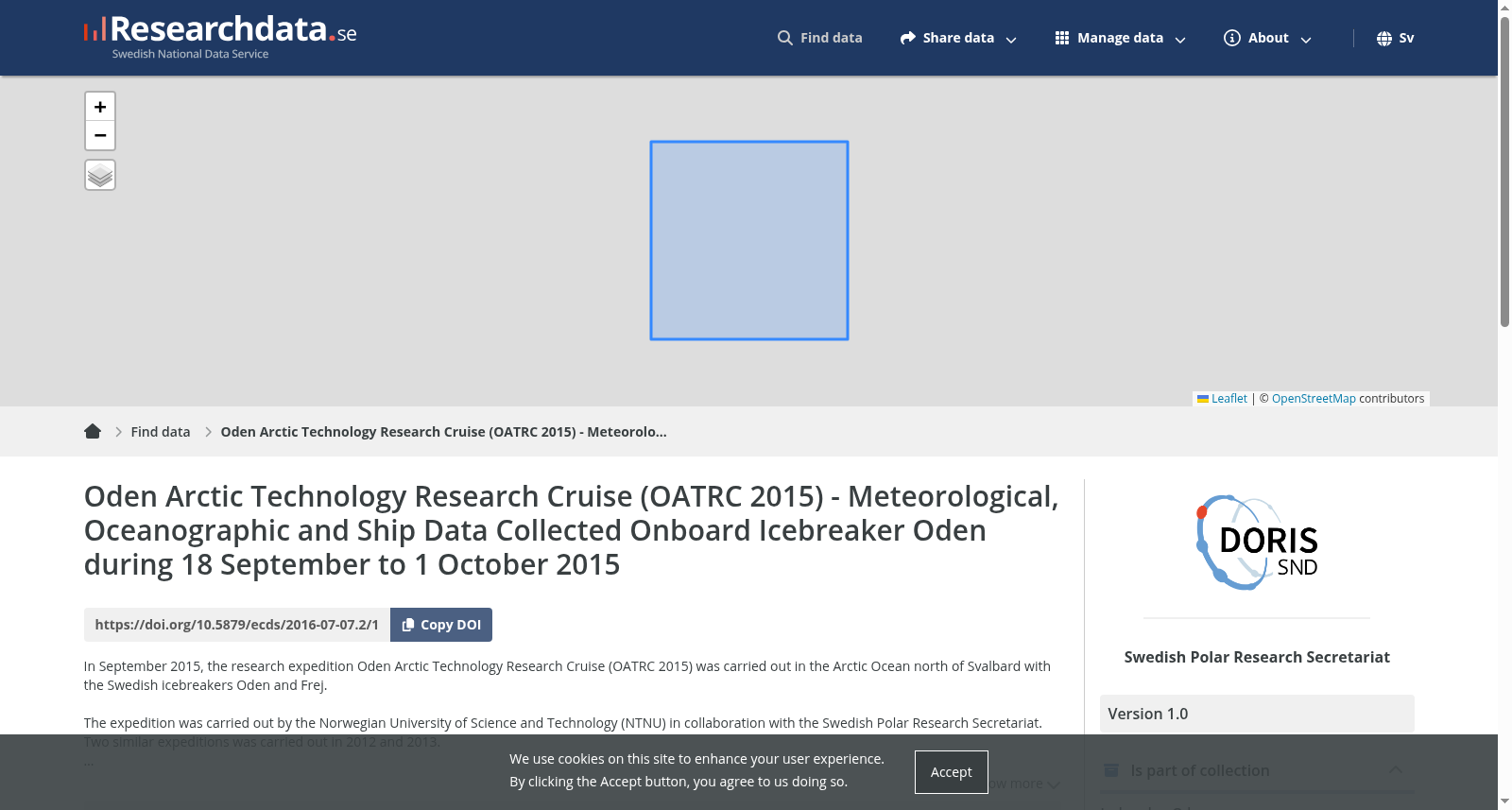
In September 2015, the research expedition Oden Arctic Technology Research Cruise (OATRC 2015) was carried out in the Arctic Ocean north of Svalbard with the Swedish icebreakers Oden and Frej.
The expedition was carried out by the Norwegian University of Science and Technology (NTNU) in collaboration with the Swedish Polar Research Secretariat. Two similar expeditions was carried out in 2012 and 2013.
OATRC 2015 was a project associated with Sustainable Arctic Marine and Coastal Technology (SAMCoT), which is a centre for research-based innovation, initiated by the Research Council of Norway and hosted by NTNU.
The main scientific scope of the research expedition was:
Collection of full-scale data necessary to build, calibrate and validate models for floaters in ice.
Collection of full-scale data necessary to build, calibrate and validate models for Ice Management operations.
Collection of data relevant for health, safety and environmental research.
Investigation of exposure to whole body vibration for icebreaker crew.
Whole body vibration denotes that the entire body is exposed to vibrations. Studies show that the risk for pain in the lower back is doubled when people are exposed to whole body vibrations.
Few investigations have been conducted regarding exposure to whole body vibration for icebreaker crews. Previous studies have focused on other types of vessels, not icebreakers. The main purpose of the study was to measure level of exposure to whole body vibrations for icebreaker crew during Arctic icebreaking conditions. The levels of exposure will be compared to levels of acceptance as published by the Swedish Work Environment Authority and international standards.
Depending on the results of the measurements, researchers may also investigate whether problems with the lower back are more common among icebreaker crews.
The project was a test of the ability to use an ice radar to make continuous measurements of sea ice thickness from the icebreaker Oden. Different antenna types and different frequency ranges was tested and the software was adapted for use on a ship. An intermediate goal was to be able to read the measurements in real-time. The radar system has previously been used for snow and ice measurements in Antarctica and in Swedish fells.
The researchers used CTD (Conductivity, Temperature, Depth), an oceanography instrument used to determine the salinity, temperature, and depth of the ocean, to quantify the water masses in a transect going from the shallow shelf out into deeper waters and through the ice front.
Water samples was also collected to answer these questions:
Can the differences in phytoplankton and bacterial communities found in a transect towards the ice front be explained by changes in physical/hydrographical factors?
Does the ice and its microflora , direct or indirect, influence the plankton communities through shading or seeding the water with organisms and organic matter?
The data will add to other chemical, biological, and physical data to give a better understanding of the biological functions at the ice edges, which are important for understanding of production, biodiversity and carbon circulation in Arctic waters.
The researchers retrieved SAR data from Sentinel-1 and a number of other satellites during the expedition. The images was processed in near-real-time to create products of ice drift and ice convergence/divergence.
This data set contains meteorological, oceanographic and ship data collected during the expedition Oden Arctic Technology Research Cruise 2015 (OATRC 2015), which was an international research cruise using the icebreaker Oden in the Arctic Ocean.
Data includes meteorological variables: Air temperature, Humidity, Wind direction/speed, Atmospheric pressure, Cloud height/cloudiness, Photosynthetic Active Radiation (PAR).
Oceanographic variables: Sea water temperature, Conductivity, Salinity and Sound velocity.
Ship data: Position, Speed, Course, Water depth.
Further metadata on instrumentation and the individual variables can be found in the info file. Graphics and files describing the route are included in the package.
Quality Information:
Obviously erroneous data (e.g. negative air pressure) have been omitted. No other processing or quality check of the data has been undertaken. Users should be aware of this in further data handling and analysis.
2015年9月,“奥登北极技术研究航次(Oden Arctic Technology Research Cruise, OATRC 2015)”搭乘瑞典破冰船“奥登号(Oden)”与“弗雷号(Frej)”,在斯瓦尔巴群岛以北的北冰洋海域开展科考作业。
本次考察由挪威科技大学(Norwegian University of Science and Technology, NTNU)联合瑞典极地研究秘书处共同实施,此前分别于2012年与2013年开展过两次同类型考察航次。
OATRC 2015隶属于可持续北极海洋与海岸技术中心(Sustainable Arctic Marine and Coastal Technology, SAMCoT)——该中心是由挪威研究理事会发起、挪威科技大学托管的研究型创新中心。
本次考察的核心科学范畴包括:
1. 采集用于构建、校准与验证浮冰漂浮物模型所需的实船实测数据;
2. 采集用于构建、校准与验证冰区作业管理模型所需的实船实测数据;
3. 采集与健康、安全及环境研究相关的数据;
4. 针对破冰船船员的全身振动(whole body vibration)暴露情况开展调查。
全身振动指人体整体暴露于振动环境的现象。研究表明,当人体暴露于全身振动时,下背部疼痛的风险会翻倍。
目前针对破冰船船员全身振动暴露的相关研究较为匮乏,既往研究多聚焦于其他类型船舶,并未涉及破冰船。本次研究的核心目的是测量北极破冰作业环境下,破冰船船员的全身振动暴露水平,并将该暴露水平与瑞典工作环境管理局(Swedish Work Environment Authority)发布的接受标准及国际标准进行比对。
根据测量结果,研究人员还将进一步分析破冰船船员的下背部疼痛问题是否更为高发。
本项目同时测试了利用冰雷达(ice radar)实现破冰船“奥登号”连续测量海冰厚度的能力。测试涵盖了不同天线类型与不同频率范围,并针对船舶使用场景适配了配套软件,中期目标是实现测量数据的实时读取。该雷达系统此前已应用于南极地区及瑞典山地的冰雪测量作业。
研究人员采用了CTD(电导率-温度-深度仪,Conductivity, Temperature, Depth)——一款用于测定海水盐度、温度与深度的海洋学仪器——对从浅海陆架延伸至深水区并穿过冰缘的断面水体团进行量化分析。
此外,研究人员还采集了水样,以解答以下科学问题:
1. 冰缘断面观测到的浮游植物(phytoplankton)与细菌群落(bacterial communities)差异,是否可通过物理/水文因子的变化予以解释?
2. 海冰及其微生区系(microflora)是否通过遮光或向水体接种生物与有机质的方式,直接或间接影响浮游植物群落(plankton communities)?
这些数据将与其他化学、生物及物理数据相结合,以深化对冰缘区域生物功能的理解,而该区域对于认识北极水域的生产力、生物多样性与碳循环(carbon circulation)具有重要意义。
考察期间,研究人员还获取了哨兵-1号(Sentinel-1)及其他多颗卫星的合成孔径雷达(Synthetic Aperture Radar, SAR)数据,并对图像进行近实时处理,以生成冰漂移与冰辐合/辐散相关产品。
本数据集包含OATRC 2015考察航次期间采集的气象、海洋学与船舶数据,该航次是依托破冰船“奥登号”在北冰洋开展的国际性科考航次。
数据涵盖以下类别:
- 气象变量:气温、湿度、风向/风速、大气压力、云高/云量、光合有效辐射(Photosynthetic Active Radiation, PAR);
- 海洋学变量:海水温度、电导率、盐度与声速;
- 船舶数据:位置、航速、航向、水深。
更多关于仪器与各变量的元数据可参阅配套说明文件,数据包中还包含航线相关图表与文件。
质量说明:
已剔除明显错误的数据(如负气压值),未对其余数据开展额外处理或质量校验。使用者在后续数据处理与分析过程中需注意此点。
提供机构:
Swedish Polar Research Secretariat
创建时间:
2016-07-07
搜集汇总
数据集介绍
背景与挑战
背景概述
该数据集包含2015年9月18日至10月1日期间,在北极斯瓦尔巴群岛以北的破冰船Oden上收集的气象、海洋和船舶数据。数据涵盖气温、湿度、风速、海水温度、盐度等变量,用于研究海冰性质、破冰船性能和船员振动暴露,数据为原始数值格式,仅进行了基本错误剔除。
以上内容由遇见数据集搜集并总结生成


