
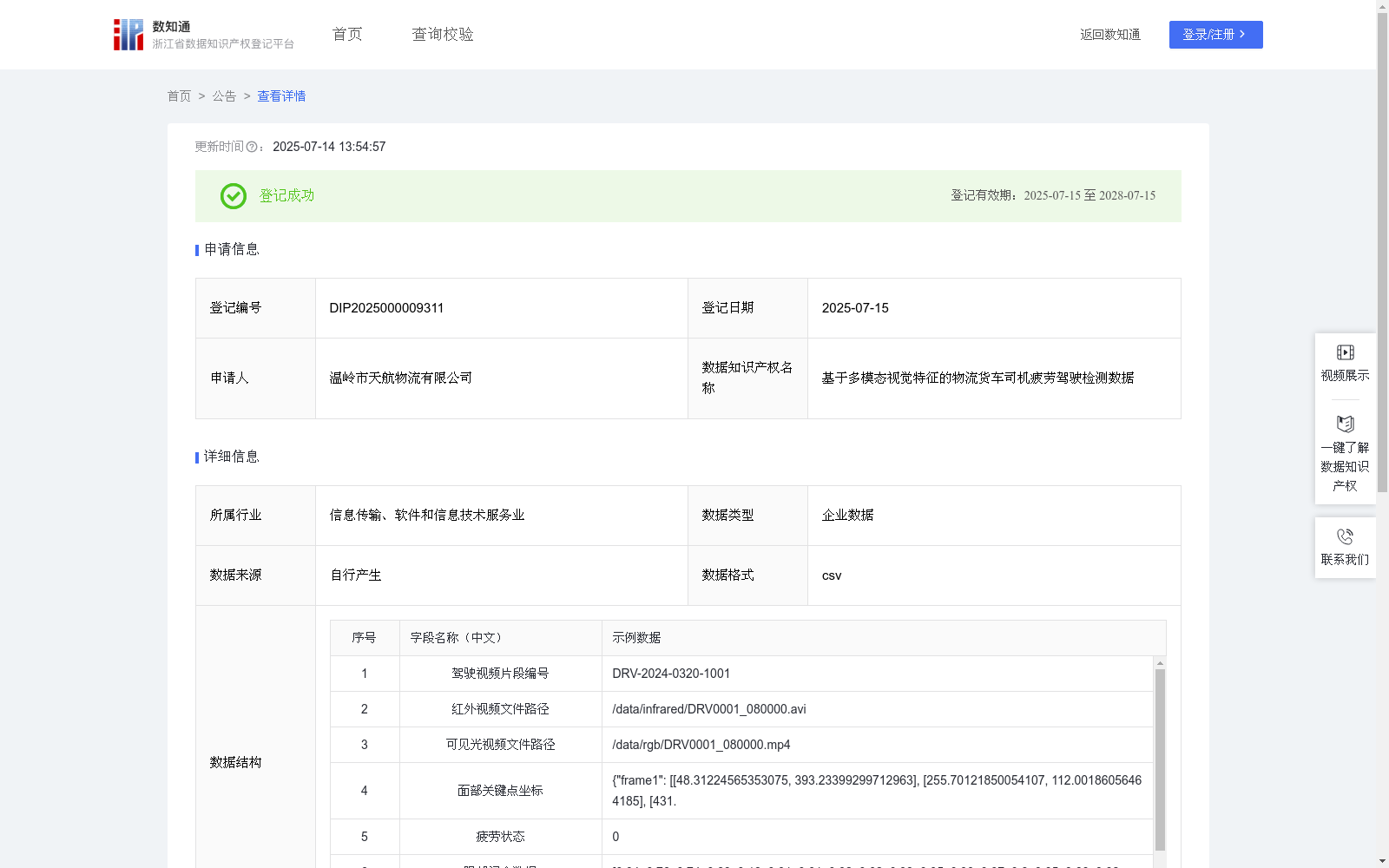
基于多模态视觉特征的物流货车司机疲劳驾驶检测数据
收藏浙江省数据知识产权登记平台2025-07-14 更新2025-07-15 收录
下载链接:
https://www.zjip.org.cn/home/announce/trends/148528
下载链接
链接失效反馈官方服务:
资源简介:
通过采集驾驶舱内红外与可见光双模态视频数据,结合面部关键点时序分析算法,构建疲劳驾驶检测模型。该数据适用于物流运输、公共交通等领域,可实时监测司机的眼部闭合频率、头部姿态偏移及打哈欠等疲劳特征,解决传统穿戴式设备侵入性强、误报率高的问题。用户可通过该数据实现非接触式疲劳预警,降低因疲劳驾驶导致的事故风险。本算法基于结构化多模态数据实现疲劳驾驶检测,数据文件按驾驶视频片段编号F-XXX-X层级存储。红外视频文件和可见光视频文件为专业红外摄像头采集,面部关键点坐标数据、疲劳状态、眼部闭合数据、头部姿态、光照强度数据均为专业数据标注人员标注。算法中,红外视频与可见光视频输入MediaPipe框架,输出预测的面部关键点坐标用于后续的疲劳状态预测。头部姿态提供三维旋转矩阵R,通过公式Δθ=arccos(tr(R_tR_{t-1}^T-1)/2计算。环境光照参数动态调节可见光视频的亮度补偿系数β=L_target/L_env,L_env表示光照强度,L_target表示目标光照强度,为固定值150。所有时序特征输入Bi-LSTM模型,输出层结合疲劳状态标签进行监督训练,最终预警信号需满足:P_fatigue=σ(W·[EAR_seq,Δθ_seq]+b)>0.7 ∧ t_response<0.5s,其中P_fatigue表示疲劳状态,0表示疲劳,1表示正常。数据编号体系保证时空一致性,如084500表示08:45:00时间戳起始的30秒片段。
A fatigue driving detection model is constructed by collecting dual-modal (infrared and visible light) video data from the cockpit and combining with temporal analysis algorithms for facial landmarks.
This dataset is applicable to scenarios including logistics transportation and public transportation, enabling real-time monitoring of fatigue-related features such as driver's eye closure frequency, head posture deviation and yawning, addressing the problems of high invasiveness and high false alarm rate of traditional wearable devices.
Users can achieve non-contact fatigue early warning using this dataset, thereby reducing the risk of traffic accidents caused by fatigued driving.
This algorithm realizes fatigue driving detection based on structured multi-modal data, and the data files are stored hierarchically with the driving video segment numbering format F-XXX-X.
Both infrared and visible light video files are collected by professional infrared cameras, while facial landmark coordinate data, fatigue status, eye closure data, head posture and illumination intensity data are annotated by professional data annotators.
In the algorithm, infrared and visible light videos are input into the MediaPipe framework, and the predicted facial landmark coordinates are output for subsequent fatigue status prediction.
The head posture provides a 3D rotation matrix R, and the angle difference Δθ is calculated via the formula: Δθ = arccos( (tr(R_t R_{t-1}^T) - 1)/2 ), where tr(·) denotes the matrix trace.
The ambient illumination parameter dynamically adjusts the brightness compensation coefficient β of the visible light video, where β = L_target / L_env, L_env represents the actual illumination intensity, and L_target is the fixed target illumination intensity with a value of 150.
All temporal features are input into the Bi-LSTM model, and supervised training is performed on the output layer combined with fatigue status labels. The final early warning signal must satisfy: P_fatigue = σ(W·[EAR_seq, Δθ_seq] + b) > 0.7 ∧ t_response < 0.5s, where σ denotes the sigmoid activation function, P_fatigue represents the fatigue status, with 0 indicating fatigue and 1 indicating normal driving.
The data numbering system ensures spatiotemporal consistency. For example, the number 084500 represents a 30-second video segment starting from the timestamp 08:45:00.
提供机构:
温岭市天航物流有限公司
创建时间:
2025-06-25
搜集汇总
数据集介绍
以上内容由遇见数据集搜集并总结生成


