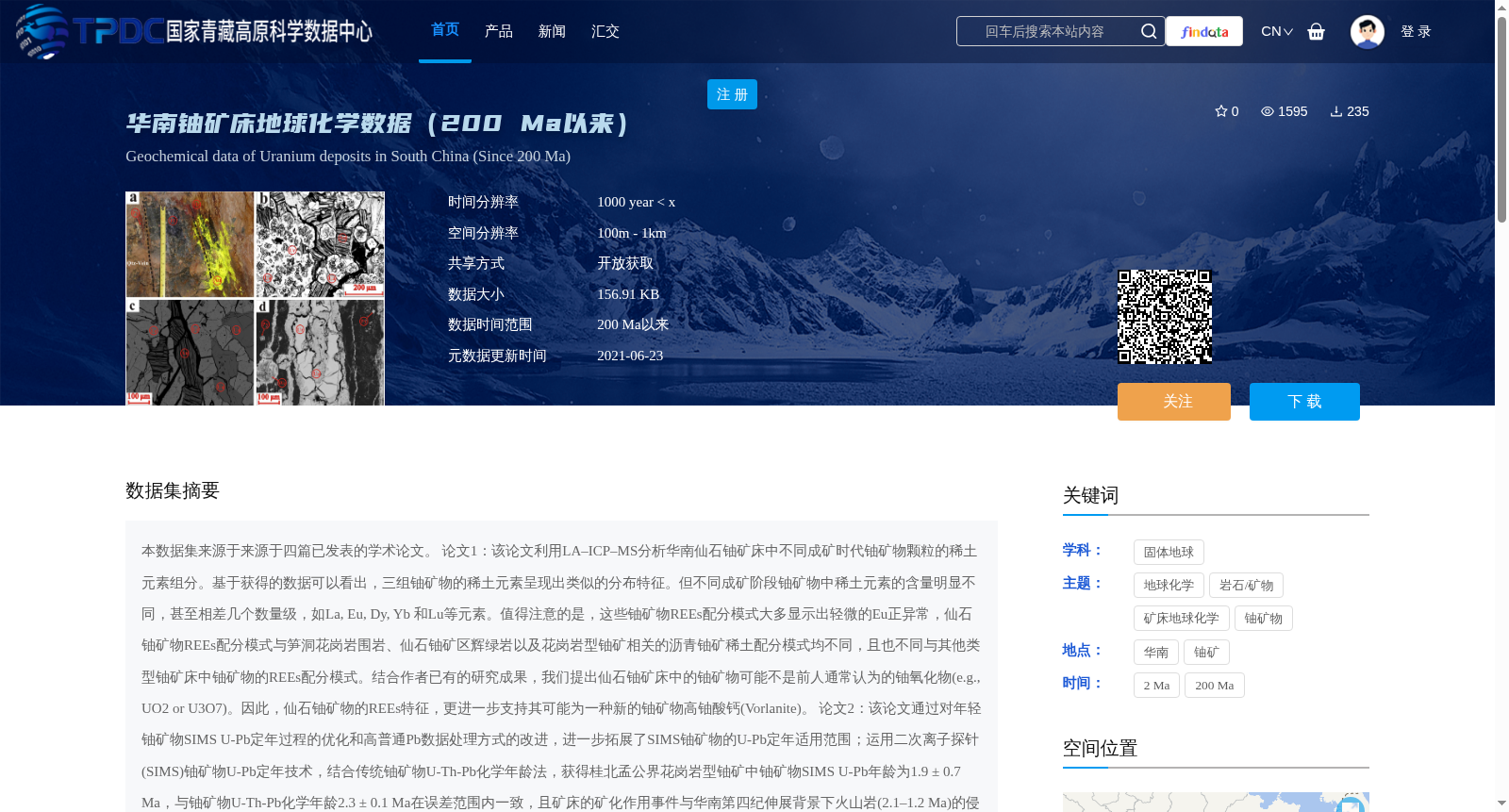
华南铀矿床地球化学数据(200 Ma以来)
收藏资源简介:
本数据集来源于来源于四篇已发表的学术论文。 论文1:该论文利用LA–ICP–MS分析华南仙石铀矿床中不同成矿时代铀矿物颗粒的稀土元素组分。基于获得的数据可以看出,三组铀矿物的稀土元素呈现出类似的分布特征。但不同成矿阶段铀矿物中稀土元素的含量明显不同,甚至相差几个数量级,如La, Eu, Dy, Yb 和Lu等元素。值得注意的是,这些铀矿物REEs配分模式大多显示出轻微的Eu正异常,仙石铀矿物REEs配分模式与笋洞花岗岩围岩、仙石铀矿区辉绿岩以及花岗岩型铀矿相关的沥青铀矿稀土配分模式均不同,且也不同与其他类型铀矿床中铀矿物的REEs配分模式。结合作者已有的研究成果,我们提出仙石铀矿床中的铀矿物可能不是前人通常认为的铀氧化物(e.g., UO2 or U3O7)。因此,仙石铀矿物的REEs特征,更进一步支持其可能为一种新的铀矿物高铀酸钙(Vorlanite)。 论文2:该论文通过对年轻铀矿物SIMS U-Pb定年过程的优化和高普通Pb数据处理方式的改进,进一步拓展了SIMS铀矿物的U-Pb定年适用范围;运用二次离子探针(SIMS)铀矿物U-Pb定年技术,结合传统铀矿物U-Th-Pb化学年龄法,获得桂北孟公界花岗岩型铀矿中铀矿物SIMS U-Pb年龄为1.9 ± 0.7 Ma,与铀矿物U-Th-Pb化学年龄2.3 ± 0.1 Ma在误差范围内一致,且矿床的矿化作用事件与华南第四纪伸展背景下火山岩(2.1–1.2 Ma)的侵位作用过程近同时;是目前识别出的华南最为年轻的铀矿化事件。 论文3:本论文针对铀矿化定年方法的发展历程进行了系统梳理和分析,评述了铀矿物定年的五种主要方法:(1) 铀矿物U-Th-totalPb化学年龄;(2) 铀矿物模式年龄;(3) 铀矿物传统等时线年龄;(4) 铀矿物矿伴生矿物年龄;(5) 原位微区铀矿物U-Pb年龄;深入探讨了铀矿化作用定年研究中存在的问题和对应方案,期望促进未来铀矿床成矿年代学的发展。 论文4:该论文利用角闪石Ar-Ar法新获得的下庄两组NWW向基性岩脉和一组NEE向基性岩脉的年龄为200~180 Ma,这些基性岩脉的年龄与下庄基性岩脉锆石U-Pb年龄在误差范围内总体一致,进一步确认粤北下庄地区存在早侏罗世的基性岩浆活动。尽管与其对应期次的铀矿化年龄迄今还未见报道,但这些早期基性岩脉的存在对铀成矿作用的认识及区域地质构造演化具有极其重要的地质意义。表明华南地区此刻处在伸展构造地质背景,标志着印支期碰撞造山作用发生后华南地区岩石圈伸展作用可能至少在200~190 Ma已经开始。 注1:孟公界铀矿GPS坐标:N26°11′ ,E110°30′。 注2:下庄铀矿GPS坐标:N24°33′,E114°14′。
This dataset is derived from four published academic papers. Paper 1: This paper employed LA-ICP-MS to analyze the rare earth element (REE) compositions of uranium mineral grains with different mineralization ages in the Xianshi uranium deposit, South China. Based on the acquired data, the REE distributions of the three groups of uranium minerals show similar patterns. However, the REE contents of uranium minerals from different mineralization stages vary significantly, even by several orders of magnitude, such as La, Eu, Dy, Yb and Lu. Notably, most of the REE partition patterns of these uranium minerals exhibit a slight positive Eu anomaly. The REE partition patterns of Xianshi uranium minerals differ from those of the wallrock Sundong granite, diabase in the Xianshi uranium mining area, and the REE partition patterns of uraninite associated with granitic uranium deposits, as well as those of uranium minerals from other types of uranium deposits. Combined with the authors’ existing research results, we propose that the uranium minerals in the Xianshi uranium deposit may not be the uranium oxides (e.g., UO₂ or U₃O₇) generally recognized in previous studies. Therefore, the REE characteristics of Xianshi uranium minerals further support that they may be a new uranium mineral, calciouranoite (Vorlanite). Paper 2: This paper optimized the SIMS U-Pb dating process for young uranium minerals and improved the data processing method for high common Pb samples, further expanding the applicable scope of SIMS U-Pb dating for uranium minerals. Using the secondary ion mass spectrometry (SIMS) U-Pb dating technique for uranium minerals combined with the traditional U-Th-Pb chemical age method for uranium minerals, the SIMS U-Pb age of uranium minerals from the Menggongjie granitic uranium deposit in northern Guangxi was determined to be 1.9 ± 0.7 Ma, which is consistent with the U-Th-Pb chemical age of 2.3 ± 0.1 Ma of uranium minerals within the error range. Moreover, the mineralization event of the deposit is approximately synchronous with the emplacement of volcanic rocks (2.1–1.2 Ma) under the Quaternary extensional setting in South China; this is the youngest uranium mineralization event identified in South China to date. Note 1: GPS coordinates of the Menggongjie uranium deposit: N26°11′, E110°30′. Paper 3: This paper systematically reviewed and analyzed the development history of uranium mineralization dating methods, and commented on five main methods for uranium mineral dating: (1) U-Th-totalPb chemical age of uranium minerals; (2) Model age of uranium minerals; (3) Traditional isochron age of uranium minerals; (4) Age of minerals associated with uranium mineralization; (5) In-situ micro-area U-Pb age of uranium minerals. It also deeply discussed the existing problems and corresponding solutions in the dating research of uranium mineralization, aiming to promote the development of metallogenic chronology of uranium deposits in the future. Paper 4: This paper newly obtained ages of 200–180 Ma for two groups of NWW-striking mafic dikes and one group of NEE-striking mafic dikes in Xiazhuang using the hornblende Ar-Ar dating method. The ages of these mafic dikes are generally consistent with the zircon U-Pb ages of mafic dikes in Xiazhuang within the error range, further confirming the existence of Early Jurassic mafic magmatism in the Xiazhuang area of northern Guangdong. Although the corresponding uranium mineralization age of this stage has not been reported so far, the existence of these early mafic dikes has extremely important geological significance for understanding uranium mineralization and regional geological tectonic evolution. This indicates that South China was in an extensional tectonic setting at that time, marking that the lithospheric extension in South China after the Indosinian collisional orogeny may have begun at least as early as 200–190 Ma. Note 2: GPS coordinates of the Xiazhuang uranium deposit: N24°33′, E114°14′.