infant-cry-detection
收藏资源简介:
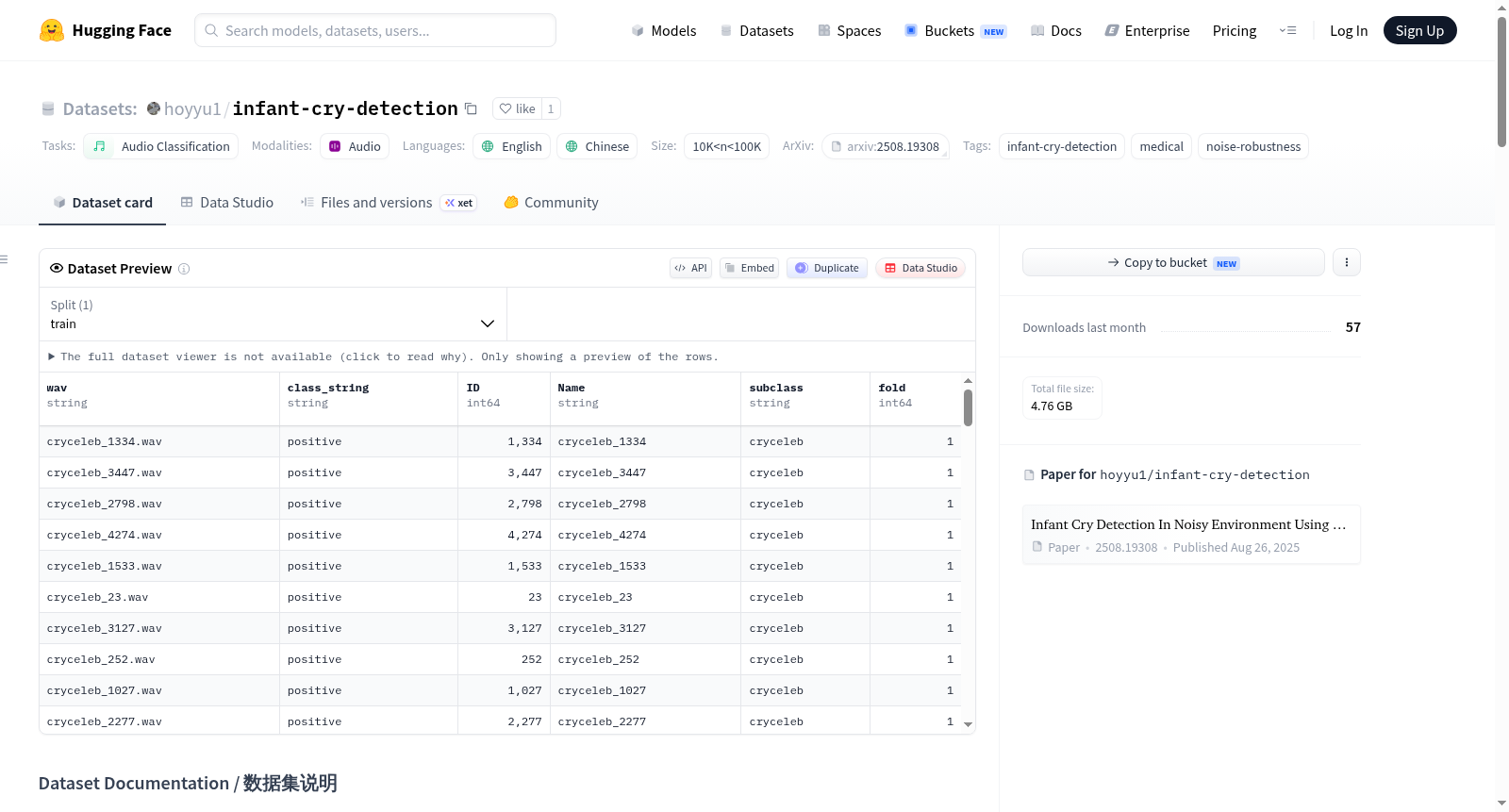
本数据集专为嘈杂家庭环境下的婴儿哭声检测任务而构建,旨在为机器学习模型(尤其是深度神经网络)的训练与评估提供一个多样化、具代表性且具备鲁棒性的音频样本集合。数据集通过整合多个公开数据集(包括CryCeleb2023、EnesBabyCries1、2020科大讯飞A.I.开发者大赛、VoxCeleb、ESC 50、Cat Meowing和DASEE)构建而成,确保样本的多样性和代表性。数据内容包含约39.6小时的音频记录,划分为哭声(正样本)和非哭声(负样本)两大类,并采用五折平衡划分以支持交叉验证。非哭声数据进一步细分为五个子类:语音、人类非语音、猫叫声、家庭噪音(涵盖家用电器、户外自然环境、城市交通等)和静音,其中特别包含了易与婴儿哭声混淆的声音(如猫叫声)以及典型的家庭环境噪声。所有音频样本均经过预处理:静音片段被移除,剩余片段被分割或拼接以形成统一长度,最终转换为单声道、16 kHz采样率、WAV PCM格式的音频文件,固定时长为5秒(足以捕获一个或多个哭声周期)。数据集的组织结构包括:audio/目录(包含positive/和negative/子目录分别存放正负样本音频文件)、metadata/目录(存储元数据及标签的CSV文件)以及rir/目录(存放用于数据增强中生成环境混响的房间冲激响应音频文件)。数据预处理流程中,样本可进一步转换为128维的对数梅尔频谱图作为深度神经网络的输入特征。为提升模型鲁棒性,数据集支持在训练时随机应用三种数据增强方法:速度扰动(以0.8至1.2的随机因子重采样,改变音高和共振峰)、环境噪声破坏(按指定信噪比添加加性噪声,并通过卷积引入真实测量的房间混响效果)以及时间与频率掩蔽(在时频域用零值随机掩蔽连续片段)。数据规模方面,哭声样本共13,330个;非哭声样本中,语音4,963个、家庭噪音4,506个、人类非语音2,076个、猫叫声1,953个、静音1,650个。该数据集适用于音频分类任务,特别是面向真实家庭噪声环境的婴儿哭声检测模型开发与评估。
This dataset is constructed specifically for infant cry detection tasks in noisy home environments, aiming to provide a diverse, representative, and robust audio corpus for the training and evaluation of machine learning models, especially deep neural networks. This dataset is compiled by integrating multiple public datasets, including CryCeleb2023, EnesBabyCries1, 2020 iFLYTEK A.I. Developer Contest, VoxCeleb, ESC 50, Cat Meowing, and DASEE, to ensure the diversity and representativeness of the samples. The dataset contains approximately 39.6 hours of audio recordings, which are categorized into two classes: cry sounds (positive samples) and non-cry sounds (negative samples), with a balanced 5-fold split to support cross-validation. The non-cry sound data is further divided into five subcategories: speech, human non-speech sounds, cat meows, household noises (covering household appliances, outdoor natural environments, urban traffic, etc.), and silence. Notably, it includes sounds that are easily confused with infant cries (such as cat meows) and typical home environmental noises. All audio samples undergo preprocessing: silent segments are removed, and the remaining segments are split or concatenated to achieve a uniform length. Finally, the samples are converted into audio files in mono, 16 kHz sampling rate, and WAV PCM format, with a fixed duration of 5 seconds, which is sufficient to capture one or multiple cry cycles. The organizational structure of the dataset includes: an audio/ directory (containing positive/ and negative/ subdirectories for storing positive and negative sample audio files respectively), a metadata/ directory (storing CSV files of metadata and labels), and a rir/ directory (storing room impulse response audio files used to generate environmental reverberation for data augmentation). During the preprocessing pipeline, samples can be further converted into 128-dimensional log-mel spectrograms as input features for deep neural networks. To improve model robustness, the dataset supports the random application of three data augmentation methods during training: 1) Speed perturbation: resampling with a random factor between 0.8 and 1.2, which alters the pitch and formants; 2) Environmental noise corruption: adding additive noise at a specified signal-to-noise ratio (SNR) and introducing real measured room reverberation effects via convolution; 3) Time and frequency masking: randomly masking continuous segments with zero values in the time-frequency domain. In terms of dataset scale, there are 13,330 cry samples; among the non-cry samples, there are 4,963 speech samples, 4,506 household noise samples, 2,076 human non-speech samples, 1,953 cat meow samples, and 1,650 silence samples. This dataset is applicable to audio classification tasks, especially the development and evaluation of infant cry detection models for real-world noisy home environments.
数据集概要
- 任务类别:音频分类(audio-classification)
- 标签:婴儿哭声检测(infant-cry-detection)、医学(medical)、噪声鲁棒性(noise-robustness)
- 语言:英语(en)、中文(zh)
- 数据规模:10,000 < 样本数 < 100,000(10K<n<100K)
数据集描述
本数据集专门用于嘈杂家庭环境下的婴儿哭声检测,通过整合 CryCeleb2023、EnesBabyCries1、2020 科大讯飞 A.I. 开发者大赛、VoxCeleb、ESC 50、Cat Meowing 和 DASEE 等多个公开数据集构建,确保样本的多样性和代表性。数据集包含约 39.6 小时的音频记录,划分为婴儿哭声(正样本)和非哭声(负样本)两类,并分为五折用于交叉验证。
目录结构
audio/:包含所有音频样本文件,内部有positive/(婴儿哭声正样本)和negative/(非哭声负样本)子目录。metadata/:包含 CSV 格式的元数据文件(如all28479.csv、noise.csv、noise_val.csv、rir.csv)。rir/:包含用于数据增强中生成混响效果的房间冲激响应(RIR)音频文件。
样本构成
- 正样本(婴儿哭声):共 13,330 个样本,来源于 CryCeleb2023、EnesBabyCries1 和 2020 科大讯飞 A.I. 开发者大赛。
- 负样本(非哭声):包含五个子类,具体样本数量如下:
- 语音(Speech):4,963 个
- 家庭噪音(Household noise):4,506 个
- 人类非语音(Human non-speech):2,076 个
- 猫叫声(Cat Meows):1,953 个
- 静音(Silences):1,650 个
数据预处理
- 移除样本中的静音片段,将剩余片段分割或拼接为固定长度(5 秒)的音频样本。
- 所有样本被转换为单声道 16 kHz WAV PCM 格式。
- 可能的处理流程:对每个样本应用大小为 512 的汉宁窗,以 400 步长分帧;使用 128 个三角形滤波器组计算梅尔尺度短时傅里叶变换,得到 128 维对数梅尔频谱图。
数据增强
在每次迭代中随机执行以下三种增强方法:
- 速度扰动:以 0.8 至 1.2 的随机加速因子重采样音频。
- 环境噪声破坏:根据指定信噪比(SNR)添加加性噪声,并使用从真实声学测量中获得的房间冲激响应通过卷积引入混响。
- 时间与频率掩蔽:在时间和频率域中用零值随机替换连续片段。
引用信息
如需引用本数据集,请引用以下论文: H. Yu and Y. Li, "Infant Cry Detection In Noisy Environment Using Blueprint Separable Convolutions and Time-Frequency Recurrent Neural Network," 2025 IEEE International Workshop on Multimedia Signal Processing (MMSP), Beijing, China, 2025, pp. 1-6, doi: 10.1109/MMSP64401.2025.11324248.
相关链接
- 代码仓库:https://github.com/fhfjsd1/ICD_MMSP
- 论文 arXiv 版本:https://arxiv.org/abs/2508.19308
- 论文 IEEE Xplore 版本:https://ieeexplore.ieee.org/document/11324248