
青藏地区1km人口数据集(1260-2020)
收藏国家青藏高原科学数据中心2025-04-08 更新2025-04-19 收录
下载链接:
https://data.tpdc.ac.cn/zh-hans/data/56ff13c3-805a-4942-9fb6-93e1b3f464eb
下载链接
链接失效反馈官方服务:
资源简介:
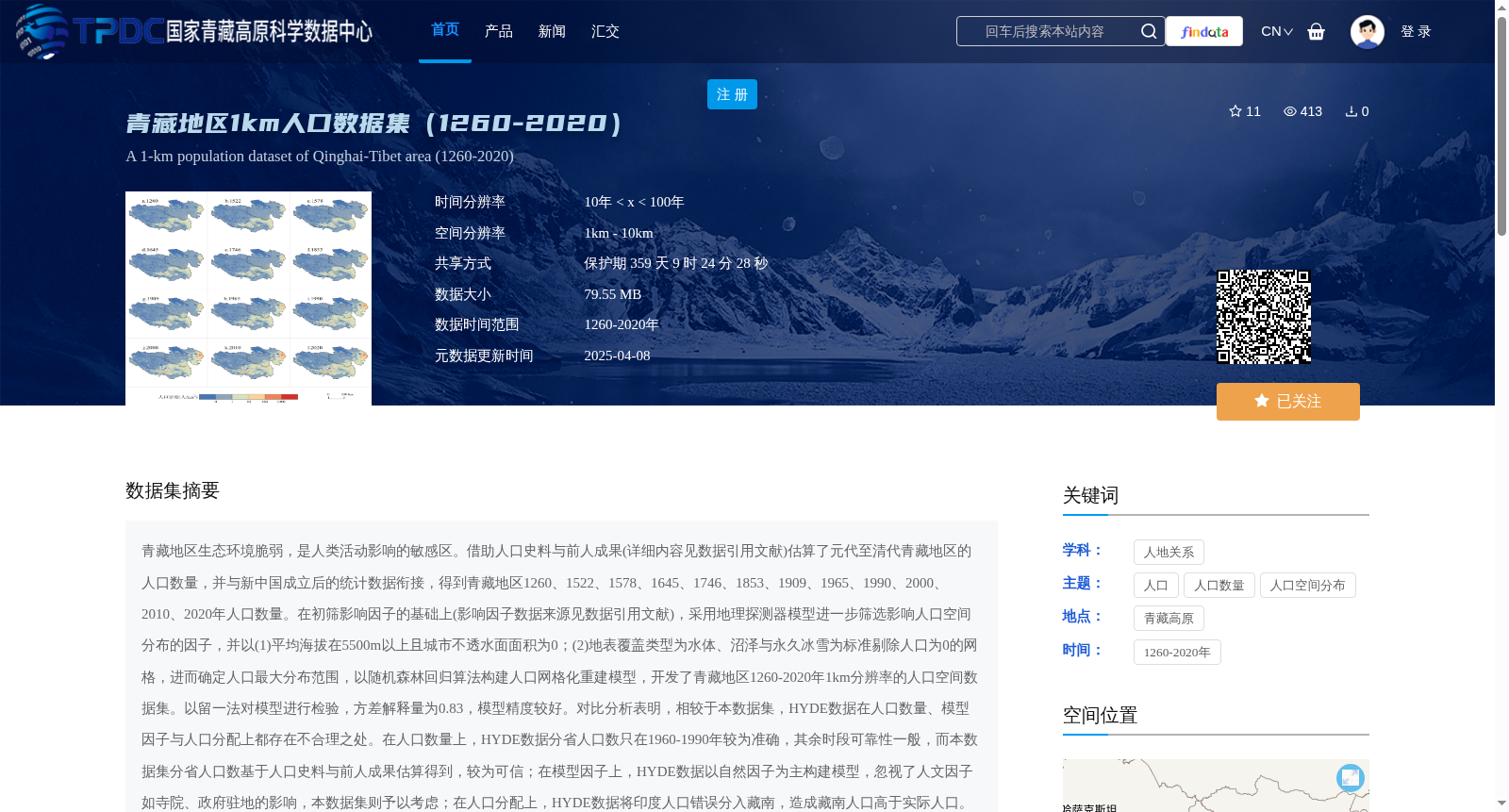
青藏地区生态环境脆弱,是人类活动影响的敏感区。借助人口史料与前人成果(详细内容见数据引用文献)估算了元代至清代青藏地区的人口数量,并与新中国成立后的统计数据衔接,得到青藏地区1260、1522、1578、1645、1746、1853、1909、1965、1990、2000、2010、2020年人口数量。在初筛影响因子的基础上(影响因子数据来源见数据引用文献),采用地理探测器模型进一步筛选影响人口空间分布的因子,并以(1)平均海拔在5500m以上且城市不透水面面积为0;(2)地表覆盖类型为水体、沼泽与永久冰雪为标准剔除人口为0的网格,进而确定人口最大分布范围,以随机森林回归算法构建人口网格化重建模型,开发了青藏地区1260-2020年1km分辨率的人口空间数据集。以留一法对模型进行检验,方差解释量为0.83,模型精度较好。对比分析表明,相较于本数据集,HYDE数据在人口数量、模型因子与人口分配上都存在不合理之处。在人口数量上,HYDE数据分省人口数只在1960-1990年较为准确,其余时段可靠性一般,而本数据集分省人口数基于人口史料与前人成果估算得到,较为可信;在模型因子上,HYDE数据以自然因子为主构建模型,忽视了人文因子如寺院、政府驻地的影响,本数据集则予以考虑;在人口分配上,HYDE数据将印度人口错误分入藏南,造成藏南人口高于实际人口。本数据集能够揭示青藏地区长时间序列的人口时空变化特征,并为此后青藏地区人类活动、气候变化研究与生态保护工作提供帮助。
The eco-environment of the Qinghai-Tibet Region is fragile and sensitive to human activities. Based on population historical documents and previous research results (detailed content is listed in the data citation literature), we estimated the population size of the Qinghai-Tibet Region from the Yuan Dynasty to the Qing Dynasty, and integrated it with the statistical data after the founding of the People's Republic of China, obtaining the population counts of the region in 1260, 1522, 1578, 1645, 1746, 1853, 1909, 1965, 1990, 2000, 2010 and 2020. On the basis of preliminary screening of influencing factors (data sources of influencing factors are listed in the data citation literature), the Geodetector model was used to further screen the factors affecting the spatial distribution of population. Then, we eliminated the grids with zero population based on two criteria: (1) average altitude above 5500m with zero urban impervious surface area; (2) land cover type being water body, marsh and permanent snow/ice, to determine the maximum population distribution range. Subsequently, a population gridding reconstruction model was constructed using the Random Forest Regression algorithm, and a 1km-resolution spatial population dataset of the Qinghai-Tibet Region from 1260 to 2020 was developed. The model was validated using Leave-One-Out Cross Validation, with a variance explanation rate of 0.83, indicating good model accuracy. Comparative analysis shows that compared with this dataset, the HYDE dataset has unreasonable aspects in terms of population size, model factors and population allocation. In terms of population size, the provincial population data of HYDE is only accurate during 1960-1990, with moderate reliability in other periods, while the provincial population data of this dataset is estimated based on population historical documents and previous research results, which is more credible. In terms of model factors, the HYDE dataset constructs the model mainly using natural factors, ignoring the impacts of human factors such as monasteries and government administrative centers, which are considered in this dataset. In terms of population allocation, the HYDE dataset incorrectly allocates the population of India into South Tibet, resulting in a higher population in South Tibet than the actual value. This dataset can reveal the spatio-temporal variation characteristics of population in the Qinghai-Tibet Region over a long time series, and provide support for subsequent research on human activities, climate change and ecological conservation in the region.
提供机构:
李士成,邱宇
创建时间:
2025-02-07
搜集汇总
数据集介绍
背景与挑战
背景概述
该数据集提供了青藏地区1260年至2020年期间1km分辨率的人口空间分布数据,涵盖了多个历史时期的人口数量估算。数据集通过随机森林回归算法构建,模型精度较高(方差解释量为0.83),能够揭示青藏地区长时间序列的人口时空变化特征,为人类活动、气候变化研究与生态保护工作提供支持。
以上内容由遇见数据集搜集并总结生成


