
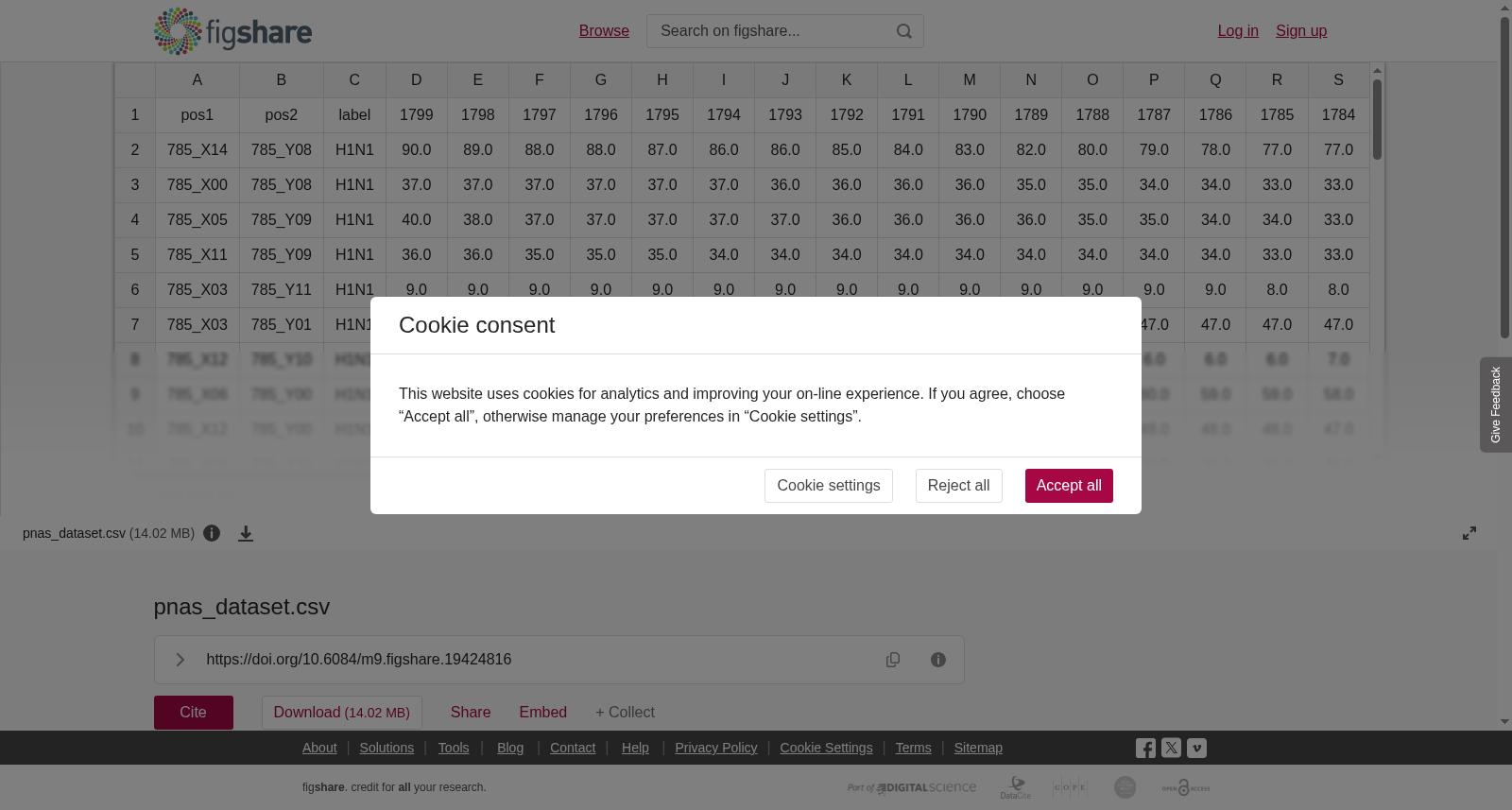
pnas_dataset.csv
收藏DataCite Commons2025-06-01 更新2024-07-29 收录
下载链接:
https://figshare.com/articles/dataset/pnas_dataset_csv/19424816/1
下载链接
链接失效反馈官方服务:
资源简介:
The dataset is acquired via the VIRRION platform designed for label-free capture and enrichment of viruses. It consists of Raman spectra of three groups of RNA viruses, including human respiratory viruses (influenza A H1N1 and H3N2, influenza B, rhinovirus, respiratory syncytial virus (RSV)), avian respiratory viruses (influenza A H5N2 and H7N2, infectious bronchitis virus (IBV), reovirus), and human enteroviruses (Coxsackievirus B type 1 and 3 (CVB1, CVB3), enteroviruses EV70 and EV71). Avian influenza virus (AIV) was propagated in specific-pathogen-free (SPF) embryonating chicken eggs (ECE) via allantoic cavity route inoculation at 9-11 days of age. The inoculated ECEs were incubated in a 37°C egg incubator for 3d (or 72 h) and then were removed/chilled at 4 °C for a minimum of 4 h or overnight. Allantoic fluid (AF) containing the virus was harvested from each egg using a sterile technique (a 3 mL sterile syringe with a 25G×5/8” needle). The harvested AF was clarified by centrifugation at 8000-1000 rpm for 10 min. Virus titer was determined in embryo infectious doses 50% (EID50) titers by the Reed-Muench method. Briefly, the EID50 test was conducted in ECE. The propagated fresh stock H5N2 AIV was prepared in 10-fold serial dilutions from 10-1 through 10-9. Each dilution was inoculated into 5 eggs, 0.1 mL per egg. The inoculated eggs were incubated at 37 °C for 72 hours. The eggs were candled daily to remove dead eggs to chill them at 4 °C refrigerator. After 72 hours of incubation, allantoic fluid was harvested from each egg. H1N1, H3N2, FluB, Rhinovirus, and RSV were prepared in Madin-Darby canine kidney-London (MDCK-London) cell culture. MDCK-London cells were cultured in Dulbecco's modified Eagle's medium (DMEM; Invitrogen, Carlsbad, CA) containing 10% fetal bovine serum and 1% penicillin-streptomycin, and incubated at 37°C in a humidified CO2 incubator. Enteroviruses (CVB1, CVB3, EV70, EV71, or PV2) were propagated using HEK 293 cell lines. The VIRRION platform constructed with nitrogen-doped carbon nanotube arrays and gold (Au) nanoparticles was used as SERS substrate for collecting Raman spectra from virus samples. A 100 μL sample of each virus was directly dropped (drop-cast) onto the VIRRION Au-CNT substrate and air-dried at room temperature for 10 hrs prior to Raman measurements. Raman data acquisition was recorded using a Horiba-LabRAM HR Evolution system with a 785nm diode laser line. The laser power on the sample was ca. 3.6 mW, focused through a 100× objective. The 600 gr/mm grating was used with a spectral range from 500 cm-1 to 2000 cm-1. The typical acquisition time was 30 s. <br>
本数据集通过专为无标记捕获与富集病毒设计的VIRRION平台获取。该数据集包含三组RNA病毒(RNA virus)的拉曼光谱(Raman spectra),分别为人类呼吸道病毒:甲型流感病毒H1N1(influenza A H1N1)、H3N2(influenza A H3N2)、乙型流感病毒(influenza B)、鼻病毒(rhinovirus)、呼吸道合胞病毒(respiratory syncytial virus, RSV);禽类呼吸道病毒:甲型流感病毒H5N2(influenza A H5N2)、H7N2(influenza A H7N2)、传染性支气管炎病毒(infectious bronchitis virus, IBV)、呼肠孤病毒(reovirus);以及人类肠道病毒:柯萨奇病毒B型1型(Coxsackievirus B type 1, CVB1)、3型(Coxsackievirus B type 3, CVB3)、肠道病毒EV70(enterovirus EV70)、EV71(enterovirus EV71)。
禽流感病毒(avian influenza virus, AIV)通过尿囊腔接种途径,在9~11日龄的无特定病原体(specific-pathogen-free, SPF)受精鸡胚(embryonating chicken eggs, ECE)中增殖。接种后的受精鸡胚置于37℃卵孵箱中培养3天(即72小时),随后取出并置于4℃冰箱冷藏至少4小时或过夜。采用无菌操作(使用3mL无菌注射器搭配25G×5/8号针头)从每枚鸡胚中收集含病毒的尿囊液(allantoic fluid, AF)。收集得到的尿囊液经8000~1000 rpm离心10分钟以澄清。采用Reed-Muench法测定病毒的50%鸡胚感染量(embryo infectious doses 50%, EID50)效价。具体而言,EID50检测在受精鸡胚中开展:将增殖得到的新鲜H5N2型禽流感病毒原液进行10倍系列稀释,稀释梯度为10^-1至10^-9;每个稀释梯度接种5枚鸡胚,每枚接种0.1mL。接种后的鸡胚置于37℃培养72小时,每日通过照蛋检出死胚并将其置于4℃冰箱冷藏。培养72小时后,从每枚鸡胚中收集尿囊液。
H1N1、H3N2、乙型流感病毒、鼻病毒及呼吸道合胞病毒在Madin-Darby犬肾-伦敦株(Madin-Darby canine kidney-London, MDCK-London)细胞中培养制备。Madin-Darby犬肾-伦敦株细胞在含10%胎牛血清与1%青霉素-链霉素的达尔伯克改良伊格尔培养基(Dulbecco's modified Eagle's medium, DMEM;Invitrogen, Carlsbad, CA)中培养,培养条件为37℃、湿润二氧化碳培养箱。肠道病毒(CVB1、CVB3、EV70、EV71及PV2)采用HEK 293细胞系进行增殖。
本研究采用以氮掺杂碳纳米管阵列与金(gold, Au)纳米颗粒构建的VIRRION平台作为表面增强拉曼散射(surface-enhanced Raman scattering, SERS)基底,用于采集病毒样本的拉曼光谱。将每份100μL的病毒样本直接滴加(滴涂法,drop-cast)至VIRRION Au-CNT基底上,于室温下风干10小时后再开展拉曼检测。拉曼数据采集采用Horiba-LabRAM HR Evolution拉曼光谱仪,激发光源为785nm二极管激光器;样本处的激光功率约为3.6mW,通过100倍物镜聚焦;采用600线/毫米的光栅,光谱采集范围为500 cm^-1至2000 cm^-1;单次采集时长通常为30秒。
提供机构:
figshare创建时间:
2022-03-26
搜集汇总
数据集介绍
以上内容由遇见数据集搜集并总结生成

暂无相关数据集


