
LNDb CT 肺结节患者扫描数据集(训练)
收藏帕依提提2024-03-04 收录
下载链接:
https://www.payititi.com/opendatasets/show-26515.html
下载链接
链接失效反馈官方服务:
资源简介:
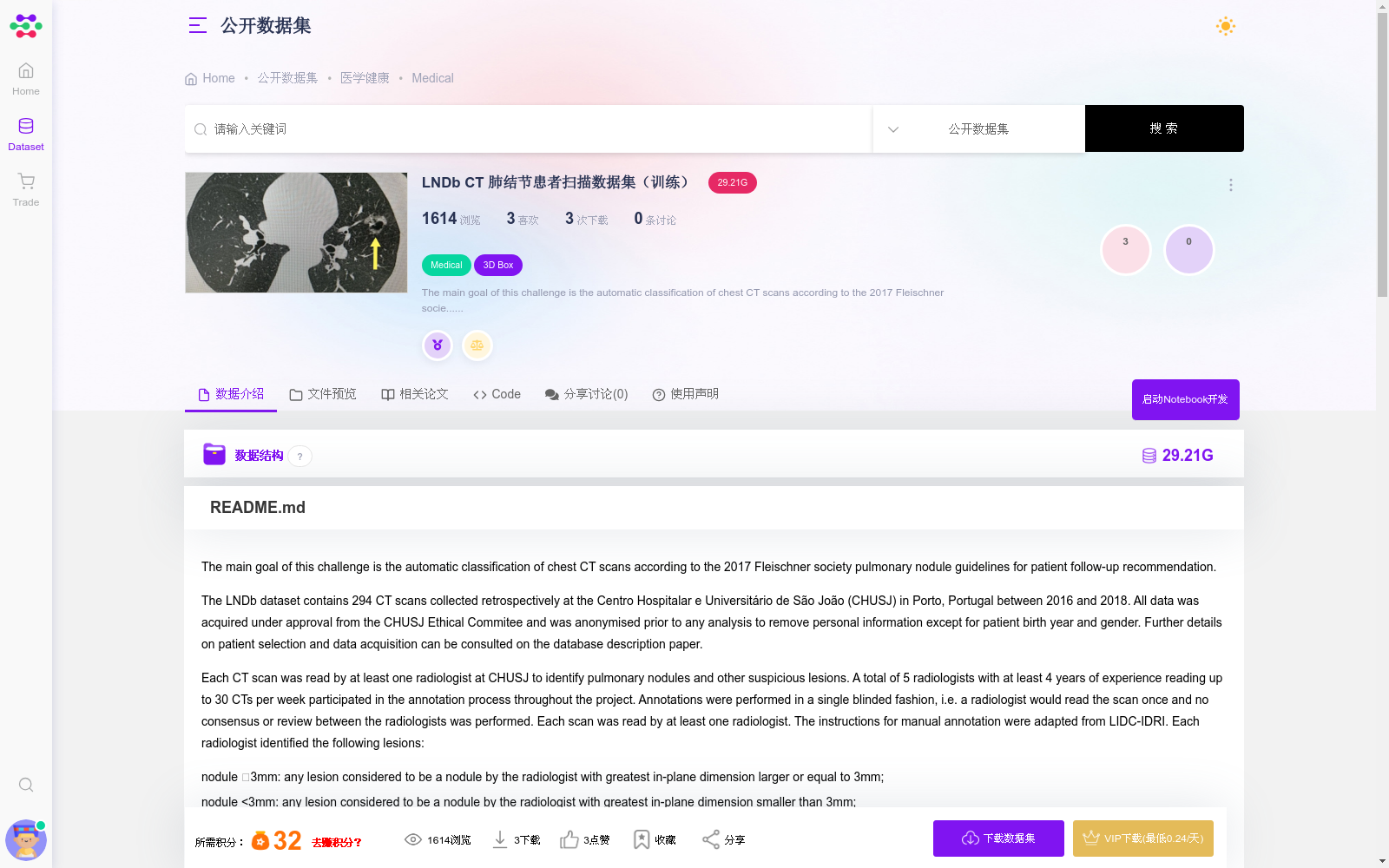
The main goal of this challenge is the automatic classification of chest CT scans according to the 2017 Fleischner society pulmonary nodule guidelines for patient follow-up recommendation. The LNDb dataset contains 294 CT scans collected retrospectively at the Centro Hospitalar e Universitário de São João (CHUSJ) in Porto, Portugal between 2016 and 2018. All data was acquired under approval from the CHUSJ Ethical Commitee and was anonymised prior to any analysis to remove personal information except for patient birth year and gender. Further details on patient selection and data acquisition can be consulted on the database description paper. Each CT scan was read by at least one radiologist at CHUSJ to identify pulmonary nodules and other suspicious lesions. A total of 5 radiologists with at least 4 years of experience reading up to 30 CTs per week participated in the annotation process throughout the project. Annotations were performed in a single blinded fashion, i.e. a radiologist would read the scan once and no consensus or review between the radiologists was performed. Each scan was read by at least one radiologist. The instructions for manual annotation were adapted from LIDC-IDRI. Each radiologist identified the following lesions: The annotation process varied for the different categories. Nodules ⩾3mm were segmented and subjectively characterized according to LIDC-IDRI (ratings on subtlety, internal structure, calcification, sphericity, margin, lobulation, spiculation, texture and likelihood of malignancy). For a complete description of these characteristics the reader is referred to McNitt-Gray et al.. For nodules <3mm the nodule centroid was marked and subjective assessment of the nodule's characteristics was performed. For non-nodules, only the lesion centroid was marked. Given that different radiologists may have read the same CT and no consensus review was performed, variability in radiologist annotations is expected. Note that from the 294 CTs of the LNDb dataset, 58 CTs with annotations by at least two radiologists have been withheld for the test set, as well as the corresponding annotations. Terms: The dataset, or any data derived from it, cannot be given or redistributed under any circumstances to persons not belonging to the registered team. If the data in the dataset is remixed, transformed or built upon, the modified data cannot be redistributed under any circumstances; The dataset cannot be used for commercial purposed under any circumstances; Appropriate credit must be given to the authors any time this data is used, independent of purpose. Attribution must be done through citation of the database description paper (https://arxiv.org/abs/1911.08434) or (after publication) to the main challenge publication. Bibtex:
本次挑战赛的核心目标是依据2017年弗莱施纳学会(Fleischner Society)肺结节随访指南,对胸部CT扫描影像实现自动化分类,以辅助制定患者随访建议。
LNDb数据集共包含294例CT扫描影像,均为2016至2018年间于葡萄牙波尔图的圣若昂大学中心医院(Centro Hospitalar e Universitário de São João, CHUSJ)回顾性收集的病例数据。所有数据均已获得CHUSJ伦理委员会的审批,并在开展分析前完成匿名化处理,仅保留患者出生年份与性别信息。如需了解患者筛选流程与数据采集的更多细节,可查阅该数据库的描述论文。
每例CT扫描影像均由CHUSJ至少一名放射科医师阅片,以识别肺结节与其他可疑病灶。本次标注工作共有5名拥有至少4年阅片经验、每周可完成至多30例CT影像阅片的放射科医师参与。标注采用单盲模式实施:即每位放射科医师仅独立阅片一次,医师之间无需达成共识或开展复审。每份CT扫描影像均至少由一名放射科医师完成阅片。手动标注的操作指南改编自LIDC-IDRI数据集。
每位放射科医师需识别以下病灶:不同类别病灶的标注流程存在差异。对于直径≥3mm的结节,需对其进行分割,并参照LIDC-IDRI的标准对其进行主观特征评级,包括细微度、内部结构、钙化情况、球形度、边缘特征、分叶征、毛刺征、纹理特征以及恶性可能性评分。如需了解上述特征的完整定义,可参阅McNitt-Gray等人的相关研究。对于直径<3mm的小结节,仅需标记其中心位置,并完成结节特征的主观评估。对于非结节类病灶,仅需标记其中心位置即可。
鉴于不同放射科医师可能对同一例CT影像进行阅片,且未开展共识复审,因此放射科医师的标注结果存在一定变异性属于可预期的情况。请注意,在LNDb数据集的294例CT影像中,共有58例由至少两名放射科医师完成标注的影像及其对应标注结果被预留为测试集,未纳入其他使用环节。
使用条款:本数据集及其衍生数据,不得以任何形式提供或分发予未纳入注册团队的人员。若对本数据集进行重构、转换或基于其开展衍生研究,加工后的衍生数据同样不得以任何形式进行分发。本数据集不得用于任何商业用途。无论使用目的如何,但凡使用本数据集,均需向原作者致以恰当的致谢。致谢需通过引用该数据库描述论文(https://arxiv.org/abs/1911.08434)完成;若该论文已正式发表,则可引用本次挑战赛的主发表论文。
Bibtex:
提供机构:
帕依提提
搜集汇总
数据集介绍
背景与挑战
背景概述
LNDb CT肺结节患者扫描数据集(训练)是一个包含294例胸部CT扫描的医学影像数据集,专门用于肺结节自动分类研究。数据由专业放射科医师标注,包含不同尺寸结节的详细特征标注,但受严格使用限制(非商用/禁止二次分发)。
以上内容由遇见数据集搜集并总结生成


