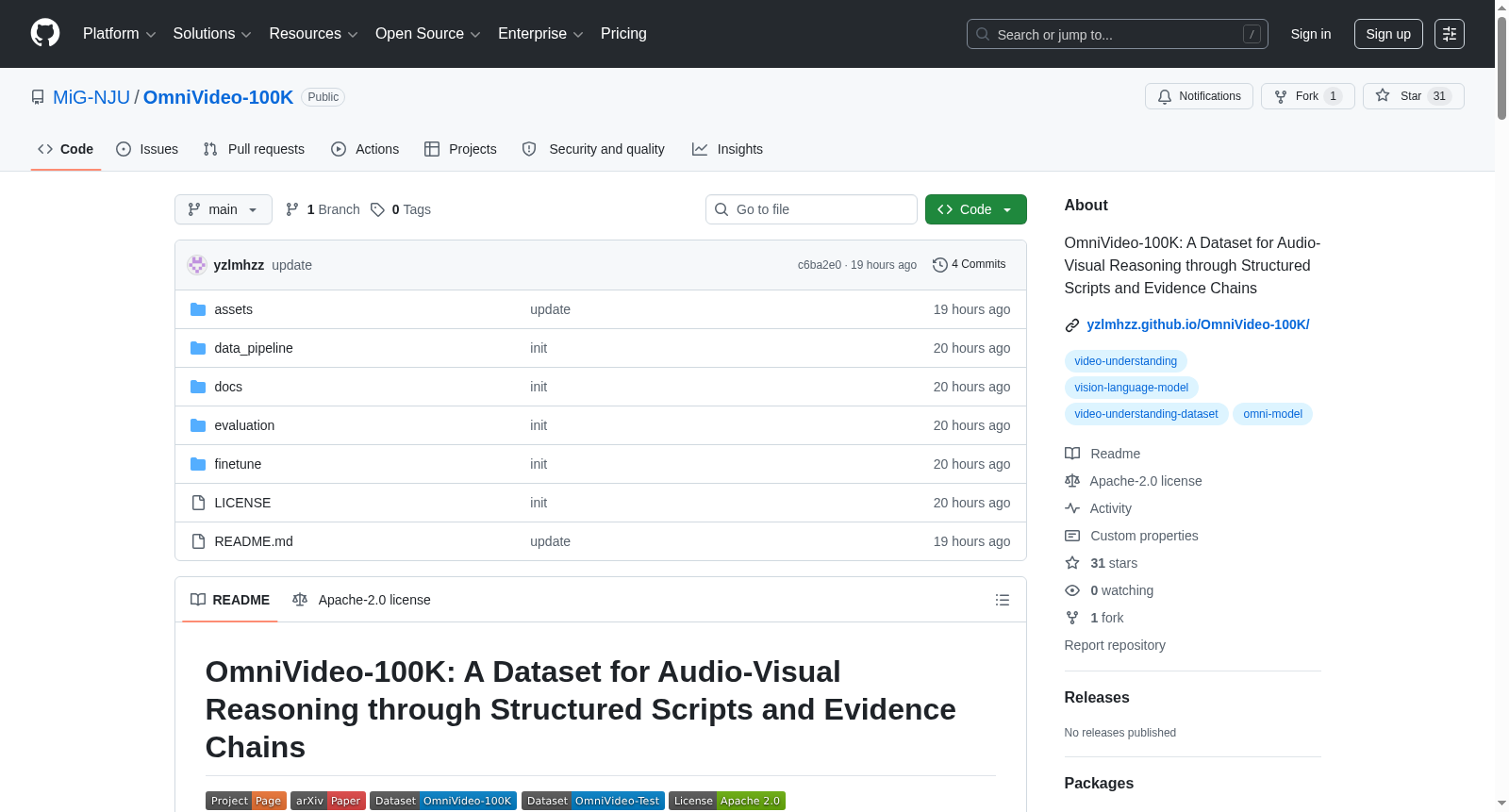
OmniVideo-100K
收藏资源简介:
OmniVideo-100K是由南京大学与中国科学院自动化研究所联合构建的大规模音频-视觉指令调优数据集,旨在通过结构化脚本与证据链促进跨模态深度推理。该数据集包含10万对自动生成的问答样本,源自5214个经过筛选的英文视频,涵盖vlog、新闻、卡通等七类真实场景,视频时长集中于1至3分钟,并均衡包含开放式与多项选择题型。其构建过程创新性地采用实体锚定脚本化与线索引导的问答生成两阶段自动化流程,首先将视频转化为包含摘要、实体列表及分段描述的结构化文本以保障叙事连贯性与声源关联,继而基于跨片段多模态线索生成具有长期时序依赖的复杂问答。该数据集主要应用于训练与评估多模态大语言模型在细粒度对齐、语义理解及因果推理等十类音频-视觉任务上的性能,致力于解决传统方法中存在的模态割裂、实体描述不一致及跨模态推理能力不足等核心问题。
OmniVideo-100K is a large-scale audio-visual instruction-tuning dataset jointly constructed by Nanjing University and the Institute of Automation, Chinese Academy of Sciences, aiming to promote cross-modal deep reasoning through structured scripts and evidence chains. This dataset comprises 100,000 automatically generated question-answer (QA) pairs, derived from 5,214 filtered English videos spanning seven real-world scenarios including vlogs, news, cartoons, etc. The video durations primarily range from 1 to 3 minutes, and the dataset evenly includes both open-ended and multiple-choice question types. Its construction innovatively adopts a two-stage automated pipeline: entity-anchored scripting and cue-guided QA generation. First, videos are converted into structured text containing summaries, entity lists and segmented descriptions to ensure narrative coherence and sound-source association. Subsequently, complex QA pairs with long-term temporal dependencies are generated based on cross-segment multimodal cues. This dataset is primarily used for training and evaluating multimodal large language models (LLMs) across ten categories of audio-visual tasks such as fine-grained alignment, semantic understanding and causal reasoning, and is dedicated to addressing core limitations of traditional methods, including modal disconnection, inconsistent entity descriptions and insufficient cross-modal reasoning capabilities.
数据集概述:OmniVideo-100K
OmniVideo-100K 是一个面向音视频推理的大规模指令微调数据集,旨在解决现有“视频-字幕-问答”流程中存在的模态偏差、时间错位和叙事不连贯问题。该数据集由论文 "OmniVideo-100K: A Dataset for Audio-Visual Reasoning through Structured Scripts and Evidence Chains" 提出。
核心机制
数据集构建基于一个全自动数据合成引擎,包含两个核心机制:
- 实体锚定视频脚本化:将原始视频转化为结构化的脚本式文本,包括摘要、主要实体列表以及带时间戳的分段音视频描述,确保跨段引用一致性和声源关联。
- 线索引导的问答生成:引导多模态大模型(MLLMs)首先从脚本中挖掘跨段和跨模态线索,然后生成具有长时间跨度和深度跨模态依赖的复杂问答对。
数据集构成
- OmniVideo-100K:大规模指令微调数据集。
- OmniVideo-Test:人工验证的测试集。
任务体系
数据集基于一个全面的认知框架设计,涵盖三个级别的 10 种 任务:
- 对齐:细粒度感知(FGP)、场景变换检测(STD)
- 理解:上下文理解(CU)、比较(CP)、情感分析(SA)、事件序列排序(ESO)、总结(SM)
- 推理:因果推理(CR)、未来预测(FP)、假设推理(HR)
目录结构要求
数据集(以 <root_path> 为根目录)的标准结构如下:
<root_path>/ ├── videos/ │ └── ori/ # 原始视频文件 (.mp4) ├── pre_files/ │ └── final_videos_list.jsonl # 经过筛选的视频列表(含时长与路径) ├── script_files/ # 中间生成的脚本文件 ├── script.jsonl # 最终整合的结构化脚本 └── qa_files/ # 生成的开放型与多选题问答对
基准测试性能
在 OmniVideo-100K 上微调的模型在外部音视频基准(如 Daily-Omni, JointAVBench)上表现出一致的性能提升,同时在通用视频基准(如 Video-MME)上保持了原有能力。
在 OmniVideo-Test 上的主要结果:
| 模型 | 参数量 | 总体 | 对齐 | 理解 | 推理 | (0, 2]分钟 | (2, 5]分钟 |
|---|---|---|---|---|---|---|---|
| Ours (Qwen3-Omni) | 30B | 63.56% | 60.34% | 67.05% | 59.54% | 62.11% | 64.24% |
| Ours (VITA-1.5) | 8B | 61.58% | 59.48% | 63.18% | 60.31% | 59.01% | 62.79% |
| Ours (Qwen2.5-Omni) | 7B | 60.59% | 62.93% | 62.40% | 54.96% | 54.66% | 63.37% |
数据获取与许可
- 项目主页:https://yzlmhzz.github.io/OmniVideo-100K/
- 论文地址:https://arxiv.org/abs/2606.14702
- 数据集下载:
- OmniVideo-100K:https://huggingface.co/datasets/MiG-NJU/OmniVideo-100K
- OmniVideo-Test:https://huggingface.co/datasets/MiG-NJU/OmniVideo-Test
- 许可证:Apache 2.0