The Dorsal Hand Dataset For Recognition System
收藏资源简介:
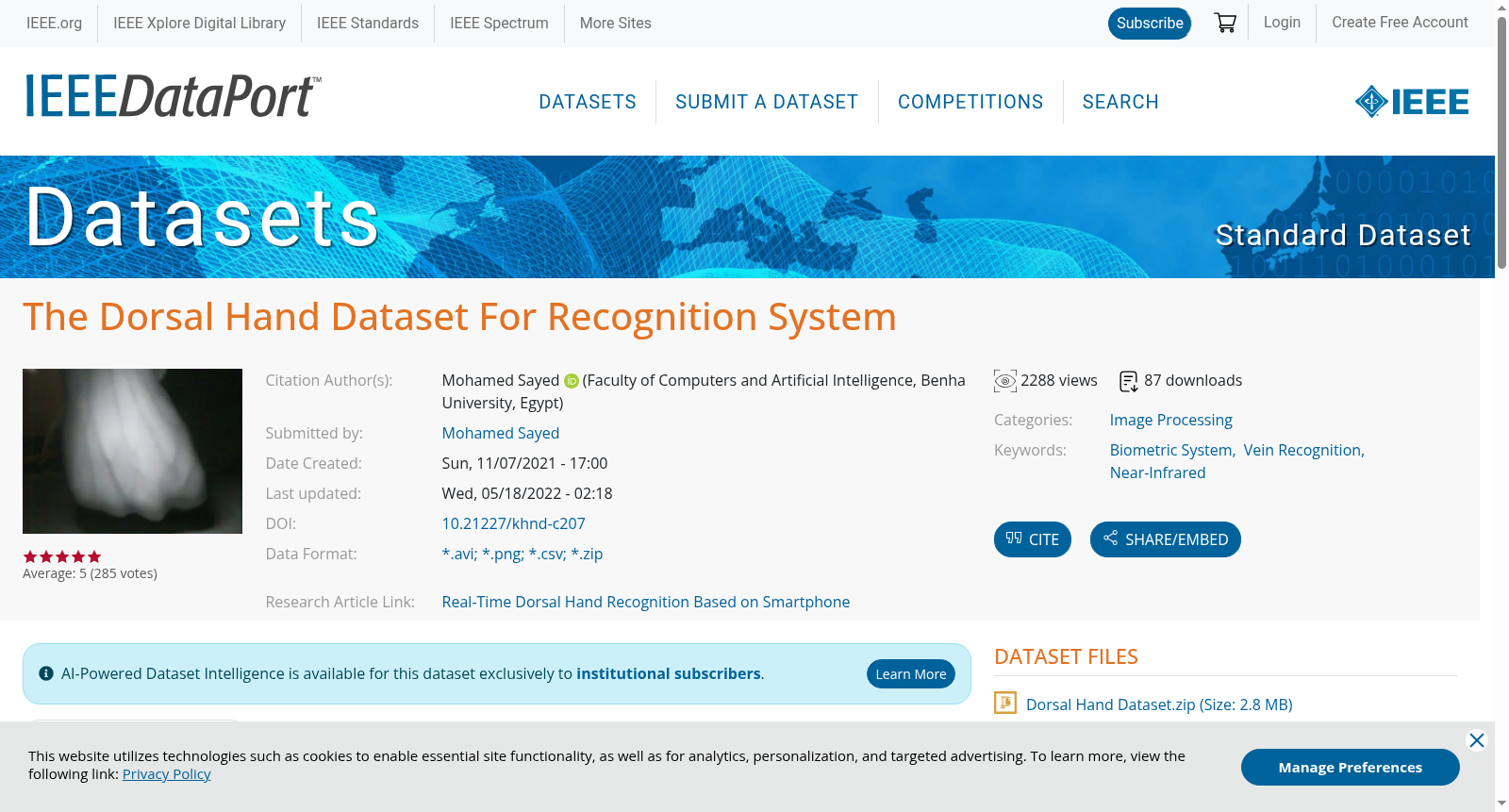
Researchers are becoming increasingly interested in dorsal hand vein biometrics because of their characteristics. These characteristics can be summarized as follows: it does not need contact with the capture device, cannot be forged, does not change over time, and provides high accuracy. Recognition systems of the dorsal hand rely on how the collected images captured from the device are good. Near-infrared (NIR) light is used to distinguish veins from the back of the hand.Contactless hardware was used to capture images of the proposed system. The hardware consists of three components: a USB camera, infrared LEDs, and a mobile smartphone. The USB-Camera has a resolution of 640×480 pixels and was modified to be sensitive to infrared light by removing the infrared cut-off filter and placing another one made of a magnetic film that only wavelengths above 700 nm can pass. For illumination, 20 infrared LEDs were mounted on a test board and connected to a power supply. The dorsal hand is illuminated with infrared LEDs, and the camera starts capturing frames and sends them to the smartphone mobile via the On-The-Go cable (OTG) for further processing.
研究人员因手背静脉生物特征识别(dorsal hand vein biometrics)的独特特性,对其关注度与日俱增。该类生物特征的优势可总结如下:无需接触采集设备、难以伪造、不会随时间发生变化,且识别精度优异。手背静脉识别系统的性能优劣,取决于设备采集图像的质量高低。近红外(Near-infrared, NIR)光可用于区分手背静脉与周边组织。本研究提出的系统采用非接触式硬件采集图像,该硬件包含三个组成部分:USB摄像头(USB Camera)、红外发光二极管(Light Emitting Diode, LED)以及移动智能手机。该USB摄像头分辨率为640×480像素,为使其可响应红外光,研究人员移除了原有的红外截止滤光片(infrared cut-off filter),并加装了一款由磁性薄膜制成的滤光片,该滤光片仅允许700纳米以上的波长光线透过。在照明环节,20颗红外发光二极管被安装于测试电路板上,并连接至电源。手背由红外发光二极管进行照明,随后摄像头开始采集帧图像,并通过OTG(On-The-Go)数据线将图像传输至智能手机,以开展后续处理。