
Metallothioneins bind metals
收藏reactome.org2025-01-21 收录
下载链接:
https://reactome.org/PathwayBrowser/#/R-HSA-5661231
下载链接
链接失效反馈官方服务:
资源简介:
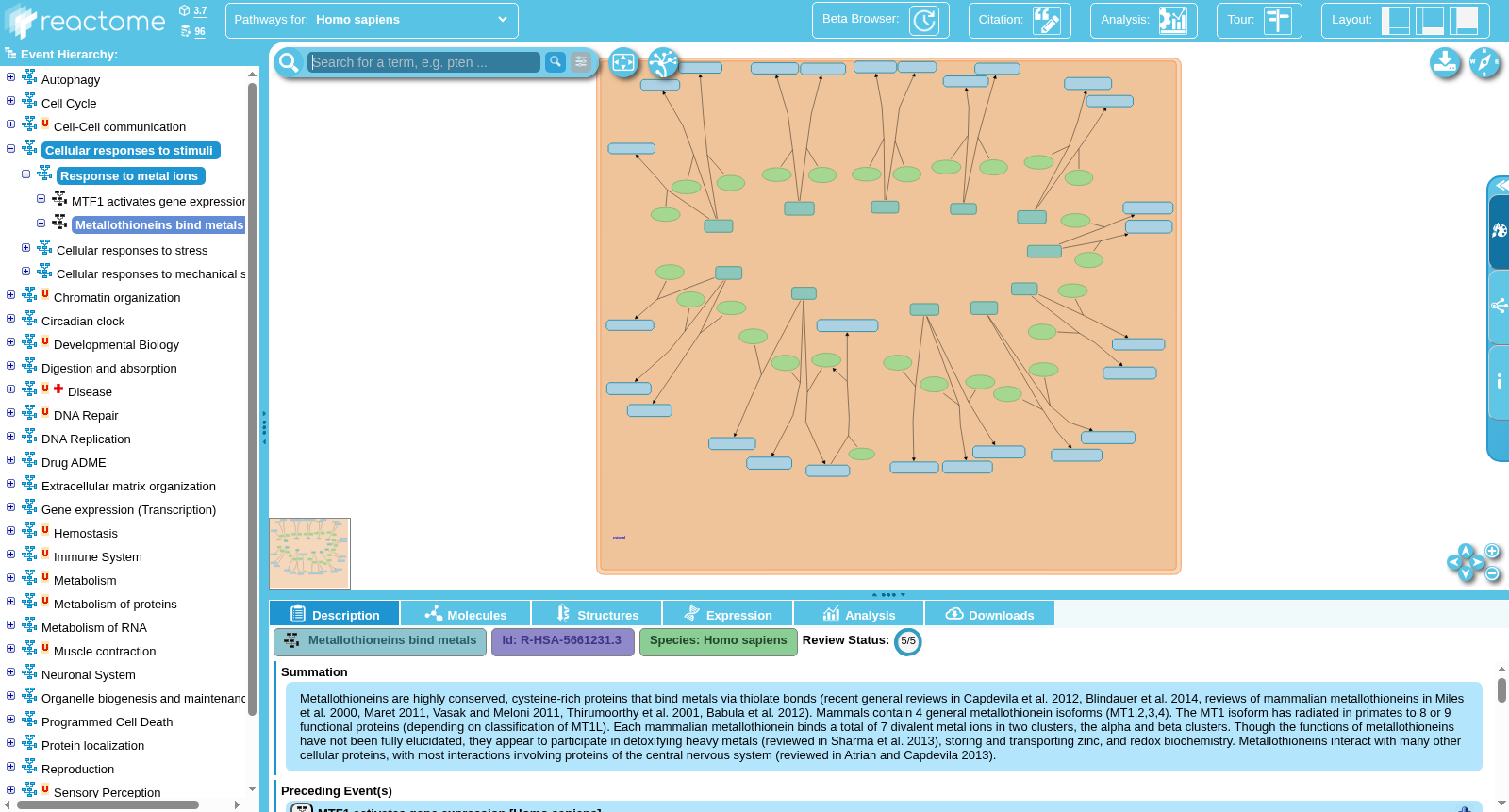
Metallothioneins are highly conserved, cysteine-rich proteins that bind metals via thiolate bonds (recent general reviews in Capdevila et al. 2012, Blindauer et al. 2014, reviews of mammalian metallothioneins in Miles et al. 2000, Maret 2011, Vasak and Meloni 2011, Thirumoorthy et al. 2001, Babula et al. 2012). Mammals contain 4 general metallothionein isoforms (MT1,2,3,4). The MT1 isoform has radiated in primates to 8 or 9 functional proteins (depending on classification of MT1L). Each mammalian metallothionein binds a total of 7 divalent metal ions in two clusters, the alpha and beta clusters. Though the functions of metallothioneins have not been fully elucidated, they appear to participate in detoxifying heavy metals (reviewed in Sharma et al. 2013), storing and transporting zinc, and redox biochemistry. Metallothioneins interact with many other cellular proteins, with most interactions involving proteins of the central nervous system (reviewed in Atrian and Capdevila 2013).
金属硫蛋白是一类高度保守、富含半胱氨酸的蛋白质,通过巯基阴离子键与金属结合(参见 Capdevila 等人 2012 年、Blindauer 等人 2014 年的最新综述,Miles 等人 2000 年、Maret 2011 年、Vasak 和 Meloni 2011 年关于哺乳动物金属硫蛋白的综述,Thirumoorthy 等人 2001 年、Babula 等人 2012 年的研究)。哺乳动物含有四种主要的金属硫蛋白同型异构体(MT1,2,3,4)。MT1 同型异构体在灵长类动物中已分化为 8 或 9 种功能蛋白(具体数量取决于 MT1L 的分类)。每种哺乳动物的金属硫蛋白可以与两个簇(α簇和β簇)中的 7 个二价金属离子结合。尽管金属硫蛋白的功能尚未完全阐明,但它们似乎参与重金属解毒(参见 Sharma 等人 2013 年的综述)、锌的储存和运输以及氧化还原生物化学。金属硫蛋白与许多其他细胞蛋白相互作用,其中大多数相互作用涉及中枢神经系统的蛋白(参见 Atrian 和 Capdevila 2013 年的综述)。
提供机构:
Reactome
搜集汇总
数据集介绍
背景与挑战
背景概述
该数据集详细描述了金属硫蛋白(Metallothioneins)的结构和功能,特别是它们如何通过硫醇盐键结合金属,并参与重金属解毒、锌的储存和运输以及氧化还原生物化学。数据集还涵盖了哺乳动物中四种主要的金属硫蛋白亚型及其在神经系统中的相互作用。
以上内容由遇见数据集搜集并总结生成



