
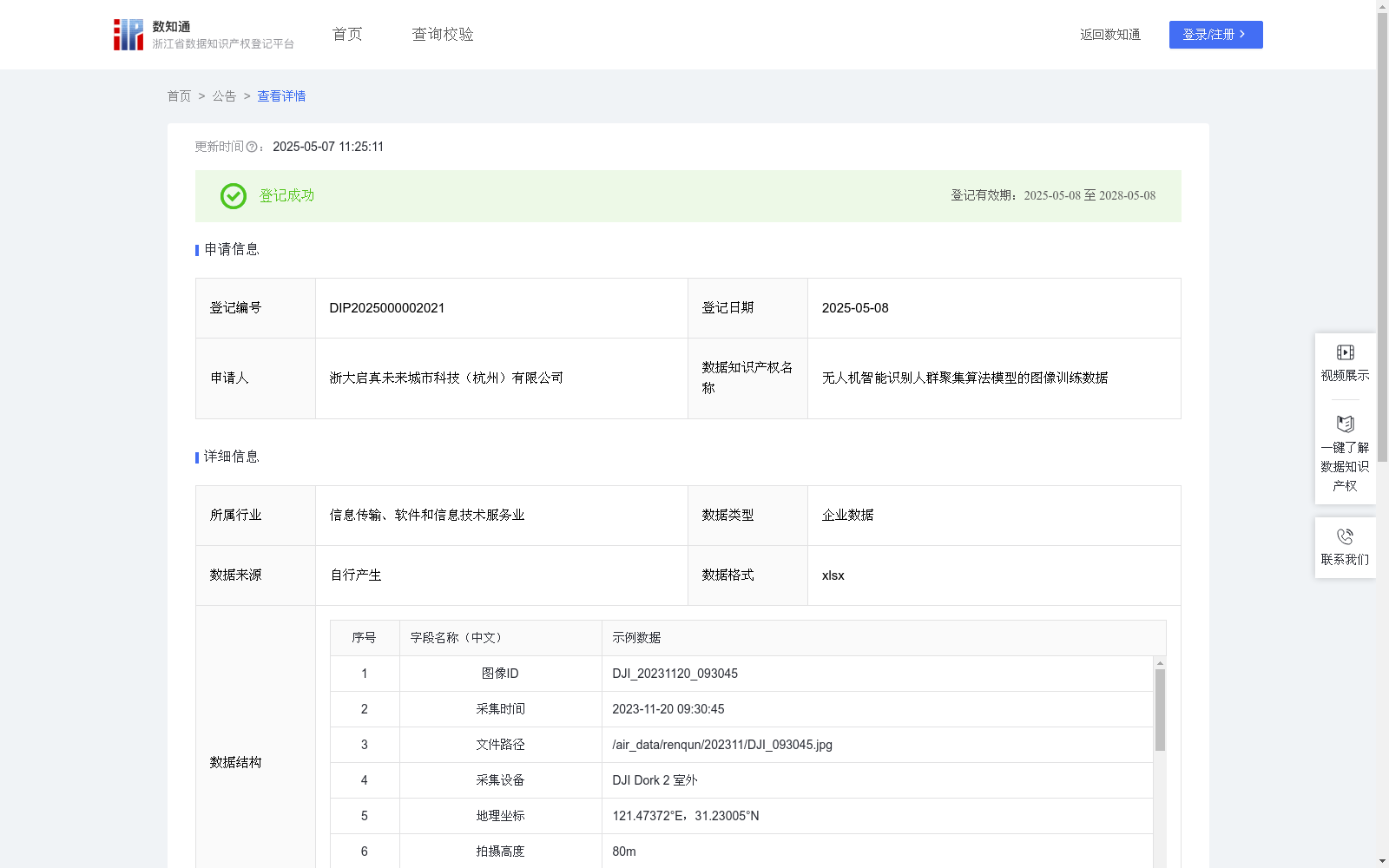
无人机智能识别人群聚集算法模型的图像训练数据
收藏浙江省数据知识产权登记平台2025-05-07 更新2025-05-08 收录
下载链接:
https://www.zjip.org.cn/home/announce/trends/127894
下载链接
链接失效反馈官方服务:
资源简介:
无人机智能识别人群聚集算法模型的图像训练数据的应用场景主要集中在提升AI模型对人群聚集的识别能力和准确度。通过对这些数据的训练,AI模型能够更有效地支撑无人机在城市公共安全治理中的智能监测应用。基于地理坐标与三级标注体系,AI模型可精准识别突发事件、商业活动、交通滞留等人群聚集场景,可用于支撑实现与城市客流预警系统的数据联动,满足如重大活动安保、节假日人流管控、应急疏散指挥等城市精细化治理需求。1、数据来源:原始数据通过自有智能无人机拍摄采集,记录图像ID、采集时间、文件路径、采集设备、地理坐标、拍摄高度、环境参数、边界框组等数据,通过数据清洗,保证数据质量。
2、数据预处理与标注:①对原始数据按7:2:1比例划分训练集/验证集/测试集;②采用多级标注体系:一级标签(聚集/正常)、二级标签(低密度/中密度/高密度)、三级标签(突发事件/商业活动/交通滞留等)。③标注关联要素包含公共设施、出入口位置等关键信息。
3、模型选择和初始化:采用YOLOv5预训练模型,并初始化模型参数,设置合理的超参数:学习率0.002-0.0001动态调整,批量大小16,锚框参数根据拍摄图像特征优化;同时集成注意力机制增强小目标检测能力。
4、模型训练:使用PyTorch框架实施分布式训练,设置训练时长,采用迁移学习策略,冻结底层特征提取层参数,引入Mosaic数据增强提升复杂场景适应能力,设置早停机制(patience=15)防止过拟合。
5、模型评估:① 构建多维评估体系:基础指标(mAP@0.5)、夜间检测率、误报率、漏报率。② 设置渐进式测试:单人群→多群体→建筑遮挡→特殊光照四阶段测试。
6、模型优化:优化推理引擎,保障推理速度,并建立区域特征库机制。
The application scenarios of the image training data for the UAV intelligent crowd gathering recognition algorithm model mainly focus on improving the recognition capability and accuracy of AI models for crowd gathering scenarios. Through training with this dataset, AI models can more effectively support intelligent monitoring applications of drones in urban public safety governance. Based on geographic coordinates and a three-level annotation system, the AI model can accurately identify crowd gathering scenarios such as emergencies, commercial activities, and traffic congestion, and can be used to support data linkage with urban passenger flow early warning systems, meeting the needs of refined urban governance including major event security, holiday pedestrian flow control, and emergency evacuation command.
1. Data Source: The original data is collected and captured by self-owned intelligent UAVs, recording information such as image ID, collection time, file path, collection equipment, geographic coordinates, shooting altitude, environmental parameters, and bounding box groups. Data cleaning is conducted to ensure data quality.
2. Data Preprocessing and Annotation:
① Divide the original data into training set, validation set and test set at a ratio of 7:2:1;
② Adopt a multi-level annotation system: first-level label (gathering/normal), second-level label (low density/medium density/high density), third-level label (emergency, commercial activity, traffic congestion, etc.);
③ Annotated associated elements include key information such as public facilities and entrance/exit locations.
3. Model Selection and Initialization: Adopt the pre-trained YOLOv5 model, initialize the model parameters, and set reasonable hyperparameters: dynamically adjust the learning rate between 0.002 and 0.0001, set the batch size to 16, optimize the anchor box parameters according to the characteristics of captured images; meanwhile, integrate the attention mechanism to enhance the detection capability of small targets.
4. Model Training: Implement distributed training using the PyTorch framework, set the training duration, adopt the transfer learning strategy by freezing the parameters of the underlying feature extraction layer, introduce Mosaic data augmentation to improve the adaptability to complex scenarios, and set an early stopping mechanism (patience=15) to prevent overfitting.
5. Model Evaluation:
① Build a multi-dimensional evaluation system including basic metrics (mAP@0.5), night detection rate, false positive rate and false negative rate;
② Conduct progressive testing in four stages: single crowd group → multiple crowd groups → building occlusion → special lighting conditions.
6. Model Optimization: Optimize the inference engine to ensure inference speed, and establish a regional feature database mechanism.
提供机构:
浙大启真未来城市科技(杭州)有限公司
创建时间:
2025-04-07
搜集汇总
数据集介绍
以上内容由遇见数据集搜集并总结生成



