
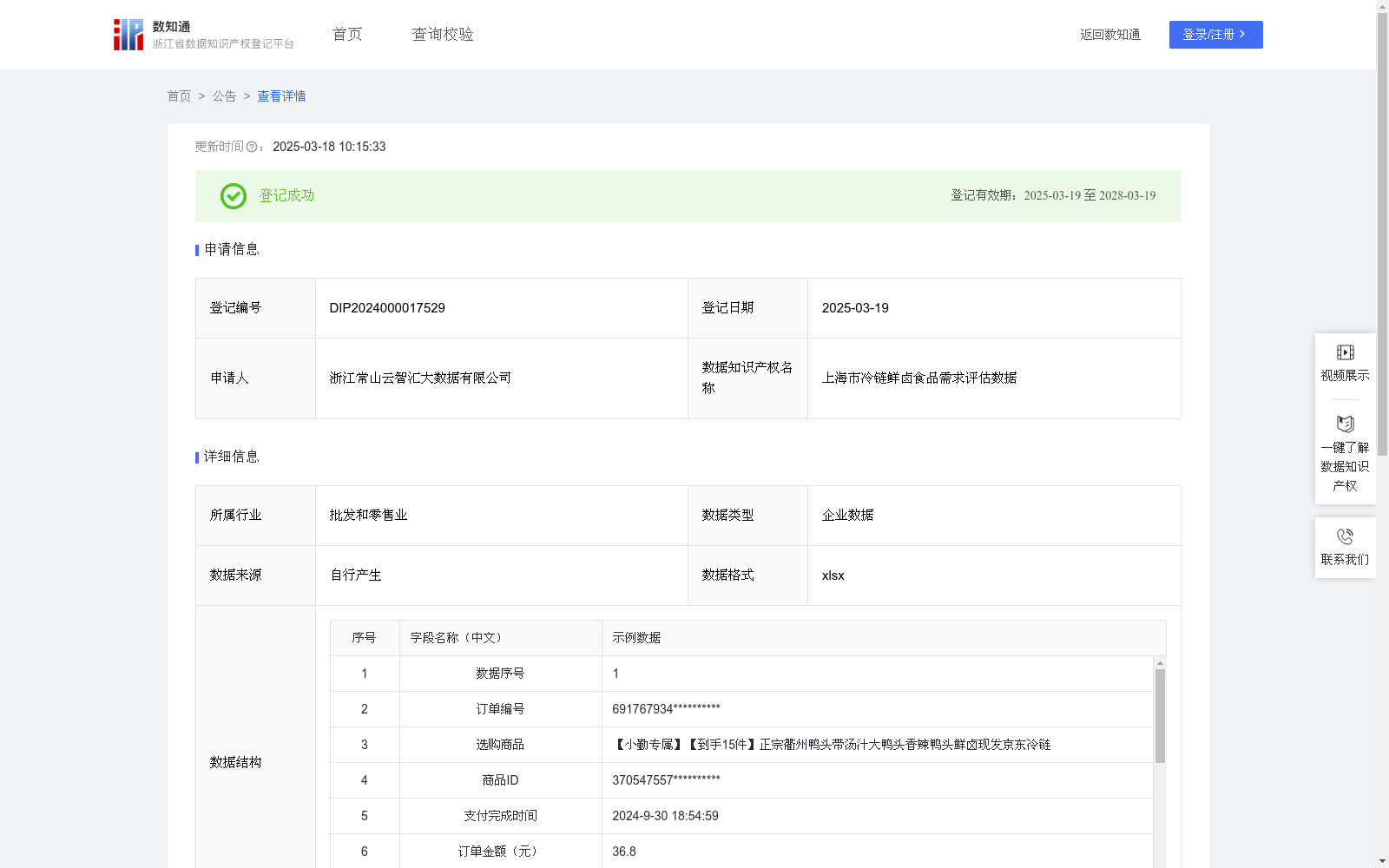
上海市冷链鲜卤食品需求评估数据
收藏浙江省数据知识产权登记平台2025-03-18 更新2025-03-19 收录
下载链接:
https://www.zjip.org.cn/home/announce/trends/117966
下载链接
链接失效反馈官方服务:
资源简介:
可用于产品投放、销售店铺、区域管理、个性化精准销售以及服务优化策略的制定;也可用于针对与行业相关、对区域消费行为与市场分析等场景有需求的企业、机构。通过收集和分析上海市对冷链鲜卤食品交易需求相关数据,了解各地区对冷链鲜卤食品的需求水平和消费偏好,针对高需求地区采用多备货,低需求地区减少库存等措施,从而为本行业的全链条企业制定生产销售策略提供数据支撑,更好地为客户提供个性化的商品和服务。(示例数据对一个区域进行展示,数据包内包含上海市全部拥有交易行为的地区)
1、数据采集:采集收货地址为上海市内区域的冷链鲜卤食品相关销售交易数据。2、数据处理,对采集到的数据进行分类、梳理,便于分析使用。3、算法加工:将处理后的数据进行分析:上海市平均订单金额=上海市销售额上海市订单总数量,某区域需求量指数P=(某区域销售总额/上海市平均订单金额)*(上海市订单总数量/上海市销售额),其中“上海市订单总数量/上海市销售额”是常数,用于将区域销售额转换为基于全上海市平均订单金额的需求量估算。数据为整理后状态,主要根据地区汇集,记录不完全按照时间先后顺序;鲜卤食品单价在各区域差异忽略不计,订单可能存在捆绑/拼单优惠,所以上海市总销售额/上海市订单总数量≠区域销售总额/区域销售数量,依据行业经验采用上海市平均订单金额进行标准化算法处理。4、数据分类分级复用:根据计算出的需求量水平,p>5.0记为高需求地区,1<P≤5.0记为中需求地区,1≥P记为低需求地区,根据地区等级安排更精准的生产营销策略,例如:当需要时,2023年关于上海市的需求评估数据,可以对2024年的铺货以及销售策略提供数据支持,加大高需求地区铺货量,降低低需求地区库存。注意:数据包内省、市、区等为区域划分,若一级名称为省,则二级划分到市,若一级划分区域为直辖市,则二级划分会出现xx区
This dataset can be applied to product launch, sales store operation management, regional management, personalized targeted sales, and the formulation of service optimization strategies. It is also suitable for enterprises and institutions that require industry-related regional consumer behavior analysis and market research scenarios. By collecting and analyzing data related to the transaction demand for cold-chain fresh marinated food in Shanghai, this dataset enables insights into the demand level and consumption preferences for cold-chain fresh marinated food across different regions. Measures such as increasing stock for high-demand regions and reducing inventory for low-demand regions can be implemented, providing data support for enterprises across the entire industry chain to formulate production and sales strategies, and delivering more personalized products and services to customers. (The sample data showcases one region, and the full data package includes all regions in Shanghai with transaction activities.)
1. Data Collection: Collect sales transaction data of cold-chain fresh marinated food with shipping addresses within the administrative regions of Shanghai.
2. Data Processing: Classify and organize the collected data to facilitate subsequent analysis and application.
3. Algorithm Processing: Analyze the processed data using the following formulas:
Shanghai Average Order Amount = Total Shanghai Sales Revenue / Total Number of Shanghai Orders;
Regional Demand Index P = (Total Regional Sales Revenue / Shanghai Average Order Amount) × (Total Number of Shanghai Orders / Total Shanghai Sales Revenue)
Here, the term "Total Number of Shanghai Orders / Total Shanghai Sales Revenue" acts as a constant to convert regional sales revenue into demand estimates based on the average order amount across Shanghai. The dataset is in a pre-processed state, primarily aggregated by region, and records are not ordered chronologically. Regional differences in the unit price of fresh marinated food are negligible. As orders may include bundle or group-buy discounts, the ratio of Total Shanghai Sales Revenue to Total Number of Shanghai Orders does not equal the ratio of Total Regional Sales Revenue to Total Regional Order Volume. Therefore, based on industry experience, the Shanghai average order amount is used for standardized algorithmic processing.
4. Data Classification, Grading and Reuse: Classify regions based on the calculated demand level: regions with P > 5.0 are categorized as high-demand regions, 1 < P ≤ 5.0 as medium-demand regions, and P ≤ 1 as low-demand regions. Develop targeted production and marketing strategies according to regional levels. For instance, the 2023 Shanghai demand assessment data can provide data support for 2024 product stocking and sales strategies: increase stocking volume in high-demand regions and reduce inventory in low-demand regions.
Note: The data package uses provincial, municipal, and district-level divisions for regional classification. If the first-level division is a province, the second-level divisions will be cities; if the first-level division is a municipality directly under the Central Government, the second-level divisions will be districts.
提供机构:
浙江常山云智汇大数据有限公司
创建时间:
2024-11-29
搜集汇总
数据集介绍
背景与挑战
背景概述
该数据集包含上海市冷链鲜卤食品的交易需求数据,涵盖订单、销售、区域需求指数等信息,用于分析消费偏好和制定销售策略。数据规模为681条,每年更新,适用于零售业的市场分析和策略优化。
以上内容由遇见数据集搜集并总结生成


