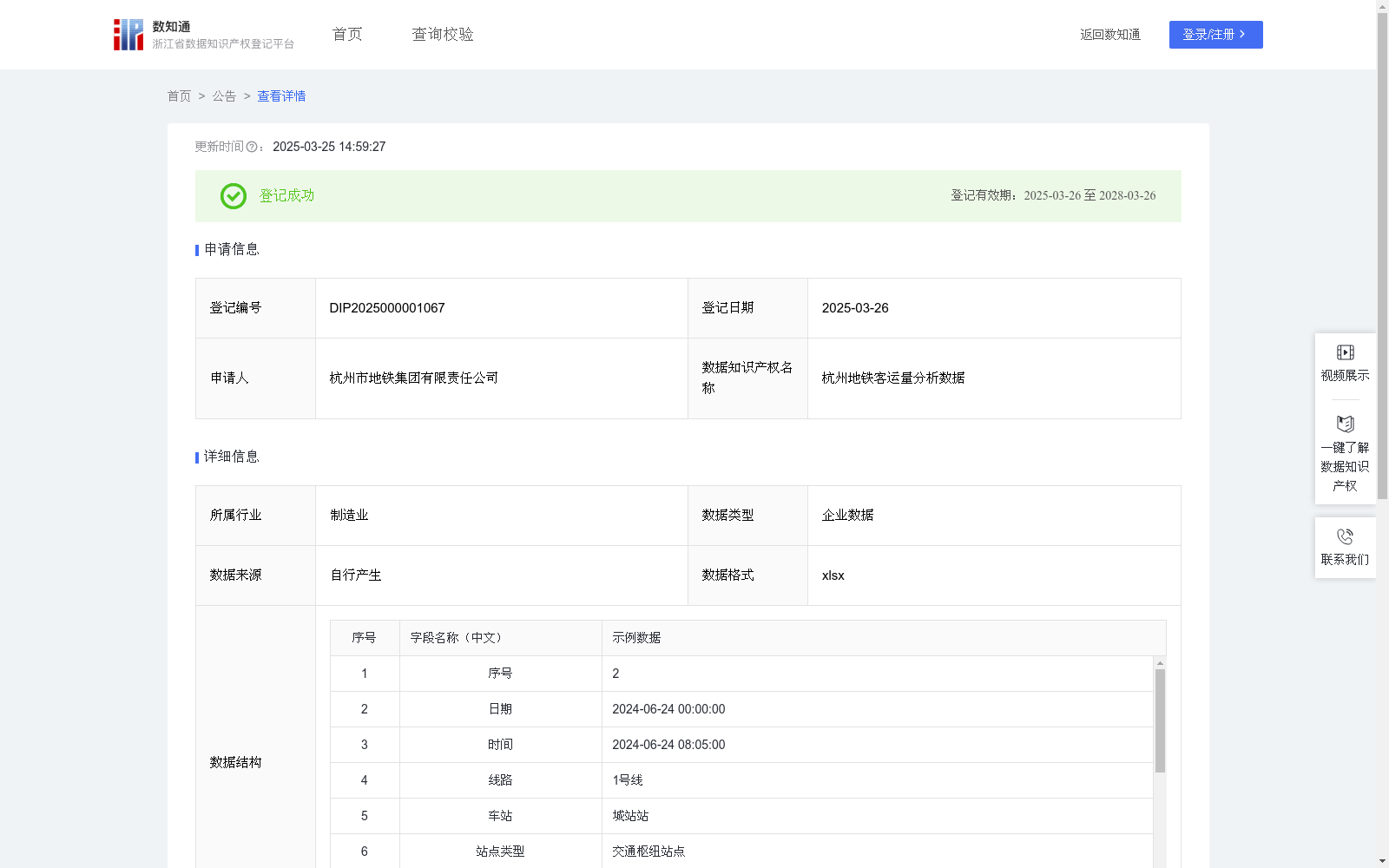
杭州地铁客运量分析数据
收藏资源简介:
通过分析不同线路、不同站点、不同时间段的进出站客运量数据,分析得到车站日均进站客运量、车站日均出站客运量,计算得出日均进出站客运量,形成有价值的客运量分析报告。可以为城市交通规划部门了解城市各区域的交通需求,为交通设施的建设和布局提供科学支持;为公交公司或单车公司优化线路设计、公交接驳、优化单车投放数量;为地铁运营公司优化列车运行计划,制定应急预案提供科学参考。城市规划与房地产:指导区域规划,预测开发潜力。此外,还可以应用于其他场景:(1)旅游与酒店:优化旅游路线,提升游客体验,调整定价和服务。(2)零售与广告:定位高人流区域,精准营销。(3)安全与应急:辅助疏散计划,提高响应效率。(4)教育与科研:支持城市交通研究,培养实践能力。(5)环保与可持续:鼓励公共交通使用,减少碳排放。(1)数据采集:自行采集杭州地铁各线路、各车站每五分钟的进站和出站客运量数据。 (2)数据处理:对数据进行脱敏处理,利用杭州地铁清分系统及相应的清分模型和算法将采集到的数据按照线路、车站统计、分析和汇总,得到不同车站的总进站量和总出站量,采用公式计算车站日均进站客运量和车站日均出站客运量: 1.车站日均进站客运量=总进站量*A/B(A为统计总时间,B为统计区间内时间,单位:分钟) 2.车站日均出站客运量=总出站量*A/B(A为统计总时间,B为统计区间内时间,单位:分钟) 3.日均进出站客运量=(车站日均进站客运量+车站日均出站客运量)/2 客运量越大,表明该线路该车站的人流量越多。
By analyzing inbound and outbound passenger volume data across different metro lines, stations and time periods, this dataset calculates the daily average inbound passenger volume, daily average outbound passenger volume, and daily average inbound-outbound passenger volume for each station, generating valuable passenger volume analysis reports. These reports can provide scientific support for urban transportation planning departments to understand regional transportation demands and guide the construction and layout of transportation facilities; assist bus companies or bike-sharing enterprises in optimizing route design, bus connections and bike deployment quantities; provide scientific references for metro operating companies to optimize train operation plans and formulate emergency response plans. For urban planning and real estate, it can guide regional planning and predict development potential. Additionally, it can be applied to other scenarios: 1. Tourism and hospitality: Optimize travel routes, enhance tourist experience, and adjust pricing and services. 2. Retail and advertising: Locate high-foot-traffic areas for precision marketing. 3. Safety and emergency: Assist evacuation planning and improve response efficiency. 4. Education and research: Support urban transportation research and cultivate practical abilities. 5. Environmental protection and sustainability: Promote public transit use and reduce carbon emissions. (1) Data collection: Self-collected 5-minute interval inbound and outbound passenger volume data of all stations on each line of Hangzhou Metro. (2) Data processing: Perform data desensitization on the collected data, use Hangzhou Metro's fare clearing system and corresponding fare clearing models and algorithms to count, analyze and aggregate the data by lines and stations, obtaining the total inbound and outbound passenger volume of each station. Calculate the daily average inbound and outbound passenger volume per station using the following formulas: 1. Daily average inbound passenger volume per station = Total inbound passenger volume * A/B (A is the total statistical time, B is the statistical interval time, unit: minute) 2. Daily average outbound passenger volume per station = Total outbound passenger volume * A/B (A is the total statistical time, B is the statistical interval time, unit: minute) 3. Daily average inbound-outbound passenger volume = (Daily average inbound passenger volume per station + Daily average outbound passenger volume per station) / 2 A larger passenger volume indicates a higher foot traffic at the corresponding station on its line.