
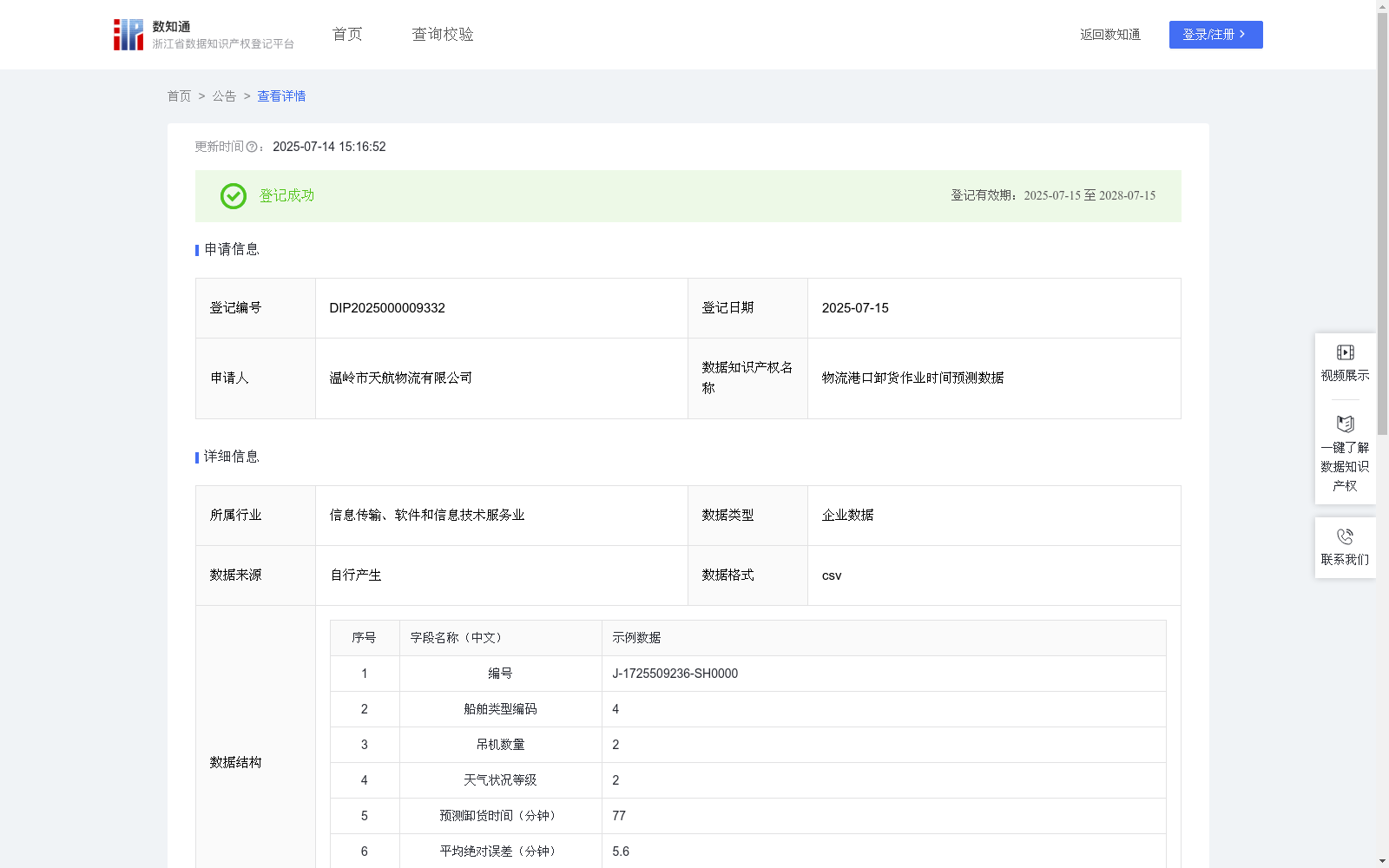
物流港口卸货作业时间预测数据
收藏浙江省数据知识产权登记平台2025-07-14 更新2025-07-15 收录
下载链接:
https://www.zjip.org.cn/home/announce/trends/148595
下载链接
链接失效反馈官方服务:
资源简介:
在港口卸货作业时间预测中具有重要的应用价值。能够提供自动时间预估,更精确地评估作业时长,帮助调度管理人员进行作业计划优化。在集装箱码头卸货作业中具有广泛的应用场景,特别是在多船同时作业、堆场资源有限调度和高峰卸货作业组织中,能够提高作业调度效率,降低设备等待时间,提供精准调度决策支持。数据收集:
本模型的数据来源包括港口作业记录系统、船舶管理系统和气象信息系统。每条样本包含编号、船舶类型编码(以整数表示不同类型的船舶,如散货船、集装箱船等)、作业吊机数量(表示投入作业的设备台数)、天气状况等级(按天气对作业影响程度编码,例如1为晴朗、5为大风或暴雨等恶劣天气),预测卸货时间为模型输出结果,平均绝对误差和均方根误差为评估指标。
数据预处理:
所有数值特征统一归一化至[0,1]区间,以防止特征量纲不一致影响训练效果。异常值(如天气等级超出设定范围)进行清洗,缺失数据使用历史平均值填充。样本按时间顺序划分训练集和测试集,保证时间一致性。
模型构建:
本算法基于多层感知机(Multi-Layer Perceptron, MLP)结构进行建模。输入特征包括船舶类型编码、吊机数量和天气状况等级,输出为预测卸货时间。模型结构由输入层、两个隐藏层和输出层组成,每层均使用ReLU激活函数,最后输出卸货时间的预测值。
核心计算过程如下:特征编码与隐层映射:Z = ReLU(W₁ × X + b₁)。其中,X为输入特征向量,包含船舶类型编码、吊机数量和天气状况等级;W₁和b₁为第一层的权重与偏置参数;ReLU为激活函数,Z为第一层输出的隐层特征。输出预测结果:T̂ = W₂ × Z + b₂。其中,T̂为模型预测的卸货时间(预测卸货时间),W₂和b₂为输出层权重与偏置。
预测结果与实际卸货时间之间的误差通过以下两个指标进行评估:平均绝对误差(MAE)= 平均值(|T̂ - T|)。均方根误差(RMSE) = 平方根(平均值((T̂ - T)²))。其中,T为实际卸货时间,T̂为模型预测值。
This work has important application value in port unloading operation time prediction. It can provide automatic time estimation, more accurately evaluate operation duration, and help scheduling managers optimize operation plans. It has a wide range of application scenarios in container terminal unloading operations, especially in multi-vessel simultaneous operation, yard resource limited scheduling and peak unloading operation organization, which can improve operation scheduling efficiency, reduce equipment waiting time, and provide accurate scheduling decision support.
Data Collection:
The data sources of this model include port operation record system, vessel management system and meteorological information system. Each sample contains the following fields: serial number, vessel type code (integers representing different vessel types, such as bulk carrier, container ship, etc.), number of operating cranes (indicating the number of equipment put into operation), weather condition level (encoded according to the impact of weather on operations, e.g., 1 represents sunny weather, 5 represents severe weather such as strong wind or heavy rain). The predicted unloading time is the model's output result, and mean absolute error and root mean square error are used as evaluation metrics.
Data Preprocessing:
All numerical features are uniformly normalized to the [0, 1] interval to prevent inconsistent feature dimensions from affecting training performance. Outliers (e.g., weather condition levels beyond the set range) are cleaned, and missing data is filled with historical average values. The samples are divided into training set and test set in chronological order to ensure temporal consistency.
Model Construction:
This algorithm is modeled based on the Multi-Layer Perceptron (MLP) structure. The input features include vessel type code, number of cranes, and weather condition level, and the output is the predicted unloading time. The model structure consists of an input layer, two hidden layers, and an output layer, with ReLU activation function used for each layer, finally outputting the predicted value of unloading time.
The core calculation process is as follows:
Feature encoding and hidden layer mapping: $Z = ext{ReLU}(W_1 imes X + b_1)$. Where $X$ is the input feature vector, including vessel type code, number of cranes, and weather condition level; $W_1$ and $b_1$ are the weight and bias parameters of the first layer; ReLU is the activation function, and $Z$ is the hidden layer feature output by the first layer.
Output prediction result: $hat{T} = W_2 imes Z + b_2$. Where $hat{T}$ is the unloading time predicted by the model, and $W_2$ and $b_2$ are the weights and biases of the output layer.
The error between the predicted result and the actual unloading time is evaluated using the following two metrics:
Mean Absolute Error (MAE) = $ ext{Average}(|hat{T} - T|)$.
Root Mean Square Error (RMSE) = $sqrt{ ext{Average}((hat{T} - T)^2)}$.
Where $T$ is the actual unloading time, and $hat{T}$ is the model's predicted value.
提供机构:
温岭市天航物流有限公司
创建时间:
2025-06-25
搜集汇总
数据集介绍
背景与挑战
背景概述
该数据集为物流港口卸货作业时间预测数据,包含5303条记录,涵盖船舶类型、吊机数量、天气状况等特征,用于预测卸货时间并优化调度。数据预处理和建模基于MLP算法,提供精准的作业时间预估和误差评估。
以上内容由遇见数据集搜集并总结生成



