
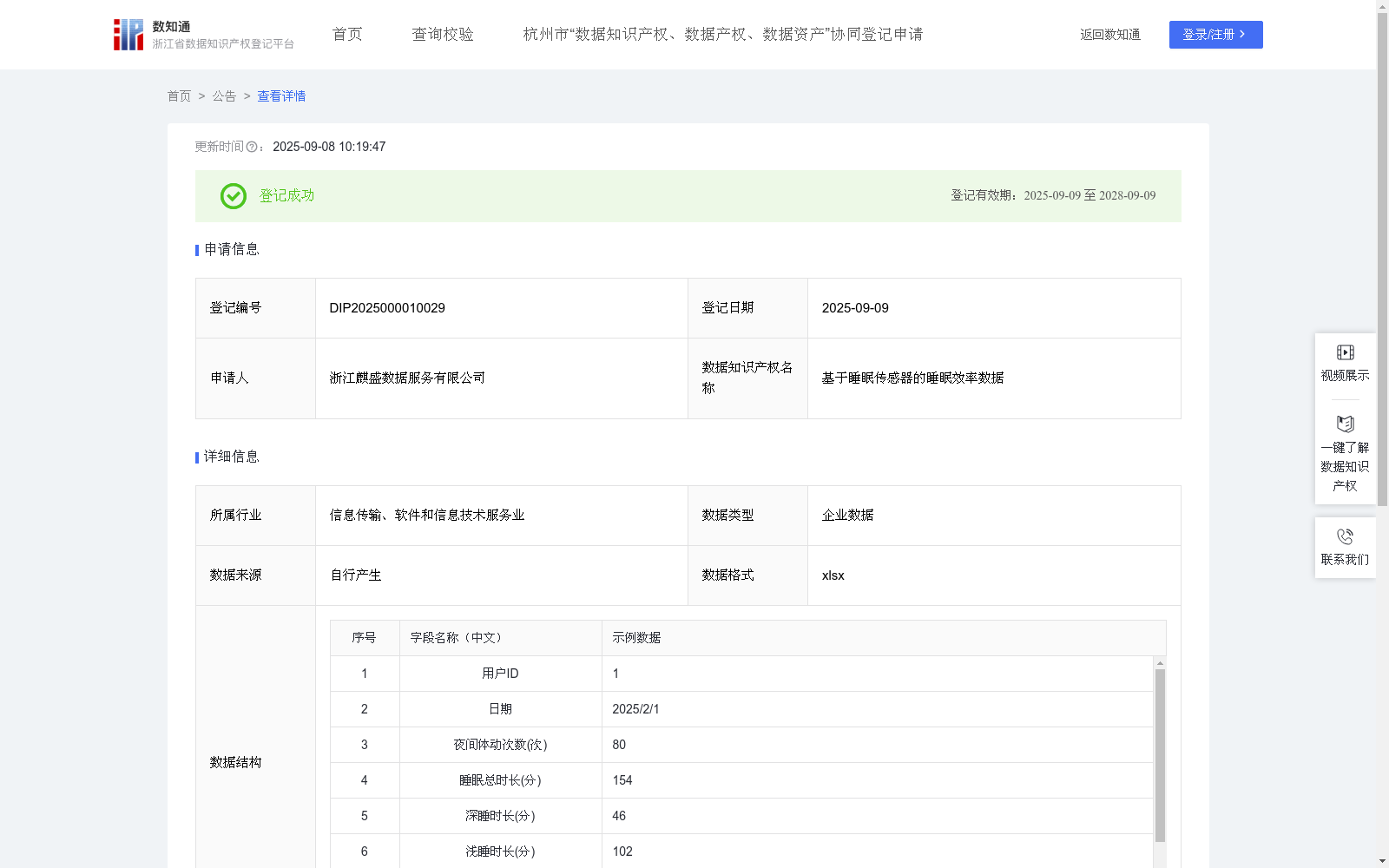
基于睡眠传感器的睡眠效率数据
收藏浙江省数据知识产权登记平台2025-09-08 更新2025-09-09 收录
下载链接:
https://www.zjip.org.cn/home/announce/trends/176412
下载链接
链接失效反馈官方服务:
资源简介:
基于睡眠传感器采集得到的用户睡眠数据,并在此基础上计算得到一些用户指标,将多个指标进行分析与信息融合,最终得到用于评价用户当晚睡眠的睡眠效率值。1)根据提供精确的睡眠质量监测和分析,帮助用户理解其睡眠模式、识别睡眠障碍或不规律行为,并通过数据支持个性化的睡眠优化建议。2)用户可根据近期趋势,及时发现健康隐患,并及时治疗。3)用户可根据该值不同的情况,自主制定相应健康调整计划。基本说明:
利用智能床的传感器,收集用户当晚夜间体动次数、睡眠总时长以及深睡时长数据。夜间体动次数是通过算法计算用户当晚体动的次数,睡眠总时长为从用户入睡到醒来的总时长(单位是分钟),深睡时长(单位是分钟)是通过心率呼吸等指标对数据进行分析处理得到的,睡眠效率是无量纲指标,因此无单位,度量用户当晚的睡眠效率。
算法流程:
首先,依据睡眠的性质,深睡较多并浅睡较长一般睡眠效率较好,由深睡时长加上浅睡时长除以睡眠总时长得到基础效率;其次,夜间体动次数通常会影响睡眠效率。体动次数较多可能意味着不深的睡眠,因此引入一个调整因子。调整因子=1-夜间体动次数/10*0.02得到;最终,综合基础效率和调整因子来计算最终的睡眠效率:睡眠效率=基础效率×调整因子,并保留两位小数。
User sleep data collected by sleep sensors is used to calculate multiple user metrics, followed by analysis and information fusion of these metrics, to finally obtain the sleep efficiency value for evaluating the user's sleep quality of that night. The specific functions are as follows:
1) It enables precise sleep quality monitoring and analysis, helping users understand their sleep patterns, identify sleep disorders or irregular behaviors, and provide personalized sleep optimization suggestions supported by data.
2) Users can detect potential health risks in a timely manner based on recent trends and receive prompt treatment.
3) Users can independently develop corresponding health adjustment plans based on different values of the sleep efficiency.
Basic Description:
Data on the number of nighttime body movements, total sleep duration, and deep sleep duration of the user that night are collected via the sensors of a smart bed. The number of nighttime body movements is calculated by an algorithm based on the user's body movements that night. Total sleep duration refers to the total time from the user falling asleep to waking up (unit: minute). Deep sleep duration (unit: minute) is obtained by analyzing and processing data through indicators such as heart rate and respiratory rate. Sleep efficiency is a dimensionless index without unit, which measures the user's sleep quality that night.
Algorithm Workflow:
First, based on the nature of sleep: more deep sleep and longer light sleep generally indicate better sleep efficiency. The basic efficiency is calculated by (deep sleep duration + light sleep duration) / total sleep duration. Second, the number of nighttime body movements usually affects sleep efficiency. A higher number of body movements may imply shallower sleep, so an adjustment factor is introduced. The adjustment factor is calculated as: adjustment factor = 1 - (number of nighttime body movements / 10) * 0.02. Finally, the final sleep efficiency is calculated by combining the basic efficiency and the adjustment factor: sleep efficiency = basic efficiency × adjustment factor, rounded to two decimal places.
提供机构:
浙江麒盛数据服务有限公司
创建时间:
2025-07-02
搜集汇总
数据集介绍
以上内容由遇见数据集搜集并总结生成



