
Online Device Usage Habits and Emotional Well-Being in Net Generation
收藏Mendeley Data2024-01-31 更新2024-06-26 收录
下载链接:
https://data.mendeley.com/datasets/856xgy2hy9
下载链接
链接失效反馈官方服务:
资源简介:
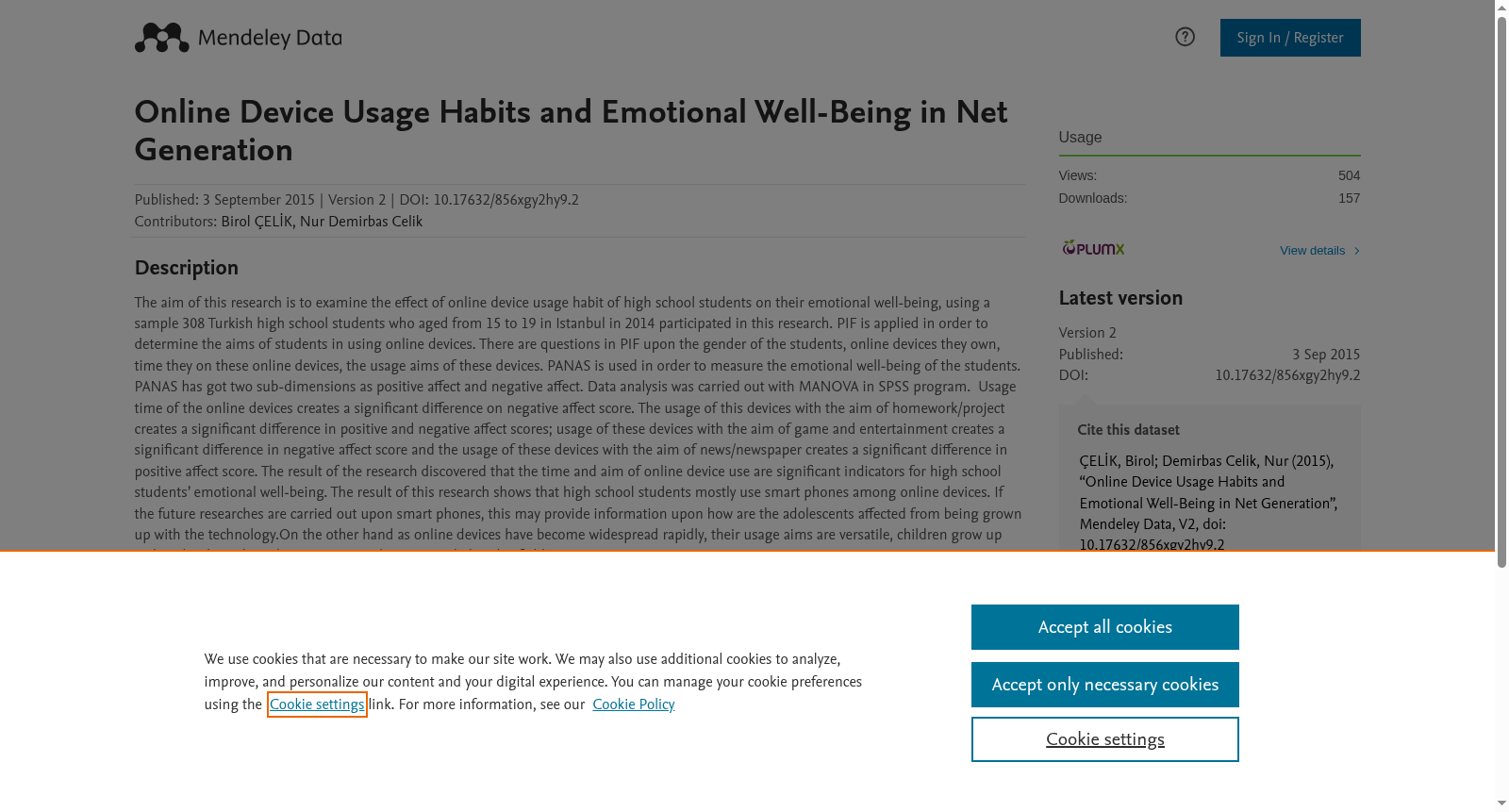
The aim of this research is to examine the effect of online device usage habit of high school students on their emotional well-being, using a sample 308 Turkish high school students who aged from 15 to 19 in Istanbul in 2014 participated in this research. PIF is applied in order to determine the aims of students in using online devices. There are questions in PIF upon the gender of the students, online devices they own, time they on these online devices, the usage aims of these devices. PANAS is used in order to measure the emotional well-being of the students. PANAS has got two sub-dimensions as positive affect and negative affect. Data analysis was carried out with MANOVA in SPSS program. Usage time of the online devices creates a significant difference on negative affect score. The usage of this devices with the aim of homework/project creates a significant difference in positive and negative affect scores; usage of these devices with the aim of game and entertainment creates a significant difference in negative affect score and the usage of these devices with the aim of news/newspaper creates a significant difference in positive affect score. The result of the research discovered that the time and aim of online device use are significant indicators for high school students’ emotional well-being. The result of this research shows that high school students mostly use smart phones among online devices. If the future researches are carried out upon smart phones, this may provide information upon how are the adolescents affected from being grown up with the technology.On the other hand as online devices have become widespread rapidly, their usage aims are versatile, children grow up with technology show that more researches are needed in this field.
本研究旨在探讨高中生在线设备使用习惯对其情绪幸福感的影响,研究纳入2014年伊斯坦布尔地区308名15至19岁的土耳其高中生作为研究样本。本研究采用个人使用动机量表(Personal Involvement with the Internet, PIF)以明确学生使用在线设备的目的,该量表包含学生性别、所持在线设备种类、设备使用时长及设备使用目的相关问题。本研究采用积极与消极情感量表(Positive and Negative Affect Schedule, PANAS)测量学生的情绪幸福感,该量表包含积极情感与消极情感两个子维度。数据分析采用SPSS软件中的多元方差分析(Multivariate Analysis of Variance, MANOVA)完成。研究结果显示,在线设备使用时长对学生的消极情感得分存在显著影响;以完成作业/项目为目的使用在线设备,对学生的积极与消极情感得分均存在显著影响;以游戏与娱乐为目的使用设备,仅对消极情感得分存在显著影响;而以获取新闻/资讯为目的使用设备,则仅对积极情感得分存在显著影响。本研究结果表明,在线设备的使用时长与使用目的是高中生情绪幸福感的重要预测指标。此外,本研究发现高中生在各类在线设备中最常使用智能手机。若未来研究聚焦于智能手机领域,将有助于揭示青少年在科技陪伴下成长所受的具体影响。另一方面,随着在线设备的快速普及,其使用目的愈发多元,伴随科技成长的青少年群体亟需更多相关领域的研究支撑。
创建时间:
2024-01-31
搜集汇总
数据集介绍
背景与挑战
背景概述
该数据集基于2014年308名土耳其高中生的调查,研究在线设备使用习惯与情绪健康之间的关系。研究发现,设备使用时间和目的(如作业、游戏、新闻)对积极和消极情绪得分有显著影响,其中智能手机是最常用设备。数据集强调了技术使用对青少年情绪健康的重要性,并呼吁未来更多相关研究。
以上内容由遇见数据集搜集并总结生成


