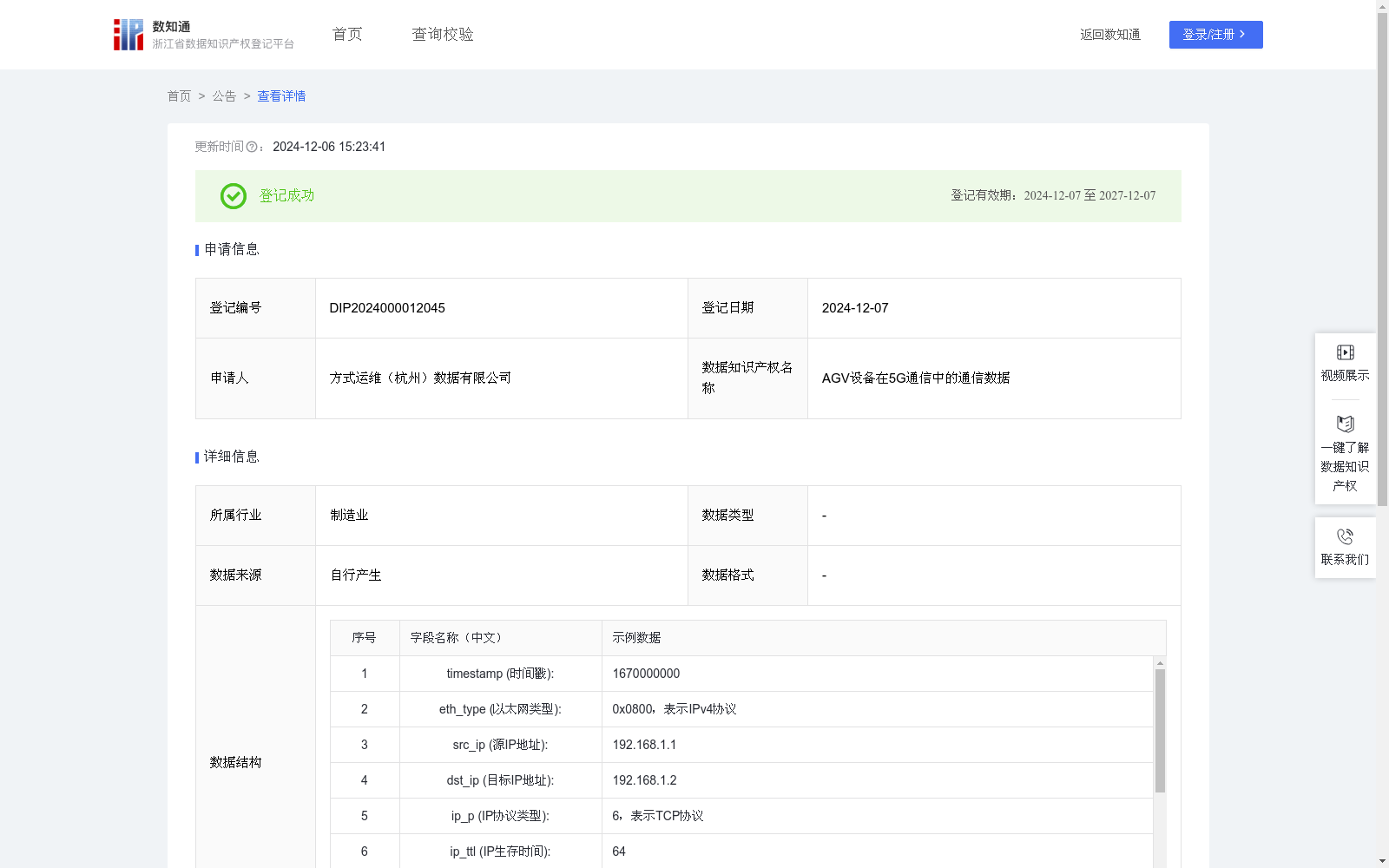
AGV设备在5G通信中的通信数据
收藏资源简介:
应用场景 工业自动化与智能制造: 条件:在工业自动化和智能制造环境中,AGV设备需要与控制系统进行实时数据交换,以实现精确的物料搬运和生产调度。 范围:适用于生产线、仓库管理系统、物流中心等场景。 对象:AGV设备、PLC(可编程逻辑控制器)、传感器、执行器等工业自动化组件。 问题解决:通过分析抓包数据,可以检测和诊断网络延迟、数据丢包、信号干扰等问题,从而判断数据包是否异常,如果数据如果 result为1数据包传输正常,为0则表示数据包传输异常,从而确保AGV设备的通信效率。1.数据采集:采集agv设备在5G通讯中的数据。2.数据处理:对采集到的数据进行分类、合并、筛选,便于分析使用。3.算法加工:将处理后的数据进行数据异常分析,两个数据包在时间戳相差1秒以内,并且它们的以太网类型、源IP地址、目标IP地址、IP协议类型、IP生存时间、源端口号、目标端口号、ICMP类型、ICMP代码以及负载数据都相同,如果以上所有条件都满足, result 将被设置为1,表示该数据包被正常发送;否则, result 将被设置为0,表示该数据包发送异常。 4.数据分类分级:根据计算出的数据结果,将数据包划分为“0,1”(如果 result为1则表示数据包传输正常,为0则数据包传输异常)从而实现对故障种类、所在位置的定位分析,以提高物联网设备运行的效率和安全性。
Application Scenario: Industrial Automation and Intelligent Manufacturing: Conditions: In industrial automation and intelligent manufacturing scenarios, AGV devices need to conduct real-time data exchange with control systems to achieve precise material handling and production scheduling. Scope: Applicable to scenarios such as production lines, warehouse management systems, and logistics centers. Objects: Industrial automation components including AGV devices, PLC (Programmable Logic Controller), sensors, actuators, etc. Problem Solving: By analyzing packet capture data, issues such as network delays, data packet loss, and signal interference can be detected and diagnosed to determine whether data packets are abnormal. If the result is 1, the packet transmission is normal; if the result is 0, the packet transmission is abnormal, thereby ensuring the communication efficiency of AGV devices. 1. Data Collection: Collect data of AGV devices during 5G communication. 2. Data Processing: Classify, merge and filter the collected data to facilitate subsequent analysis and application. 3. Algorithm Processing: Perform data anomaly analysis on the processed data. If two packets have a time stamp difference of less than 1 second, and their Ethernet type, source IP address, destination IP address, IP protocol type, IP Time to Live, source port number, destination port number, ICMP type, ICMP code and payload data are all identical, the result will be set to 1, indicating normal packet transmission; otherwise, the result will be set to 0, indicating abnormal packet transmission. 4. Data Classification and Grading: According to the calculated results, divide packets into two categories "0" and "1" (result 1 means normal packet transmission, result 0 means abnormal packet transmission), so as to realize the localization analysis of fault types and their locations, and improve the operating efficiency and safety of IoT devices.