中国地区酒类产品客户分级评价数据
收藏资源简介:
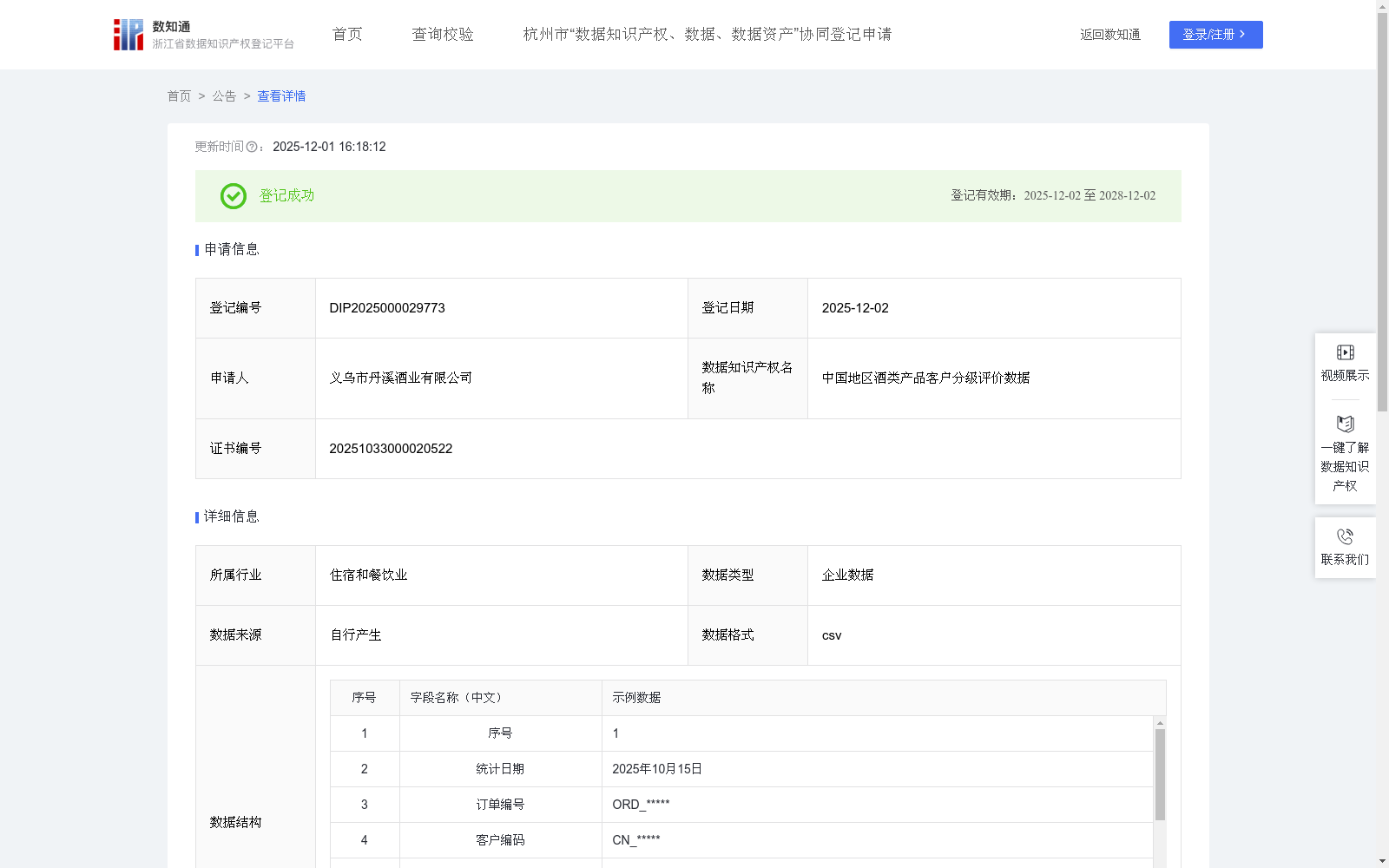
通过收集和分析中国区域客户对酒产品的采购消费相关数据,使用RFM客户价值模型,了解客户的购买力水平和消费偏好,对客户进行等级评级,实现精准化运营。通过对客户价值管理,满足不同价值客户的个性化需求。对于A级会员可每月1至2次与之沟通,了解需求动态,提供VIP专属服务和优先供货保障;对于B级会员可每季度1至2次与之沟通,保持客户关系,推动向A级转化;对于C级会员可每半年1至2次与之沟通,进行常规维护和激活唤醒。通过客户全生命周期价值管理,不仅满足不同等级客户的个性化需求,更深度挖掘客户在产业链中的协同价值。对于上游企业(原料供应商、包装材料商、物流服务商、仓储运营商等),数据可提供需求预测支持,帮助其掌握白酒市场的采购趋势、区域需求分布、产品品类偏好、季节性波动规律,从而优化生产计划、库存管理和资源配置,降低库存成本,提升供应链效率;对于下游企业(区域经销商、零售终端、餐饮渠道商、电商平台等),数据可提供市场洞察和客户画像,帮助其了解目标客户的采购行为特征、价值等级分布、消费能力水平、购买频次规律,为其产品定位、市场开拓、销售策略制定、促销活动设计提供决策依据,提升市场竞争力和盈利能力。1. 数据采集:采集公司中国区域酒类产品的销售情况数据,历史服务时间段为2020年01月01日至统计日期。其中,'订单日期'为距离统计日期最近的一次订单时间,'订单金额(元)'指该次订单的交易金额,'订单数量(件)'指该次订单的数量,'历史购买总次数'和'历史购买总金额(元)'指历史时间段内统计得出的购买次数和购买金额。 2. 数据处理:对采集到的订单金额(元,人民币)、订单数量(件)、历史购买总金额(元,人民币)等数据进行分类、合并、累加,便于分析使用。为保护客户隐私与商业机密,涉及订单编号、客户编码及产品名称等敏感字段均已脱敏处理或打码,仅保留必要的统计特征数据用于分析。 3. 算法加工: (1) R评分(最近购买时间):根据客户订单日期距离统计日期天数(D)划分为5个等级:0≤D≤60为5分(活跃客户),60<D≤180为4分(较活跃),180<D≤365为3分(一般活跃),365<D≤730为2分(沉睡客户),D>730为1分(流失风险) (2) F评分(购买频次):根据历史购买总次数(S)划分为5个等级: S≥20为5分(超高频),15≤S<20为4分(高频),10≤S<15为3分(中频),5≤S<10为2分(低频),S<5为1分(极低频) (3) M评分(消费金额):根据历史购买总金额(Z,单位:元)划分为5个等级: Z>500万为5分(超级大客户),200万<Z≤500万为4分(顶级客户),80万<Z≤200万为3分(优质客户),30万<Z≤80万为2分(普通客户),Z≤30万为1分(小客户) 4. 数据处理: (1) RFM综合评分计算:综合评分 = 0.25×R评分 + 0.35×F评分 + 0.40×M评分。 (2) 会员等级划分:综合评分≥4为A级会员(高价值客户),2.5≤综合评分<4为B级会员(中等价值客户),综合评分<2.5为C级会员(普通客户)
This dataset collects and analyzes customer purchasing and consumption data for alcoholic products in the Chinese market, leveraging the RFM customer value model to assess customers' purchasing power and consumption preferences, grade customers, and enable precise operational management. Through customer value management, personalized needs of customers across different value tiers are met. For Grade A members, communicate 1 to 2 times per month to understand their dynamic demands, provide exclusive VIP services and priority supply guarantees; for Grade B members, communicate 1 to 2 times per quarter to maintain customer relationships and promote their upgrade to Grade A; for Grade C members, communicate 1 to 2 times every six months for routine maintenance and reactivation. Through full customer lifecycle value management, this dataset not only meets the personalized needs of customers at different tiers but also deeply explores the collaborative value of customers in the industrial chain. For upstream enterprises (including raw material suppliers, packaging material suppliers, logistics service providers, warehouse operators, etc.), the dataset provides demand forecasting support, helping them grasp the purchasing trends, regional demand distribution, product category preferences, and seasonal fluctuation rules of the Chinese Baijiu market, so as to optimize production plans, inventory management and resource allocation, reduce inventory costs, and improve supply chain efficiency. For downstream enterprises (including regional distributors, retail terminals, food and beverage channel merchants, e-commerce platforms, etc.), the dataset provides market insights and customer personas, helping them understand the purchasing behavior characteristics, value tier distribution, consumption capacity levels, and purchase frequency rules of their target customers, providing decision-making basis for their product positioning, market development, sales strategy formulation, and promotional activity design, thereby enhancing market competitiveness and profitability. 1. Data Collection: Collect sales data of the company's alcoholic products in the Chinese market, with the historical service period spanning from January 1, 2020 to the statistical date. Specifically, "Order Date" refers to the timestamp of the most recent order relative to the statistical date; "Order Amount (CNY)" denotes the transaction amount of the corresponding order; "Order Quantity (units)" refers to the number of items in the order; "Total Historical Purchase Times" and "Total Historical Purchase Amount (CNY)" represent the total number of purchases and total purchase amount calculated over the entire historical period. 2. Data Processing: Classify, merge, and accumulate the collected data such as order amount (CNY), order quantity (units), and total historical purchase amount (CNY) to facilitate subsequent analysis. To protect customer privacy and commercial secrets, sensitive fields including order numbers, customer codes, and product names have been desensitized or obscured, and only necessary statistical feature data are retained for analysis purposes. 3. Algorithm Processing: (1) Recency (R) Score: Divided into 5 levels based on the number of days (D) between the customer's order date and the statistical date: 5 points (active customers) for 0≤D≤60, 4 points (relatively active) for 60<D≤180, 3 points (generally active) for 180<D≤365, 2 points (dormant customers) for 365<D≤730, and 1 point (at risk of customer churn) for D>730. (2) Frequency (F) Score: Divided into 5 levels based on the total number of historical purchases (S): 5 points (ultra-high frequency) for S≥20, 4 points (high frequency) for 15≤S<20, 3 points (medium frequency) for 10≤S<15, 2 points (low frequency) for 5≤S<10, and 1 point (extremely low frequency) for S<5. (3) Monetary (M) Score: Divided into 5 levels based on the total historical purchase amount (Z, unit: CNY): 5 points (super high-value customers) for Z>5000000, 4 points (top-tier customers) for 2000000<Z≤5000000, 3 points (premium customers) for 800000<Z≤2000000, 2 points (regular customers) for 300000<Z≤800000, and 1 point (small customers) for Z≤300000. 4. Data Processing: (1) RFM Comprehensive Score Calculation: Comprehensive Score = 0.25×R Score + 0.35×F Score + 0.40×M Score. (2) Membership Level Division: Grade A members (high-value customers) for Comprehensive Score ≥4; Grade B members (medium-value customers) for 2.5≤Comprehensive Score <4; Grade C members (ordinary customers) for Comprehensive Score <2.5.