湟水河流域水体微塑料分布及其基础指标实测数据(2021-2022)
收藏资源简介:
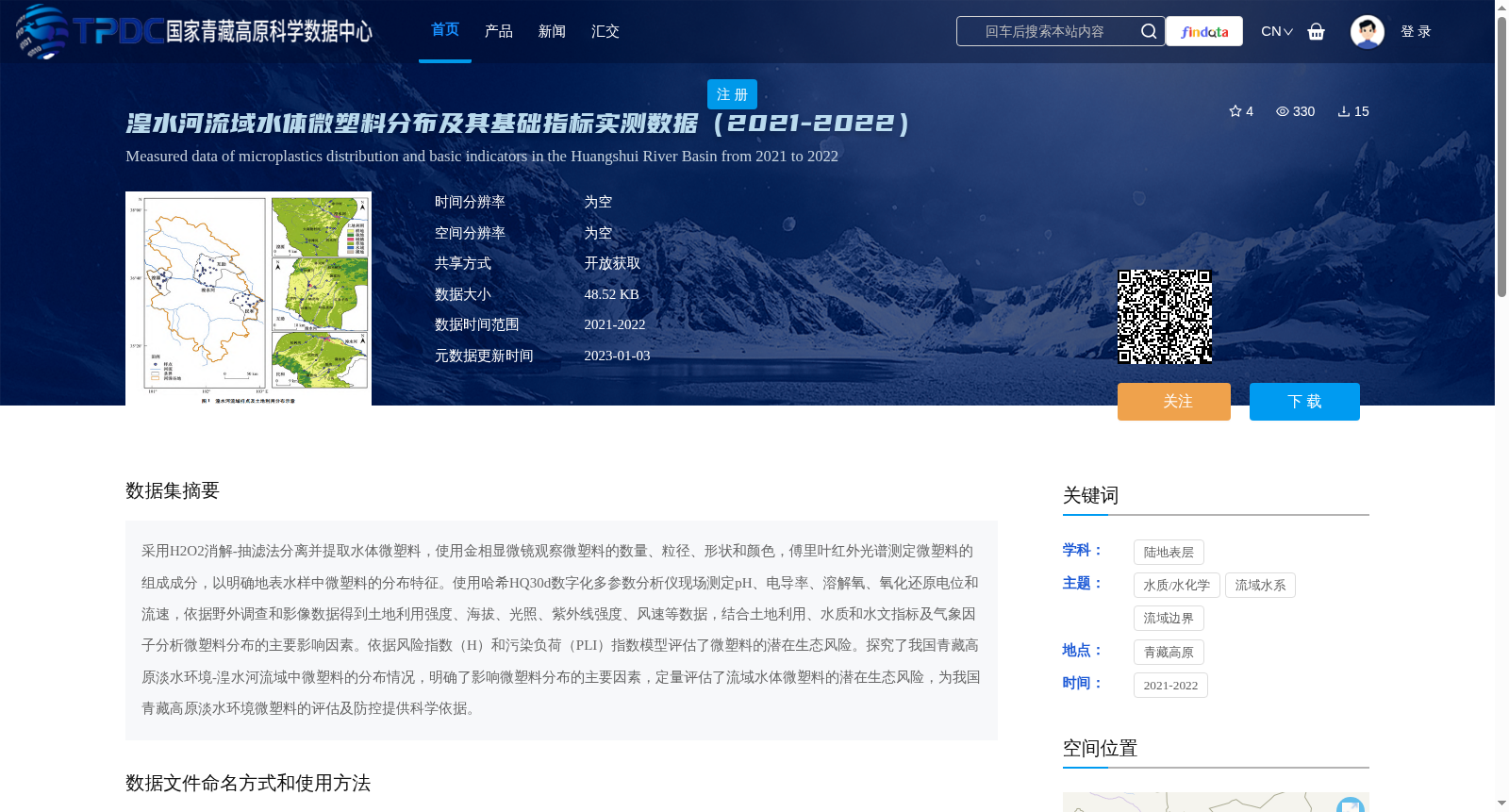
采用H2O2消解-抽滤法分离并提取水体微塑料,使用金相显微镜观察微塑料的数量、粒径、形状和颜色,傅里叶红外光谱测定微塑料的组成成分,以明确地表水样中微塑料的分布特征。使用哈希HQ30d数字化多参数分析仪现场测定pH、电导率、溶解氧、氧化还原电位和流速,依据野外调查和影像数据得到土地利用强度、海拔、光照、紫外线强度、风速等数据,结合土地利用、水质和水文指标及气象因子分析微塑料分布的主要影响因素。依据风险指数(H)和污染负荷(PLI)指数模型评估了微塑料的潜在生态风险。探究了我国青藏高原淡水环境-湟水河流域中微塑料的分布情况,明确了影响微塑料分布的主要因素,定量评估了流域水体微塑料的潜在生态风险,为我国青藏高原淡水环境微塑料的评估及防控提供科学依据。
This study separated and extracted microplastics from water samples using H₂O₂ digestion-vacuum filtration method. The quantity, particle size, shape and color of the microplastics were observed under a metallographic microscope, and their composition was determined via Fourier Transform Infrared Spectroscopy (FTIR) to clarify the distribution characteristics of microplastics in surface water samples. pH, electrical conductivity, dissolved oxygen, redox potential and flow velocity were measured in situ using a Hach HQ30d digital multi-parameter analyzer. Data including land use intensity, elevation, solar radiation, ultraviolet intensity and wind speed were collected based on field surveys and image data. The main influencing factors of microplastic distribution were analyzed by combining land use, water quality and hydrological indicators as well as meteorological factors. The potential ecological risks of microplastics were assessed using the risk index (H) and pollution load index (PLI) models. This study investigated the distribution of microplastics in the freshwater environment of the Huangshui River Basin, Qinghai-Tibet Plateau, China, clarified the main influencing factors of microplastic distribution, quantitatively evaluated the potential ecological risks of microplastics in the basin's water bodies, and provided scientific basis for the assessment, prevention and control of microplastics in the freshwater environment of the Qinghai-Tibet Plateau, China.