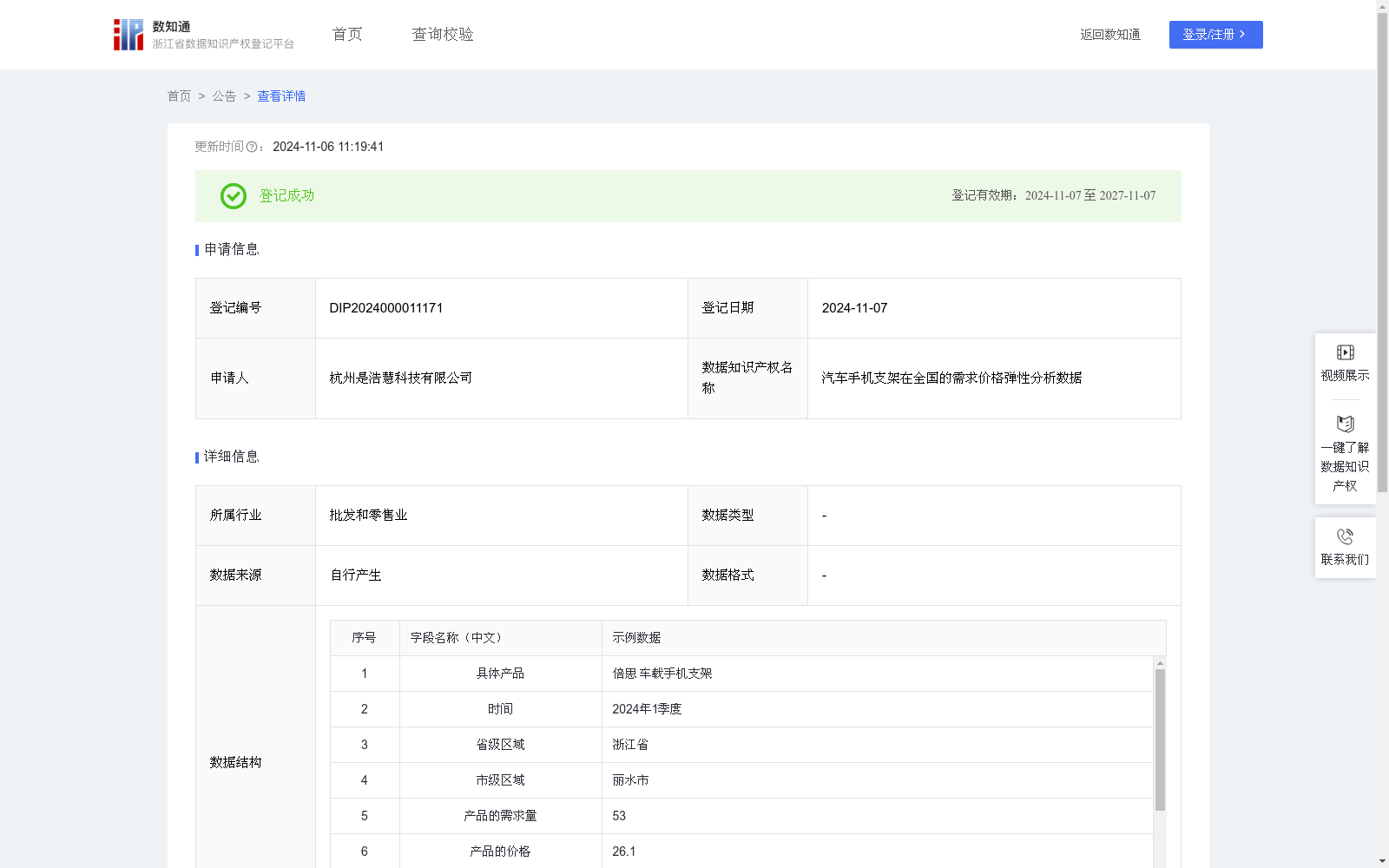
汽车手机支架在全国的需求价格弹性分析数据
收藏资源简介:
为更好了解不同区域的顾客对汽车手机支架的市场需求情况,我单位对相关汽车手机支架的需求弹性数据进行采集计算。采集相关汽车手机支架在某一时间段的需求数据和价格数据,得到该汽车手机支架的需求价格弹性,如果汽车手机支架需求量变动的比率大于价格变动的比率,那么汽车手机支架需求富有弹性,说明顾客对于价格变化的敏感程度,弹性越大,需求对价格变化越敏感,本行业所有企业可以适当的降低汽车手机支架价格来获得较多的收益。如果汽车手机支架需求缺乏弹性,本行业所有企业可以适当的提高汽车手机支架价格来获得较多的收益。该项数据对本行业所有企业的市场营销决策有重要意义。1.数据采集:采集相关汽车手机支架各季度不同区域的需求数据和价格数据,按照顾客的区域进行整理归纳,得到该汽车手机支架在不同区域的需求量变动数值和价格变化数值。 2.算法规则:对采集得到的数据按照如下公式进行计算:需求弹性系数Ed=-(△Q/Q)÷(△P/P),得到需求弹性系数。式中:Q表示产品的需求量,单位为份;P表示产品的价格,单位为元;△Q表示需求量同比变动值,单位为份;△P表示价格同比变动值,单位为元。取需求弹性系数的绝对值|Ed|作为分析数据时的参考系数。 3.数据分析:根据|Ed|的数值可分析该汽车手机支架的需求价格弹性。(1)0<|Ed|<1(需求缺乏弹性),说明需求量变动幅度小于价格变动幅度;(4)|Ed|=1(单位需求价格弹性),说明需求量变动幅度与价格变动幅度相同,这表示不管价格怎样变动,需求量总是固定不变;(5)|Ed|>1(需求富有弹性),说明需求量变动幅度大于价格变动幅度。
To better understand regional customer market demand for automotive phone mounts, our organization collected and calculated demand elasticity data for relevant automotive phone mounts. By collecting demand and price data of automotive phone mounts over a specific period, we derived their price elasticity of demand. If the percentage change in quantity demanded of automotive phone mounts is greater than the percentage change in their price, the demand is considered elastic, indicating that customers are more sensitive to price changes: the larger the elasticity, the more sensitive demand is to price fluctuations. All enterprises in this industry can appropriately lower the prices of automotive phone mounts to gain higher revenue. If the demand for automotive phone mounts is inelastic, all enterprises in this industry can appropriately raise their prices to gain higher revenue. This dataset holds significant importance for the marketing decision-making of all enterprises in the industry. 1. Data Collection: Collect demand and price data of automotive phone mounts across different regions by quarter, and organize and summarize the data based on customer regions to obtain the changes in quantity demanded and price changes of automotive phone mounts in different regions. 2. Algorithm Rules: Calculate using the following formula on the collected data to obtain the demand elasticity coefficient: Demand Elasticity Coefficient Ed = -(ΔQ/Q) ÷ (ΔP/P) Where: Q represents the quantity demanded of the product, with the unit of piece; P represents the price of the product, with the unit of yuan; ΔQ represents the year-on-year change in quantity demanded, with the unit of piece; ΔP represents the year-on-year change in price, with the unit of yuan. Take the absolute value |Ed| of the demand elasticity coefficient as the reference coefficient for data analysis. 3. Data Analysis: Analyze the price elasticity of demand for automotive phone mounts based on the value of |Ed|: (1) 0 < |Ed| < 1 (Demand is Inelastic): Indicates that the magnitude of change in quantity demanded is smaller than that of price change; (4) |Ed| = 1 (Unitary Price Elasticity of Demand): Indicates that the magnitude of change in quantity demanded is the same as that of price change, meaning that regardless of price changes, the quantity demanded remains fixed; (5) |Ed| > 1 (Demand is Elastic): Indicates that the magnitude of change in quantity demanded is greater than that of price change.