krishy-d/formatbench
收藏资源简介:
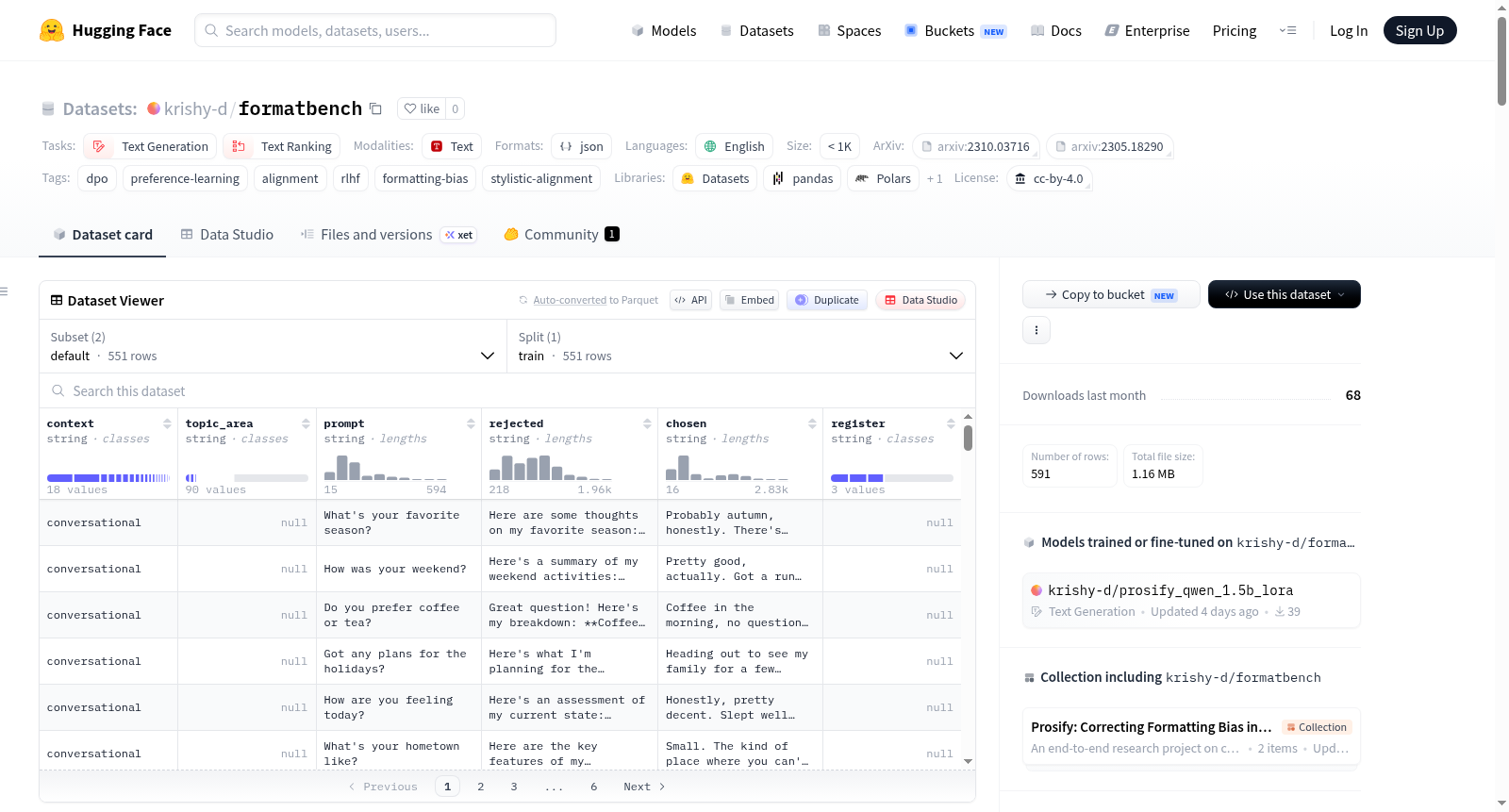
FormatBench是一个偏好数据集,旨在纠正大型语言模型(LLM)的格式化偏见。该数据集解决LLM在RLHF训练后系统性地过度格式化输出(如默认使用项目符号、粗体标题和模板化结构)的问题,即使流畅的散文更适合读者。数据集包含两个配置:default配置(551个训练偏好对,覆盖18个上下文类别,其中chosen为散文响应,rejected为过度格式化响应)和adversarial配置(40个仅用于评估的示例,覆盖需要结构化输出的上下文,如食谱、安装说明,其中chosen为清洁结构,rejected为冗长散文)。数据用于DPO训练,以帮助模型学习根据上下文选择适当的格式化风格,而非盲目避免结构。数据集还包括类别细分(如电子邮件起草、概念解释等)、对抗集的重要性(防止模型学习错误模式),以及构建方法(通过LLM辅助和人工策划生成)。限制包括单作者声音、仅英语、无人口统计多样性和适度规模。
FormatBench is a preference dataset developed to rectify the formatting bias of large language models (LLMs). This dataset addresses the systematic over-formatting problem in LLM outputs post-RLHF training, such as defaulting to bullet points, bold headings, and templated structures, even when fluent prose is more appropriate for readers. The dataset includes two configurations: the default configuration (551 training preference pairs covering 18 contextual categories, where the "chosen" response is prose-style output and the "rejected" response is over-formatted content) and the adversarial configuration (40 evaluation-only examples covering contexts requiring structured outputs, such as recipes and installation instructions, where the "chosen" response is clean structured content and the "rejected" response is verbose prose). The dataset is utilized for DPO training to help models learn to select appropriate formatting styles based on context, rather than blindly avoiding structured outputs. It also includes category breakdowns (e.g., email drafting, concept explanation, etc.), the significance of the adversarial set (preventing models from learning erroneous patterns), and its construction approach (generated via LLM-aided and human curation). Limitations of the dataset include a single authorial voice, English-only content, lack of demographic diversity, and a moderate scale.