
<b>Stable carbon degradation strategies drive microbial carbon use efficiency after afforestation</b>
收藏DataCite Commons2025-10-29 更新2025-05-07 收录
下载链接:
https://figshare.com/articles/dataset/_b_Soil_microbial_life_history_strategies_drive_microbial_carbon_use_efficiency_following_afforestation_b_/28142954
下载链接
链接失效反馈官方服务:
资源简介:
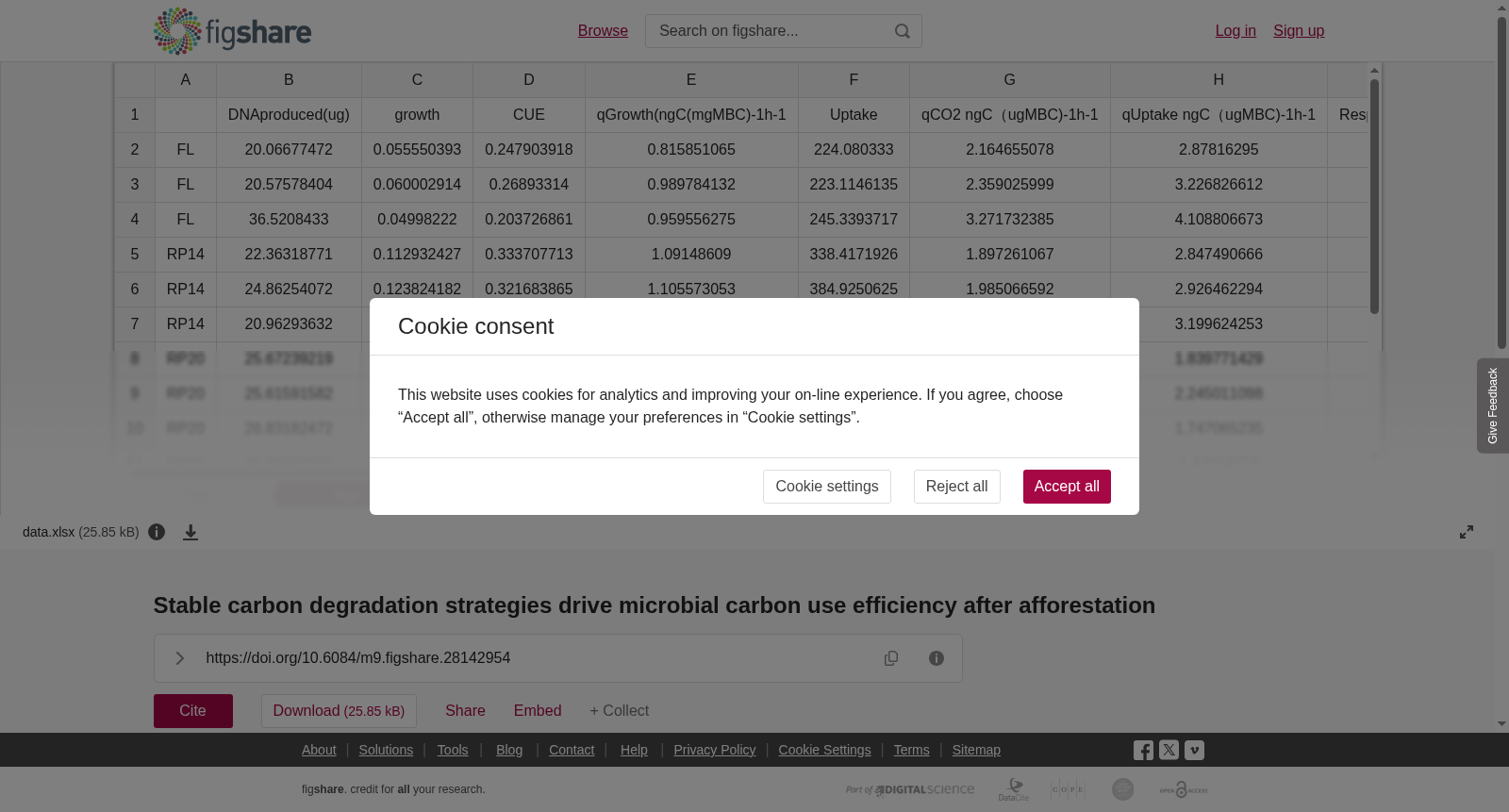
Microbial carbon use efficiency (CUE) is a critical metric to assess soil microbial participation in the carbon cycle. However, the mechanistic links between microbial functional traits and CUE under land-use change remain poorly understood. By selecting soil samples from a 45-year <i>Robinia pseudoacacia</i> (RP) afforestation chronosequence and combining an <sup>18</sup>O-H₂O labeling method with metagenomic techniques to explore how afforestation alters soil substrate conditions and microbial metabolism. We found that CUE increased due to a relatively high increase in microbial biomass and a relatively low increase in microbial respiration after afforestation. This outcome is jointly determined by soil stoichiometry and carbon substrate characteristics. Nutrient imbalances, especially phosphorus limitation, stimulated microbial communities to mine stable organic matter for essential elements. Since the breakdown of stable substrates requires higher activation energy, microbes must enhance their metabolic efficiency, thereby increasing CUE. Functional gene analysis further revealed that forest soils with higher abundances of stable carbon-degrading genes exhibited enhanced CUE, while farmland soils with fewer such genes showed low CUE. These findings provide empirical evidence for microbial mediation of soil substrate changes and emphasize that the influence of the stable carbon pool on microbial metabolism is not negligible in soil carbon cycle.
微生物碳利用效率(Microbial carbon use efficiency, CUE)是评估土壤微生物参与碳循环过程的关键指标。然而,土地利用变化背景下,微生物功能性状与CUE之间的机制性关联仍未得到充分阐释。本研究选取了为期45年的刺槐(Robinia pseudoacacia, 缩写RP)造林年代序列土壤样品,结合18O-H₂O标记水法与宏基因组技术,探究造林如何改变土壤底物条件与微生物代谢过程。研究发现,造林后CUE得以提升,这源于微生物生物量的相对较高增幅与微生物呼吸的相对较低增幅。该结果由土壤化学计量特征与碳底物特性共同决定。养分失衡,尤其是磷限制,会促使微生物群落分解稳定有机质以获取必需营养元素。由于稳定底物的降解需要更高的活化能,微生物需提升自身代谢效率,进而提高CUE。功能基因分析进一步显示,稳定碳降解基因丰度更高的森林土壤CUE更高,而此类基因丰度较低的农田土壤则CUE较低。本研究为土壤底物变化的微生物介导过程提供了实证依据,并强调在土壤碳循环中,稳定碳库对微生物代谢的影响不容忽视。
提供机构:
figshare创建时间:
2025-02-14
搜集汇总
数据集介绍
背景与挑战
背景概述
该数据集基于45年刺槐造林时间序列的土壤样本,通过18O-H₂O标记和宏基因组技术,探究了造林后微生物碳利用效率(CUE)的变化机制。研究发现CUE增加主要由微生物生物量相对较高增长和呼吸相对较低增长驱动,且与稳定碳降解基因丰度正相关,揭示了土壤底物变化对微生物代谢的关键影响。
以上内容由遇见数据集搜集并总结生成


