
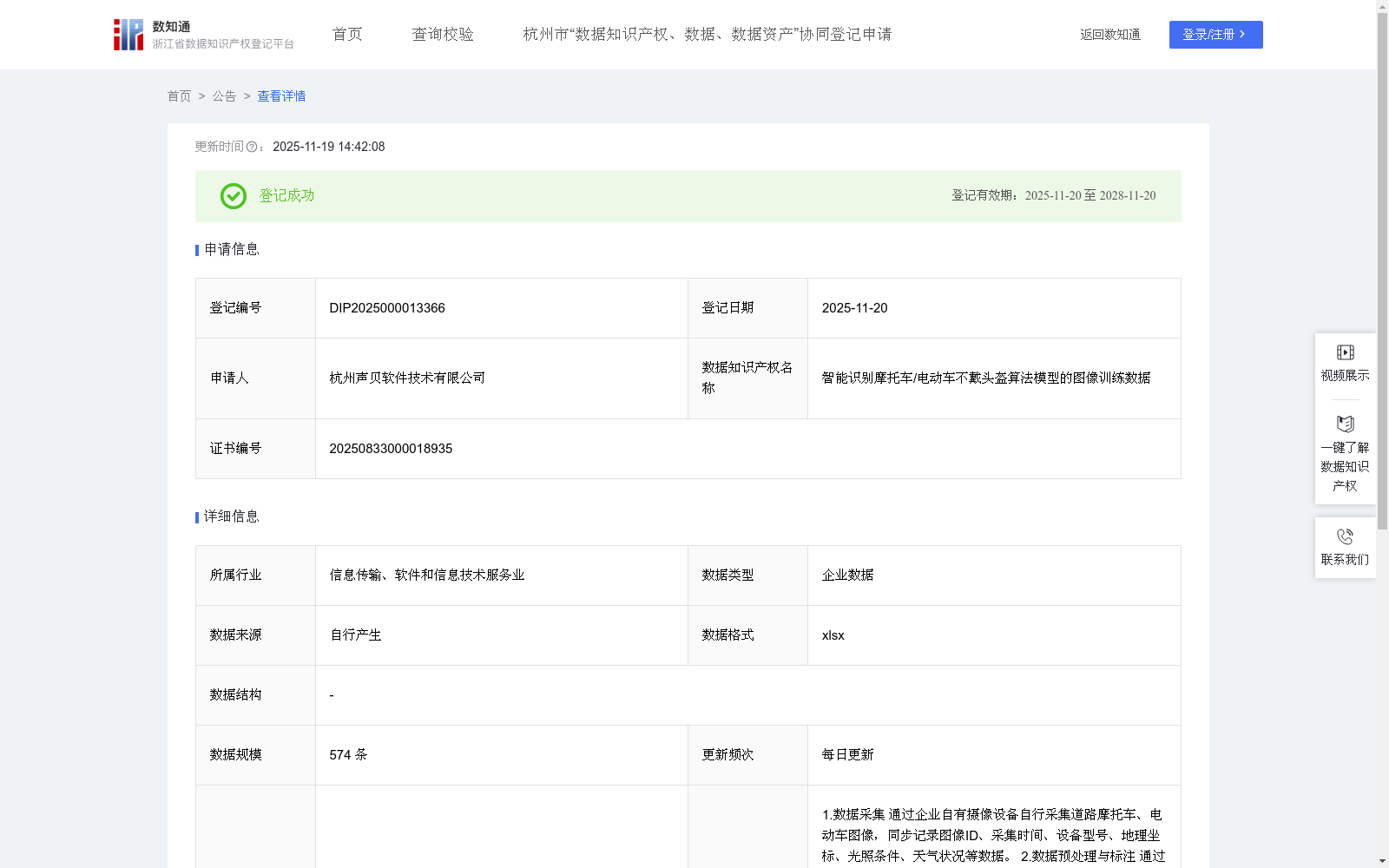
智能识别摩托车/电动车不戴头盔算法模型的图像训练数据
收藏浙江省数据知识产权登记平台2025-11-19 更新2025-11-26 收录
下载链接:
https://www.zjip.org.cn/home/announce/trends/8402551
下载链接
链接失效反馈官方服务:
资源简介:
本数据集主要用于提升AI模型对摩托车/电动车驾驶员未佩戴头盔行为的识别能力与精确性。通过对该数据集的训练,使AI模型能够精准识别完全未戴头盔、佩戴不规范等行为,并可应用于交通执法电子警察系统、道路安全监控、共享电动车管理平台及保险定损等场景。同时,本数据集可为交通管理部门提供智能化执法依据,有效提升监管效率;为保险行业提供事故责任判定支持,从而全面提升道路交通安全水平,降低事故伤亡风险,促进行业规范发展。
1.数据采集
通过企业自有摄像设备自行采集道路摩托车、电动车图像,同步记录图像ID、采集时间、设备型号、地理坐标、光照条件、天气状况等数据。
2.数据预处理与标注
通过数据清洗,剔除图像模糊或严重遮挡情况。按6:2:2比例划分训练集/验证集/测试集。设置多级标注体系:
一级标签:合规/未戴头盔
二级标签:完全未戴(头部裸露)/佩戴不规范(头盔未系扣)
辅助标注:头部边界框坐标、车辆类型(摩托车/电动车)
3.模型选择与初始化
采用YOLOv8s作为基础架构,初始化参数并优化超参数:学习率设置为0.02-0.002动态调整,批量大小1-64动态调整,锚框参数根据头部形态特征定制,确保对不同尺寸头盔的检测适应性。
4.模型训练
基于PyTorch框架实施分阶段训练策略,设置训练时长。训练采用混合精度(FP16)加速,数据增强模块模拟实际道路环境,动态生成雨雾、逆光和树影等干扰场景。设置早停机制(patience=15)和梯度裁剪(max_norm=1.0)防止过拟合。
5.模型评估
在训练模型的过程中,使用验证集调整超参数,训练完成后在测试集上评估模型表现,评估指标包含:
基础性能:mAP@0.5、误报率
场景鲁棒性测试:夜间检出率
This dataset is primarily developed to improve the recognition accuracy and capability of AI models in identifying the behaviors of motorcycle and electric bicycle riders who fail to wear helmets or wear them improperly. Training AI models on this dataset allows them to accurately recognize behaviors such as completely not wearing a helmet and improper helmet wearing. It can be applied to scenarios including traffic law enforcement electronic police systems, road safety monitoring, shared electric bicycle management platforms, and insurance claim settlement. Meanwhile, this dataset can provide intelligent law enforcement references for traffic management departments, effectively improving supervision efficiency; it can also offer support for accident liability determination in the insurance industry, thereby comprehensively enhancing road traffic safety levels, reducing the risk of accident casualties, and promoting the standardized development of related industries.
1. Data Collection
Images of road motorcycles and electric bicycles are collected using the enterprise's own camera equipment, while supporting data including image ID, collection time, device model, geographic coordinates, lighting conditions, and weather conditions are synchronously recorded.
2. Data Preprocessing and Annotation
Data cleaning is conducted to eliminate images with blurriness or severe occlusion. The dataset is split into training, validation, and test sets at a ratio of 6:2:2. A multi-level annotation system is established as follows:
- First-level labels: Compliant / Not wearing a helmet
- Second-level labels: Completely not wearing a helmet (head exposed) / Improperly wearing a helmet (helmet not fastened)
- Auxiliary annotations: Head bounding box coordinates, vehicle type (motorcycle / electric bicycle)
3. Model Selection and Initialization
YOLOv8s is adopted as the base architecture, with parameter initialization and hyperparameter optimization: the learning rate is dynamically adjusted between 0.02 and 0.002, the batch size is dynamically adjusted between 1 and 64, and the anchor box parameters are customized based on head morphological features to ensure adaptability to helmets of various sizes.
4. Model Training
A staged training strategy is implemented under the PyTorch framework, with a predefined training duration. Mixed precision (FP16) training is employed to accelerate the process, and the data augmentation module simulates real-world road environments, dynamically generating interference scenarios such as rain, fog, backlighting, and tree shadows. An early stopping mechanism (patience=15) and gradient clipping (max_norm=1.0) are set to prevent overfitting.
5. Model Evaluation
During the model training phase, the validation set is used to adjust hyperparameters. After training is completed, the model's performance is evaluated on the test set. The evaluation metrics include:
- Basic performance: mAP@0.5, false positive rate
- Scene robustness test: nighttime detection rate
提供机构:
杭州声贝软件技术有限公司
创建时间:
2025-08-03
搜集汇总
数据集介绍
背景与挑战
背景概述
该数据集是用于训练AI模型识别摩托车/电动车驾驶员未佩戴头盔行为的图像数据,包含574条企业数据,每日更新,采用YOLOv8s算法进行分阶段训练,强调数据增强和场景鲁棒性测试。其主要应用于交通执法、道路安全监控和保险定损等场景,旨在提升识别精确性和监管效率,降低事故风险。
以上内容由遇见数据集搜集并总结生成


