X2I
收藏资源简介:
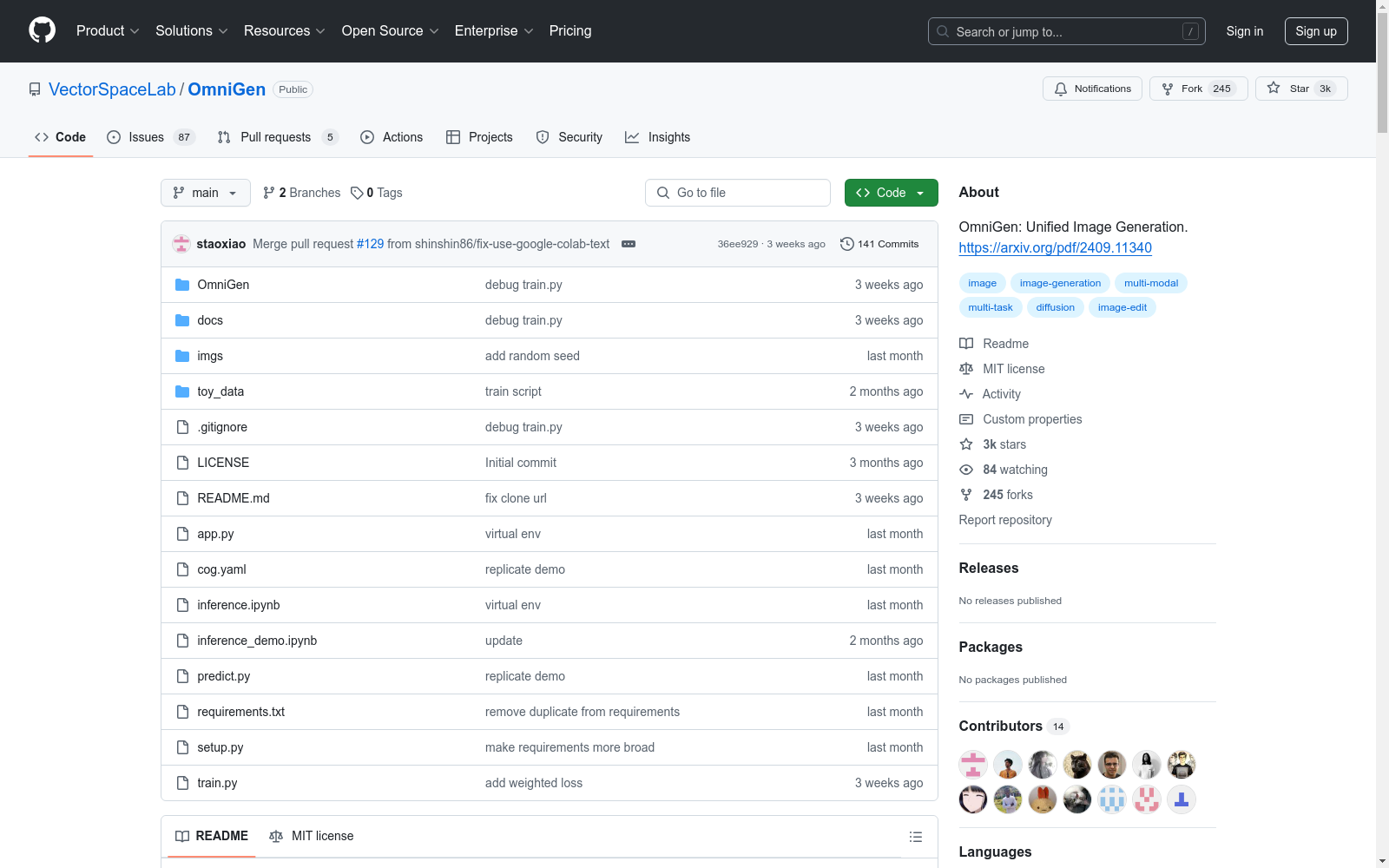
OmniGen是北京智源研究院提出的一款全新的扩散模型,致力于统一图像生成任务。X2I数据集是为了训练一个强大的统一模型OmniGen而构建的,它是首个大规模统一图像生成数据集,将各种任务统一到了一个格式中。这个数据集包含了大约1亿张图片,涵盖了多种图像生成任务,如文本到图像的生成、多模态到图像的生成、主题驱动的图像生成和计算机视觉任务等。X2I数据集的构建旨在通过统一的格式来训练模型,使其能够在一个框架内处理多种图像生成任务,从而提高模型的泛化能力和多任务处理能力。通过这个数据集,OmniGen模型能够学习到丰富的视觉和文本信息,进而在多种图像生成任务中表现出色。
OmniGen, a novel diffusion model proposed by the Beijing Academy of Artificial Intelligence, is dedicated to unifying image generation tasks. The X2I dataset was constructed to train a robust unified model, OmniGen, and represents the first large-scale unified image generation dataset that consolidates various tasks into a single format. This dataset comprises approximately 100 million images, encompassing a wide range of image generation tasks such as text-to-image generation, multimodal-to-image generation, theme-driven image generation, and computer vision tasks. The creation of the X2I dataset aims to train models through a unified format, enabling them to handle multiple image generation tasks within a single framework, thereby enhancing the model's generalization and multitasking capabilities. Through this dataset, the OmniGen model can learn rich visual and textual information, excelling in various image generation tasks.
OmniGen 数据集概述
1. 基本介绍
- 名称: OmniGen
- 类型: 统一图像生成模型
- 特点: 支持多模态提示生成图像,无需额外插件或预处理步骤
- 目标: 实现简单、灵活的图像生成范式
2. 关键功能
- 文本到图像生成
- 主题驱动生成
- 身份保留生成
- 图像编辑
- 图像条件生成
- 参考表达式生成(自动识别输入图像中的对象)
3. 技术特性
- 方法论: 详见论文 arXiv:2409.11340
- 优势: 自动识别输入图像特征(如物体、人体姿态、深度映射等)
- 灵活性: 可通过微调添加新功能
4. 资源获取
- 模型权重: Shitao/OmniGen-v1
- 演示平台:
- 数据集: X2I Dataset
5. 使用方式
-
安装方法: bash git clone https://github.com/VectorSpaceLab/OmniGen.git cd OmniGen pip install -e .
-
快速开始示例代码: 提供文本到图像和多模态到图像的生成示例
-
Diffusers集成: 支持通过Diffusers库使用
6. 微调支持
- 支持LoRA微调
- 提供完整微调选项
- 训练脚本:
train.py - 详细指南: docs/fine-tuning.md
7. 许可信息
- 许可证: MIT License
8. 引用方式
bibtex @article{xiao2024omnigen, title={Omnigen: Unified image generation}, author={Xiao, Shitao and Wang, Yueze and Zhou, Junjie and Yuan, Huaying and Xing, Xingrun and Yan, Ruiran and Wang, Shuting and Huang, Tiejun and Liu, Zheng}, journal={arXiv preprint arXiv:2409.11340}, year={2024} }