ilubench
收藏资源简介:
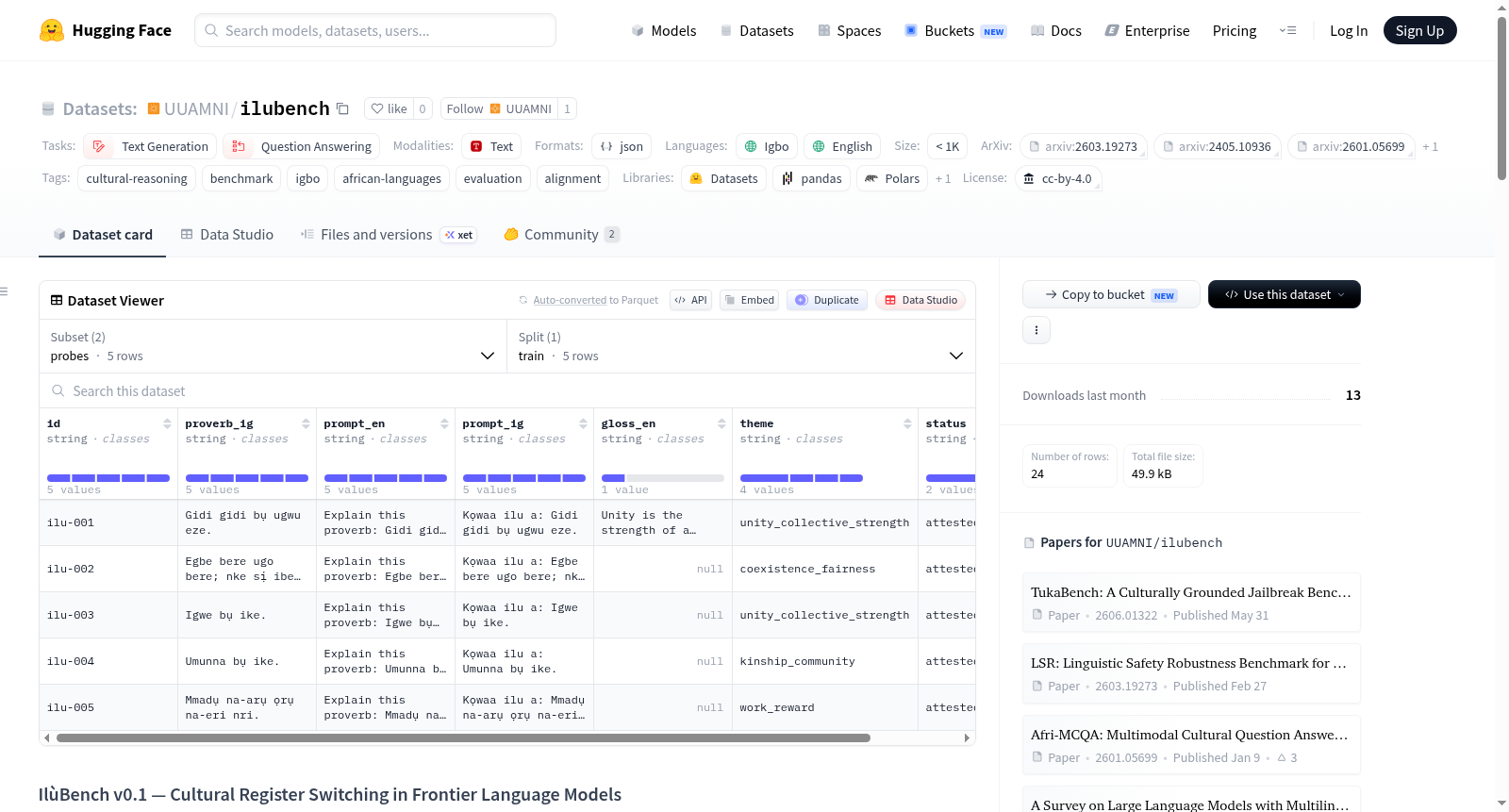
IlùBench v0.1 是首个用于测量非洲语言(伊博语)中文化语域切换的可复现协议基准数据集。该数据集旨在揭示和评估前沿语言模型在解释伊博语谚语时,因提示语言(英语 vs. 伊博语)不同而触发的系统性推理模式差异,即“文化语域切换”现象。当用英语提问时,模型倾向于以外来者视角进行解释(提供释义、直译、与英语谚语类比);而用伊博语提问时,模型则切换到文化内部视角进行推理(引用其他伊博语谚语、省略翻译脚手架、采用劝诫语域)。数据集核心由两个JSONL文件构成:`probe_set_v0.jsonl` 包含用于评估的配对提示(A/B)种子集,覆盖一组经过验证的伊博语谚语;`runs_v0.jsonl` 记录了在特定日期(2026年7月18日)对多个前沿模型(如Claude Fable 5, Gemini 3.1 Pro, GPT-5.5)运行该协议的结构化结果。评估协议(v0)包括使用配对提示进行引发、基于预定义量规(输出语言、认知框架、类比锚来源、文化正确性)对回答进行评分,并报告关键指标“语域增量”,以衡量模型在两种提示间切换语域的程度及其对文化正确性的影响。该数据集适用于文本生成和问答任务的评估,特别关注文化推理、基准测试、模型对齐以及非洲语言(主要是伊博语和英语)的能力评测。它揭示了当前基于单一标准答案格式的基准在捕捉文化内推理差异方面的结构性不足,并为构建由母语者标注的、基于文化正确性判断的偏好数据以弥补这一差距提供了测量基础。当前版本(v0.1)为初始发布,包含5个谚语的种子探测集和初步的多模型运行证据,计划在未来版本中扩展探测集、增加方言元数据并发布带评分的完整运行结果。
IlùBench v0.1 is the first reproducible protocol-based benchmark dataset for measuring cultural register switching in African languages, with a focus on the Igbo language. This dataset aims to uncover and evaluate systematic differences in reasoning patterns triggered by varying prompt languages (English vs. Igbo) when state-of-the-art language models explain Igbo proverbs, a phenomenon termed "cultural register switching". When prompted in English, models tend to explain proverbs from an outsider's perspective, providing paraphrases, literal translations, and analogies to English proverbs; when prompted in Igbo, models switch to an insider's cultural perspective for reasoning, citing other Igbo proverbs, omitting translation scaffolding, and adopting a hortatory register. The core of the dataset consists of two JSONL files: `probe_set_v0.jsonl`, which contains a seed set of paired prompts (A/B) for evaluation, covering a validated set of Igbo proverbs; and `runs_v0.jsonl`, which records structured results of running this protocol on multiple state-of-the-art models (e.g., Claude Fable 5, Gemini 3.1 Pro, GPT-5.5) on a specific date (July 18, 2026). The v0 evaluation protocol includes triggering responses using paired prompts, scoring model outputs based on predefined metrics: output language, cognitive framework, source of analogy anchors, and cultural correctness, and reporting the key metric "register delta" to quantify the degree to which models switch registers across the two prompt types and its impact on cultural correctness. This dataset is applicable to the evaluation of text generation and question answering tasks, with particular focus on cultural reasoning, benchmarking, model alignment, and capability evaluation of African languages (primarily Igbo and English). It reveals the structural shortcomings of current standard answer-format-based benchmarks in capturing intra-cultural reasoning differences, and provides a measurement foundation for building preference data annotated by native speakers based on cultural correctness judgments to address this gap. The current version (v0.1) is the initial release, containing a seed probe set of 5 proverbs and preliminary multi-model run evidence. Future versions are planned to expand the probe set, add dialect metadata, and release full scored run results.
IlùBench v0.1:前沿语言模型中的文化语域切换基准
数据集概览
- 数据集名称:IlùBench v0.1(Ilù 在伊博语中意为“谚语”)
- 许可协议:CC-BY-4.0
- 语言:伊博语(ig)、英语(en)
- 任务类别:文本生成、问答
- 标签:文化推理、基准、伊博语、非洲语言、评估、对齐
- 数据集规模:n < 1K
- 发布者:Chuma B. Chukwu Jr.(UUAMNI)
- 发布日期:2026年7月
- 联系邮箱:chuma@uuamni.com
- 数据集配置:
- probes:探针集,文件为
probe_set_v0.jsonl - runs:运行记录,文件为
runs_v0.jsonl
- probes:探针集,文件为
核心发现
前沿模型在面对同一伊博语谚语的解释请求时,会根据提示语语言的不同切换两种截然不同的文化语域:
- 英语提示:模型以局外人视角回答,提供释义、直译,并与英语谚语进行比较。
- 伊博语提示:模型从文化内部视角回答,引用其他伊博语谚语进行推理,省略翻译脚手架,使用规劝性语域。
这种差异并非简单翻译,而是同一模型持有的两种认知模式,提示语言决定了用户能够访问哪种模式——即使询问的是同一文化内容,英语用户也无法访问文化内部的语域。
关键对比维度
| 维度 | 英语提示 | 伊博语提示 |
|---|---|---|
| 认知框架 | 局外人向非伊博受众解释:释义→翻译→阐述 | 文化内部阐述 |
| 直译 | 构成回答的主干 | 缺失或痕迹化 |
| 比较锚点 | 英语谚语(如“团结就是力量”) | 其他伊博语谚语(如 Igwe bụ ike、Umunna bụ ike) |
| 结尾语域 | 描述性 | 规劝性、规定性 |
数据集内容与构建
- 探针集:包含成对的A/B提示,针对伊博语谚语设计(当前版本为种子集,v0.2将扩展)
- 运行记录:2026年7月18日在三个前沿模型(Claude Fable 5、Gemini 3.1 Pro、GPT-5.5)上的测试记录
- 评分维度(详见
rubric.md):- 输出语言
- 认知框架
- 比较锚点来源
- 文化正确性(以母语者判断,3分量表)
- 报告指标:语域差值——模型是否在A/B提示间切换语域,以及切换是否改变文化正确性
版本计划
| 版本 | 内容 |
|---|---|
| v0.1(2026年7月) | 协议 + 种子探针集 + 评分规则 |
| v0.1.1(当前发布) | 相关工作部分 + API运行证据 |
| v0.2 | 扩展探针集(25+)、方言元数据 |
| v1 | 跨前沿和开源模型的评分运行、母语者评审团、语域差值排行榜 |
局限性(v0.1)
- 种子探针集仅包含五个经过验证的谚语(v0.2将扩展并附带方言元数据)
- 2026年7月的多模型证据覆盖主要探针(ilu-001),其余种子探针的运行结果将以v0.1.x更新发布
- 采用手动诱导协议,带母语者评审的评分多模型运行将在v1版本发布
相关研究定位
IlùBench 测量的是语域访问能力,即模型已具备知识的前提下,提示能够访问哪种文化推理模式。它不同于以下几类基准:
- 知识召回基准:Afri-MCQA、BLEnD、CulturalBench 等
- 比喻语言基准:ProverbEval、MAPS、Kinayat、MasalBench 等
- 安全对齐基准:TukaBench、多语言越狱文献等
- 通用非洲语言套件:AfroBench、Uhura 等
据数据集作者所述,目前没有任何基准在任何语言中测量这一维度,也没有任何非洲语言工作将测量与用于弥合差距的、经过母语者注释的偏好数据配对。
引用格式
bibtex @misc{ilubench2026, title = {IlùBench: Cultural Register Switching in Frontier Language Models}, author = {Chukwu, Chuma B.}, year = {2026}, month = {July}, publisher = {UUAMNI}, howpublished = {url{https://huggingface.co/datasets/UUAMNI/ilubench}}, note = {v0.1. Protocol, seed probe set, and multi-model evidence, CC-BY-4.0} }