Data-Gouv-FR/indicateurs-dencadrement-h-e-et-e-s-a-la-rentree-dans-le-secteur-public
收藏资源简介:
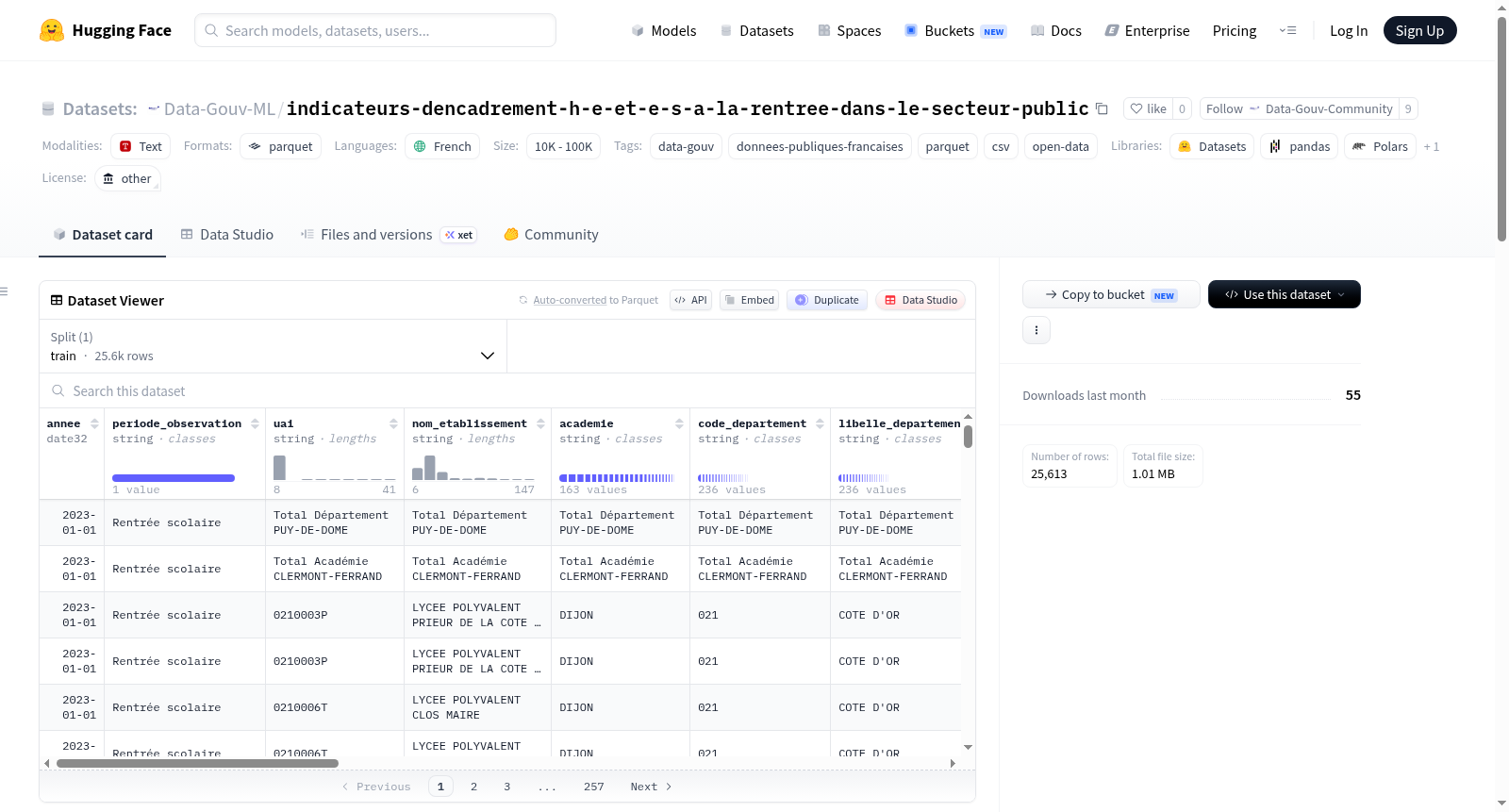
该数据集展示了法国公共教育部门在学年开始时,按机构和培训级别以及按部门和学院的H/E和E/S指导指标。H/E指标:指每名学生平均每周由国民教育部资助的教学小时数(每名学生的小时数)。该指标对应于国民教育部资助的每周教学小时数与给定机构和培训级别的在校学生人数之比。例如,H/E为1.5表示每100名学生,每周有150小时的教学由该部资助。H代表该部为给定机构和培训级别资助的每周教学小时数;E是该机构该培训级别的学生总数。H/E的差异需考虑学校机构的数量和规模(机构越小,部门中小机构越多,H/E越高)以及培训级别的分布(职业教育越多,H/E越高)。此外,H/E中考虑的学生人数是机构中的学生总数,相当于班级人数的总和。然而,许多教学是在比班级更小的学生小组中进行的。因此,引入了第二个指标:每个结构(完整班级或小组)的平均学生数E/S。这有助于分析在给定每个结构平均学生数的情况下,分配的资源(H/E)差异。E/S指标:每个结构的学生数E/S(每个结构的平均学生数)。这是按每个结构的教学小时数加权的结构(完整班级或小组)学生人数的平均值。它用于估计一名教授平均在一节课上负责的在校学生数。当学生以小组形式上课时,该值较低;而当课程以完整班级形式进行时,该值较高。E:按该结构的教学小时数加权的结构学生数;S:每周面对学生的教学小时数。注意:如果结构的学生人数少于2人,则该结构的E/S指标的分子和分母标记为缺失。因此,用于计算E/S的每个机构和培训级别的教学小时数总和可能与用于计算H/E的略有不同。当指标不显著时(通常由于培训级别学生人数非常少),可能取值为ns。观察日期定为每年的11月1日,但实际在机构之间和年份之间可能从9月1日到12月15日变化。
This dataset presents the H/E and E/S guidance indicators of the French public education sector at the start of the academic year, categorized by institution, training level, department, and college. The H/E indicator refers to the average weekly number of teaching hours funded by the French Ministry of National Education per student (hours per student). This indicator corresponds to the ratio of the weekly teaching hours funded by the Ministry of National Education to the total number of enrolled students at a given institution and training level. For example, an H/E value of 1.5 means that for every 100 students, the ministry funds 150 weekly teaching hours. Here, H represents the weekly teaching hours funded by the ministry for a given institution and training level, while E represents the total number of students at that institution and training level. Variations in H/E values need to account for two factors: the number and scale of school institutions (smaller institutions and a higher proportion of small institutions within a department lead to higher H/E values) and the distribution of training levels (more vocational education corresponds to higher H/E values). Additionally, the student count considered in H/E is the total number of students at the institution, which is equivalent to the sum of class sizes. However, much teaching is conducted in smaller student groups than full classes. Therefore, a second indicator was introduced: the average number of students per structure (full class or group), E/S. This helps analyze disparities in allocated resources (H/E) given the average number of students per structure. The E/S indicator: average number of students per structure (average students per structure). This is the weighted average of the number of students per structure (full class or group), weighted by the teaching hours allocated to that structure. It is used to estimate the average number of enrolled students that a professor is responsible for in a single class. This value is lower when students attend classes in small groups, and higher when courses are conducted as full classes. Here, E represents the number of students per structure weighted by the teaching hours allocated to that structure, while S represents the weekly number of teaching hours delivered to students. Note: If a structure has fewer than 2 students, both the numerator and denominator of the E/S indicator for that structure are marked as missing. Accordingly, the total teaching hours per institution and training level used to calculate E/S may differ slightly from those used for H/E. When an indicator is not statistically significant (typically due to an extremely small number of students at a training level), it may be assigned the value `ns`. The observation date is set as November 1 each year, but the actual date may vary between institutions and across years, ranging from September 1 to December 15.