
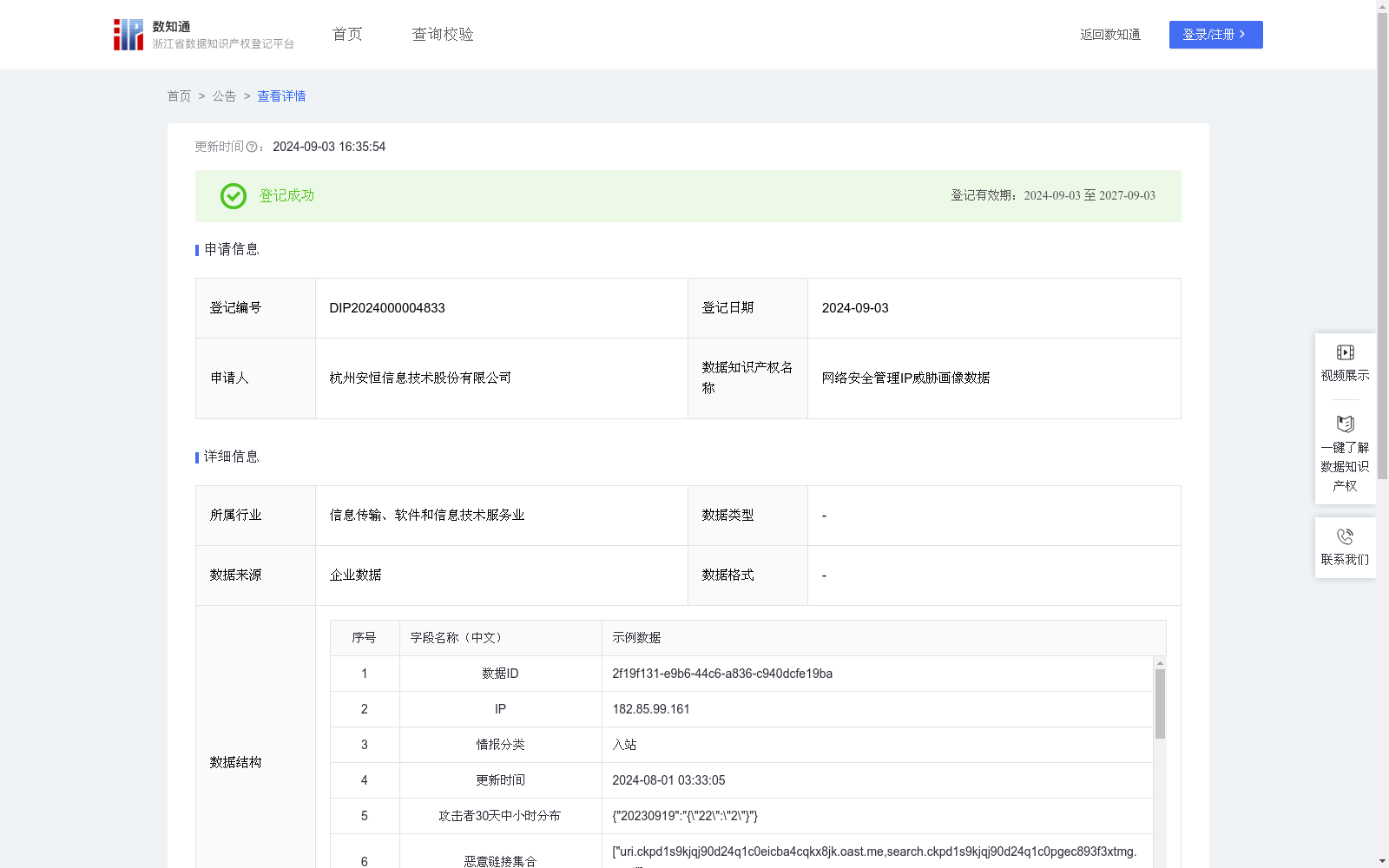
网络安全管理IP威胁画像数据
收藏浙江省数据知识产权登记平台2024-09-03 更新2024-09-04 收录
下载链接:
https://www.zjip.org.cn/home/announce/trends/57494
下载链接
链接失效反馈官方服务:
资源简介:
1. 安全管理平台/态势感知: 全面监控与风险识别:IP威胁画像数据为安全管理平台提供详尽的IP地址信息,涵盖地理位置、组织归属、历史行为等。通过实时网络监控与画像库信息的融合,平台能高效识别异常或高风险IP,为安全团队提供即时的风险预警。 威胁溯源与定位:安全事件发生时,IP威胁画像数据助力安全团队迅速追踪攻击源头,了解攻击者背景和行为模式,为制定精准应对措施提供支持。 2.威胁情报(TI): 恶意IP识别:IP威胁画像数据整合了已知的恶意IP信息,如僵尸网络节点、恶意软件C&C服务器等。威胁情报系统利用这些信息快速识别网络中的恶意IP,为安全团队提供关键威胁线索。 情报分析与关联:借助IP威胁画像数据的丰富数据,威胁情报系统能深入分析安全事件,揭示复杂网络环境中的潜在威胁。例如,通过对比多个恶意IP的画像信息,可发现其关联关系,揭示更广泛的威胁网络。 情报共享与协作:IP威胁画像数据支持跨组织情报共享,通过共享IP画像信息,促进不同组织间的网络安全防护能力提升,实现更广泛的威胁情报协作。数据采集:通过采集系统获取网络安全攻击信息,内容包括但不限于攻击时间、侦查扫描攻击集合、IP等。通过恶意文件监控系统获取内外部流行恶意文件样本:综合收集各类产品日志、SaaS监测等数据; 数据清洗:对采集到的数据进行ETL。以满足后续对IP画像信息进行生产的需求。 数据加工: 1. 利用AI大模型、LSTM+CRF算法等技术进行自然语言处理和安全文章分析,提取分析相关IP画像信息。2. 采用MinHashLSH、Xgboost等算法结合数据进行挖掘产出-恶意IP画像字段:IP、攻击者30天中小时分布、省份分布集合、dnslog集合、侦查扫描攻击集合、漏洞利用攻击集合、IP攻击分析访问端口集合、正常UA占比、403占比、携带XFF占比、访问成功占比、活跃时区分析、访问域名 Top10集合、行为走势分析访问端口TOP10 集合、UA Top10集合、访问路径 Top10集合3. 采用Flink和Kafka等流处理技术,对实时数据进行高效处理分析,并利用Spark和Hadoop等计算框架对海量IP数据并行处理。 4. 结合图谱与聚类算法,形成以上述提到的”恶意IP画像字段“构成的IP威胁画像
1. Security Management Platform/Situation Awareness:
Comprehensive Monitoring and Risk Identification: IP threat profile data provides detailed IP address information for security management platforms, covering geographic location, organizational affiliation, historical behavior, and more. By integrating real-time network monitoring and profile database information, the platform can efficiently identify abnormal or high-risk IPs, providing timely risk warnings for security teams.
Threat Tracing and Localization: When a security incident occurs, IP threat profile data assists security teams in rapidly tracing the source of attacks, understanding the attacker's background and behavioral patterns, and supporting the development of precise response measures.
2. Threat Intelligence (TI):
Malicious IP Identification: IP threat profile data integrates information on known malicious IPs, such as botnet nodes, malicious software Command & Control (C&C) servers, etc. Threat intelligence systems leverage this information to quickly identify malicious IPs within the network, providing critical threat clues for security teams.
Intelligence Analysis and Correlation: With the rich data from IP threat profile data, threat intelligence systems can conduct in-depth analysis of security incidents and uncover potential threats in complex network environments. For example, by comparing the profile information of multiple malicious IPs, their associated relationships can be identified, revealing a broader threat network.
Intelligence Sharing and Collaboration: IP threat profile data supports cross-organizational intelligence sharing. By sharing IP profile information, the cybersecurity protection capabilities of different organizations are enhanced, facilitating more extensive threat intelligence collaboration.
Data Collection: Obtain cybersecurity attack information via collection systems, including but not limited to attack time, reconnaissance and scanning attack sets, IP addresses, etc. Obtain internal and external prevalent malicious file samples through malicious file monitoring systems; comprehensively collect data from various product logs, SaaS monitoring, and other sources.
Data Cleaning: Perform ETL (Extract-Transform-Load) on the collected data to meet the requirements for subsequent production of IP profile information.
Data Processing:
1. Utilize technologies such as AI Large Language Models (LLMs), LSTM+CRF algorithms to perform natural language processing and security article analysis, and extract relevant IP profile information for analysis.
2. Adopt algorithms including MinHashLSH and XGBoost combined with data mining to generate malicious IP profile fields: IP, attacker's hourly distribution over 30 days, provincial distribution set, DNSlog set, reconnaissance and scanning attack set, vulnerability exploitation attack set, IP attack analysis access port set, proportion of normal UA, proportion of 403 status codes, proportion of requests carrying XFF, proportion of successful accesses, active time zone analysis, Top 10 accessed domain name set, Top 10 access port set from behavioral trend analysis, Top 10 UA set, Top 10 access path set
3. Employ stream processing technologies such as Flink and Kafka to efficiently process and analyze real-time data, and use computing frameworks such as Spark and Hadoop to conduct parallel processing of massive IP data.
4. Combine graph and clustering algorithms to form IP threat profiles composed of the aforementioned "malicious IP profile fields".
提供机构:
杭州安恒信息技术股份有限公司
创建时间:
2024-08-02
搜集汇总
数据集介绍
特点
网络安全管理IP威胁画像数据是一个由企业提供的网络安全数据集,包含508条记录,每日更新,详细记录了IP威胁画像信息,如攻击者行为分布、恶意链接集合等,主要用于安全管理平台和威胁情报系统。数据处理采用了多种先进算法和技术,并通过区块链存证确保数据安全。
以上内容由遇见数据集搜集并总结生成


