electricsheepafrica/africa-ilo-str-days-eco-rt-days-not-worked-due-to-strikes-and-lockouts-by-eco
收藏资源简介:
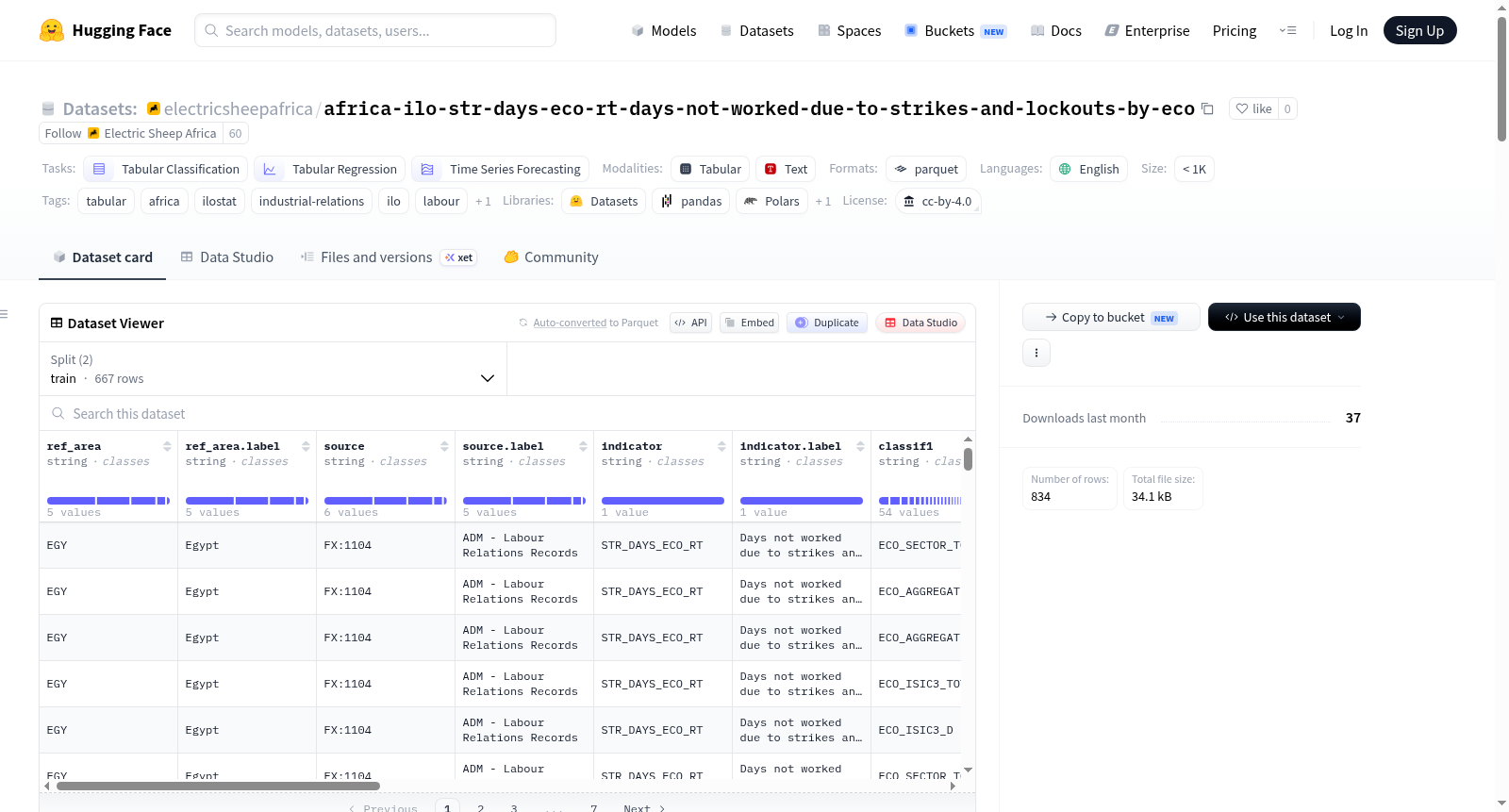
该数据集包含关于因罢工和停工而未工作的天数(按经济活动划分,每1000名工人)的工业关系数据,专门针对非洲地区。数据来源于国际劳工组织(ILO)的ILOSTAT数据库,覆盖了5个非洲国家(包括南非、毛里求斯、埃及、尼日尔和塞舌尔),时间跨度为1980年至2024年,共有834个观测值。数据集的核心指标是STR_DAYS_ECO_RT,用于衡量每1000名工人因罢工和停工而未工作的天数,按经济活动细分。数据以年度频率发布,经过ILOSTAT API获取并过滤,确保与ILO的统计标准一致。数据集架构包括国家代码、国家名称、数据来源、指标代码、分类变量、观测年份、观测值等列,适用于表格分类、回归和时间序列预测等任务。数据质量方面,ILO选择最佳来源处理多源数据,且分类列仅在指标发布细分数据时非空。数据集旨在为研究人员和开发者提供机器学习就绪的非洲劳动力市场数据,便于通过HuggingFace的datasets库快速加载和分析。
This dataset contains industrial relations data on days not worked due to strikes and lockouts, measured per 1,000 workers and disaggregated by economic activity, specifically focusing on the African region. The data is sourced from the ILOSTAT database of the International Labour Organization (ILO), covering 5 African countries including South Africa, Mauritius, Egypt, Niger, and Seychelles, spanning the period from 1980 to 2024 with a total of 834 observations. The core indicator of this dataset is STR_DAYS_ECO_RT, which measures the days not worked per 1,000 workers due to strikes and lockouts, disaggregated by economic activity. The data is released at an annual frequency, obtained and filtered via the ILOSTAT API to ensure alignment with ILO statistical standards. The dataset schema includes columns such as country code, country name, data source, indicator code, categorical variables, observation year, and observed value, making it suitable for tasks like tabular classification, regression, and time series forecasting. In terms of data quality, the ILO selects the best available sources to process multi-source data, and categorical columns are only non-null when the indicator publishes disaggregated data. This dataset aims to provide machine learning-ready African labor market data for researchers and developers, facilitating rapid loading and analysis via the Hugging Face datasets library.