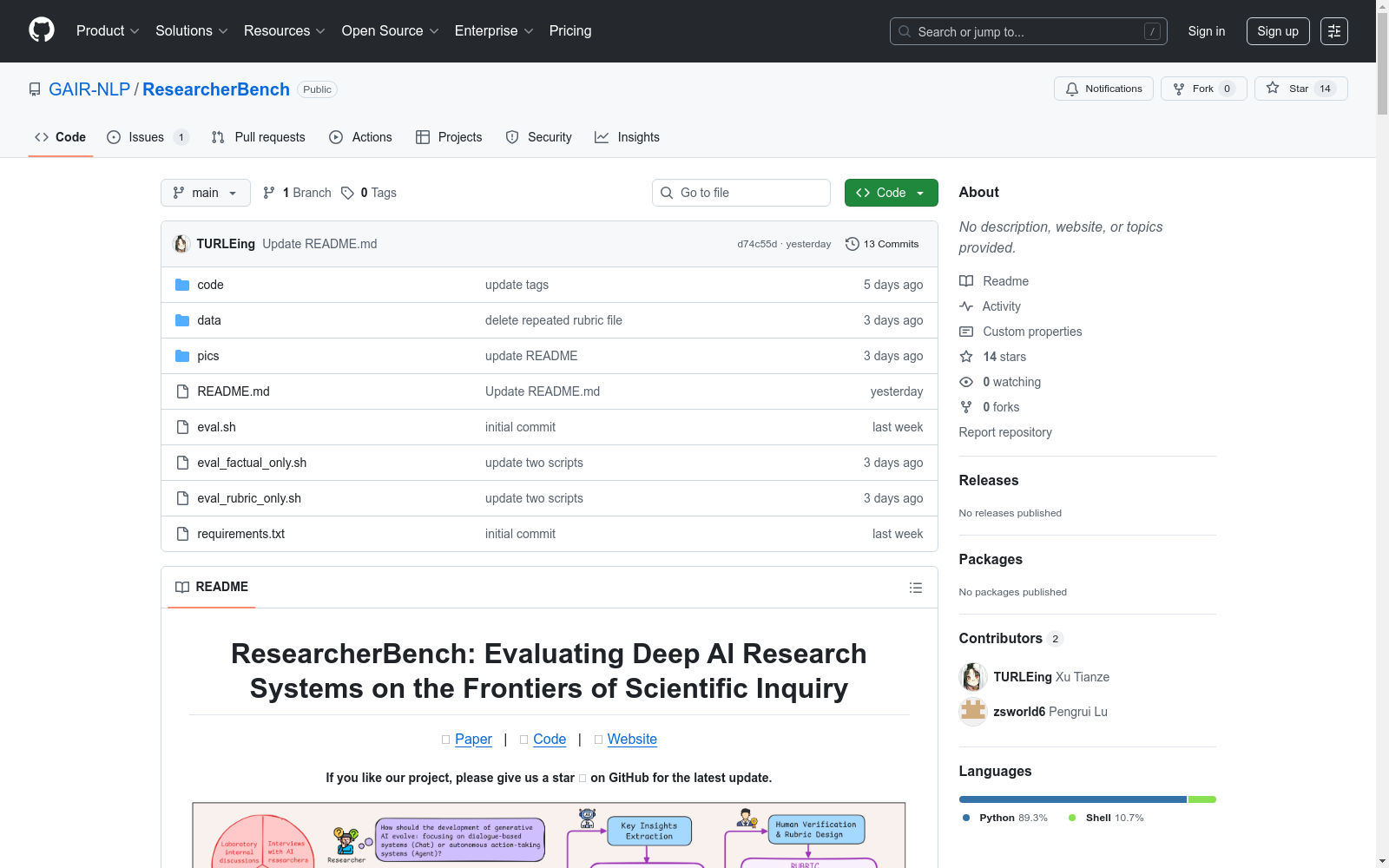
ResearcherBench
收藏资源简介:
ResearcherBench是一个用于评估深度人工智能研究系统(DARS)在科学前沿问题上能力的基准测试平台。该数据集由65个精心挑选的研究问题组成,这些研究问题来自实验室讨论、与领先的人工智能研究人员的访谈和活跃的科学论坛等真实世界科学场景,涵盖了35个不同的人工智能研究主题,并分为技术细节、文献综述和开放咨询三种类型。数据集的创建过程遵循了严格的数据收集和筛选方法,确保了问题的真实性和质量。该数据集旨在解决当前评估框架在评估深度研究能力方面的局限性,特别是在评估人工智能系统是否能够理解复杂问题并提供有意义的见解方面。数据集的应用领域包括促进新一代人工智能研究助手的开发,以及为人工智能研究评估提供新的视角。
ResearcherBench is a benchmark platform for evaluating the capabilities of Deep Artificial Intelligence Research Systems (DARS) on cutting-edge scientific problems. This dataset comprises 65 carefully curated research questions sourced from real-world scientific scenarios including laboratory discussions, interviews with leading AI researchers, and active scientific forums. It covers 35 distinct AI research topics and is categorized into three types: technical details, literature reviews, and open consultation. The dataset was constructed following strict data collection and filtering methodologies to ensure the authenticity and quality of the included questions. This benchmark aims to address the limitations of current evaluation frameworks in assessing in-depth research capabilities, particularly regarding whether AI systems can comprehend complex problems and deliver meaningful insights. The application scenarios of this dataset include facilitating the development of a new generation of AI research assistants, as well as providing new perspectives for AI research evaluation.
ResearcherBench: Evaluating Deep AI Research Systems on the Frontiers of Scientific Inquiry
📋 数据集概述
ResearcherBench是一个专门用于评估深度AI研究系统(DARS)在科学前沿问题上能力的综合评估基准。
核心特点
- 前沿研究问题数据集:包含65个从真实科学场景中精心挑选的研究问题,涵盖35个不同的AI研究主题。
- 双重评估框架:结合专家设计的标准评估和事实评估,全面衡量DARS的能力。
- 系统性评估:对主流商业系统进行系统评估,了解其当前能力和局限性。
🏗️ 数据集构建
数据收集策略
- 实验室内部研究讨论:研究人员积极解决未解决的技术挑战。
- 与领先AI研究人员的访谈:揭示新兴研究方向和开放问题。
- 科学论坛讨论:讨论实施挑战和理论差距。
数据集组成
- 问题类型:技术细节、文献综述和开放咨询。
- 覆盖领域:35个不同的AI主题,如模型架构、强化学习、AI政策和伦理。
🔬 评估框架
1. 标准评估
- 关键见解提取:使用Claude-3.7-Sonnet从多源上下文中提取关键见解。
- 专家标准设计:经验丰富的研究人员将提取的见解转化为加权评估标准(1-3分)。
- 评估方法:评估DARS响应是否覆盖专家标准中指定的关键见解,并计算加权覆盖率。
2. 事实评估
- 声明提取:提取DARS生成报告中的所有事实声明及其上下文。
- 引用支持验证:验证每个URL-声明-上下文三元组是否支持相应声明。
- 评估方法:计算忠实度(Faithfulness)和基础性(Groundedness)两个指标。
📊 评估结果
主要性能
| 模型 | 覆盖率 | 忠实度 | 基础性 |
|---|---|---|---|
| OpenAI Deep Research | 0.7032 | 0.84 | 0.34 |
| Gemini Deep Research | 0.6929 | 0.86 | 0.59 |
| Grok3 DeepSearch | 0.4414 | 0.69 | 0.32 |
| Grok3 DeeperSearch | 0.4398 | 0.80 | 0.31 |
| Perplexity Deep Research | 0.4800 | 0.85 | 0.56 |
| GPT-4o Search Preview | 0.3576 | 0.86 | 0.39 |
| Perplexity: Sonar Reasoning Pro | 0.4663 | 0.62 | 0.68 |
关键见解
- DARS作为研究构思伙伴:所有评估系统在开放咨询问题上表现更好。
- 合成优于检索:高基础性并不一定与研究质量相关。
🚀 快速开始
环境设置
bash git clone https://github.com/GAIR-NLP/ResearcherBench.git cd ResearcherBench pip install -r requirements.txt export OPENAI_API_KEY="your-openai-api-key" export JINA_API_KEY="your-jina-api-key"
数据准备
bash cp your_model_responses.json data/user_data/<model_name>.json export MODEL=<model_name>
运行评估
bash ./eval.sh
查看结果
bash cat results/rubric_eval/<model_name>/<model_name>_evaluation_results.txt cat results/factual_eval/<model_name>/factual_analysis.json
📁 项目结构
ResearcherBench/ ├── data/ │ ├── eval_data/ │ │ ├── rubric.json │ │ └── questions.json │ └── user_data/ ├── code/ │ ├── rubric_eval/ │ └── faithfulness_eval/ ├── results/ │ ├── rubric_eval/ │ ├── factual_eval/ │ ├── claims/ │ └── logs/ ├── eval.sh ├── requirements.txt └── README.md
📋 数据格式
json [ { "id": 1, "question": "What are the latest developments in quantum computing?", "response": "Recent advances in quantum computing include... [1]" } ]
📚 引用
bibtex @misc{xu2025researcherbenchevaluatingdeepai, title={ResearcherBench: Evaluating Deep AI Research Systems on the Frontiers of Scientific Inquiry}, author={Tianze Xu and Pengrui Lu and Lyumanshan Ye and Xiangkun Hu and Pengfei Liu}, year={2025}, eprint={2507.16280}, archivePrefix={arXiv}, primaryClass={cs.AI}, url={https://arxiv.org/abs/2507.16280}, }