OpenViTac
收藏资源简介:
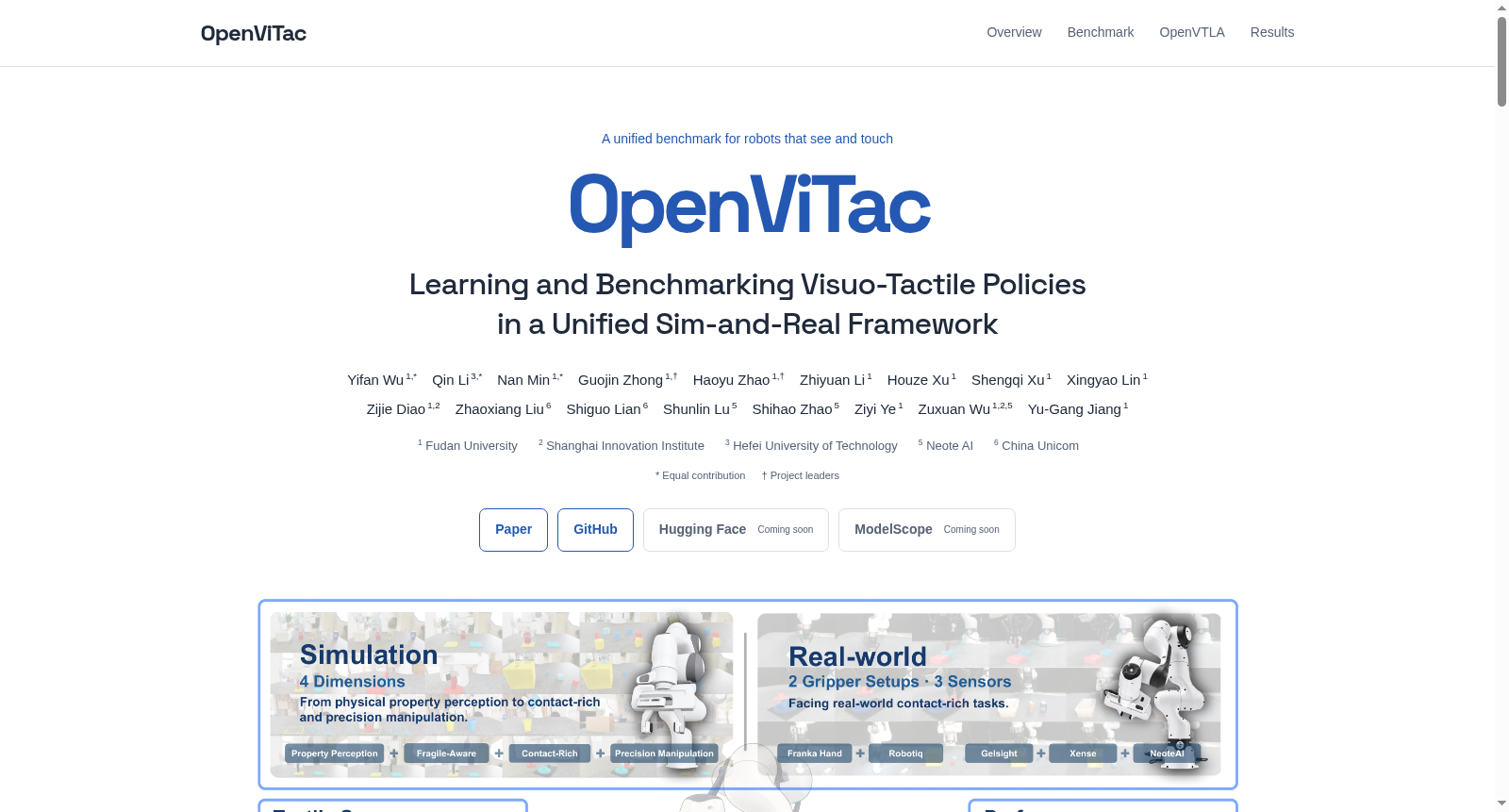
OpenViTac 是由复旦大学、上海市多模态具身智能重点实验室、合肥工业大学、新加坡国立大学、Neote AI 与中国联通等联合构建的统一视觉-触觉机器人操作基准,旨在贯通仿真与真实环境进行一致评测。该基准围绕物理属性感知、脆弱物体感知、富接触操作和精细操作四维能力,涵盖11项仿真任务与8项配对真实任务,支持2种夹爪配置和3类触觉传感器。其构建采用智能体辅助的真实到仿真流水线,从多视图重建仿真资产,并在任务级对齐物体、目标与机器人初始状态,同时可配置背景和场景外观以扩展数据分布。它主要服务于 VLA、WAM 与 VTLA 策略的跨域评估,并支撑触觉表征、融合策略及仿真-真实协同训练研究,以解决触觉机器人操作缺乏统一基准的问题。
OpenViTac is a unified vision-tactile robotic manipulation benchmark jointly developed by Fudan University, Shanghai Key Laboratory of Multimodal Embodied Intelligence, Hefei University of Technology, National University of Singapore, Neote AI, China United Network Communications and other institutions. It is designed to enable consistent evaluation of robotic manipulation across both simulation and real-world scenarios. Centered on four core capabilities including physical property perception, fragile object perception, rich-contact manipulation and dexterous manipulation, the benchmark encompasses 11 simulation tasks and 8 paired real-world tasks, and supports two types of gripper configurations and three categories of tactile sensors. The benchmark is built upon an agent-assisted real-to-simulation pipeline, which reconstructs simulation assets from multi-view images, aligns objects, targets and robot initial states at the task level, and allows configurable backgrounds and scene appearances to expand the data distribution. It primarily serves for cross-domain evaluation of VLA, WAM and VTLA policies, and supports research on tactile representation, fusion strategies and simulation-real world collaborative training, aiming to address the shortage of unified benchmarks for tactile robotic manipulation.
OpenViTac 数据集概述
基本信息
- 名称:OpenViTac
- 全称:OpenViTac: Learning and Benchmarking Visuo-Tactile Policies in a Unified Sim-and-Real Framework
- 类型:面向机器人的视觉-触觉统一基准(sim-and-real 统一框架)
- 核心目标:为同时具备视觉与触觉的机器人提供统一基准,评估视觉-语言-动作(VLA)、世界-动作(world-action)、视觉-触觉-语言-动作(VTLA)等策略
- 相关资源:Paper、GitHub、Hugging Face(Coming soon)、ModelScope(Coming soon)
作者与机构
- 作者:Yifan Wu、Qin Li、Nan Min、Guojin Zhong、Haoyu Zhao、Zhiyuan Li、Houze Xu、Shengqi Xu、Xingyao Lin、Zijie Diao、Zhaoxiang Liu、Shiguo Lian、Shunlin Lu、Shihao Zhao、Ziyi Ye、Zuxuan Wu、Yu-Gang Jiang
- 机构:
- Fudan University
- Shanghai Innovation Institute
- Hefei University of Technology
- Neote AI
- China Unicom
- 标注:* 表示同等贡献,† 表示项目负责人
数据集规模与构成
- 仿真任务:11
- 配对真实世界任务:8
- 触觉能力维度:4
- 触觉传感器类型:3
任务分类
任务按能力分为四类,共计 11 个:
| 类别 | 数量 | 任务 |
|---|---|---|
| 属性感知(Property perception) | 5 | 重量分类(WC)、硬度分类(HC)、粗糙度分类(RC)、粗糙度引导重抓取(RR)、空罐选择(ECS) |
| 脆弱性感知(Fragility-aware) | 1 | 抓取芯片(GC) |
| 接触丰富(Contact-rich) | 2 | 齿轮装配(GA)、拉抽屉(PD) |
| 精密操作(Precision) | 3 | 插入 USB(In-USB)、插入积木 v1(In-B v1)、插入积木 v2(In-B v2) |
触觉能力维度
覆盖四个视觉难以获取的物理属性:重量、纹理、脆弱性、接触。
仿真与真实世界对齐
- 对应任务:8 个共享任务在仿真与真实硬件上采用匹配的操作目标,支持对比。
- 多样化环境:背景、工作空间外观与周围环境变化,而底层任务配置保持一致,从而扩大训练分布。
- 资产与任务构建:通过智能体辅助的资产重建与任务构建,在跨域间保留任务相关结构。
OpenVTLA 方法
- 定义:一种将预训练 VLA 模型适配触觉的实用方法,并研究仿真经验如何提升真实世界操作。
- 架构要点:
- 时序触觉编码器:使用 AnyTouch2 将触觉历史编码为紧凑 token。
- 早期 token 级融合:触觉 token 投影到 VLM 隐藏维度,并前置到 π 0.5 的视觉序列。
- 保留原始视觉-语言与动作通路,无需额外融合模块或触觉专用专家。
- 研究维度:
- 触觉表示:4 种
- 融合策略:5 种
评测结果
总体成功率
- 仿真环境:68.7%
- 真实硬件:54.6%
- 仿真-真实 Pearson 相关系数:0.913
仿真策略成功率(%,按平均成功率排序,展示 5/11 个策略)
| 策略 | WC | HC | RC | RR | ECS | GC | GA | PD | In-USB | In-B v1 | In-B v2 | 平均 |
|---|---|---|---|---|---|---|---|---|---|---|---|---|
| OpenVTLA(VTLA,本文) | 89 | 99 | 100 | 90 | 73 | 69 | 91 | 99 | 27 | 11 | 8 | 68.7 |
| FTP-1(VTLA) | 61 | 100 | 100 | 78 | 50 | 60 | 83 | 94 | 27 | 12 | 8.3 | 61.2 |
| InternVLA-A1.5(VLA) | 53 | 76 | 65 | 77 | 47 | 53 | 79 | 98 | 3 | 6 | 9.3 | 51.5 |
| π₀.₅(VLA) | 53 | 60 | 64 | 52 | 48 | 39 | 87 | 99 | 14 | 9 | 9.3 | 48.6 |
| Lingbot-VLA-2(VLA) | 52 | 58 | 58 | 53 | 52 | 41 | 78 | 92 | 8 | 5 | 2.7 | 45.4 |
- 平均值为任务间未加权均值。
- 所有策略均采用单任务训练。
仿真数据对真实数据的增益
在每任务 100 条真实演示的基础上,增加 500 条仿真演示,可使 OpenVTLA 在 USB 插入与齿轮装配上的平均成功率提升 15 个百分点。
| 训练数据 | Insert USB | Gear assembly |
|---|---|---|
| 100 real | 20 | 50 |
| 100 real + 500 sim | 40 | 60 |
引用信息
- BibTeX Key:wu2026openvitac
- 年份:2026
- 状态:预印引用,出版信息将随论文发布补充。
缩略语对照
| 缩略语 | 全称 |
|---|---|
| WC | Weight classification(重量分类) |
| HC | Hardness classification(硬度分类) |
| RC | Roughness classification(粗糙度分类) |
| RR | Roughness-guided regrasp(粗糙度引导重抓取) |
| ECS | Empty-can selection(空罐选择) |
| GC | Grasp chip(抓取芯片) |
| GA | Gear assembly(齿轮装配) |
| PD | Pull drawer(拉抽屉) |
| In-USB | Insert USB(插入 USB) |
| In-B v1 | Insert block v1(插入积木 v1) |
| In-B v2 | Insert block v2(插入积木 v2) |