ModalityFaultLines-SCEval
收藏资源简介:
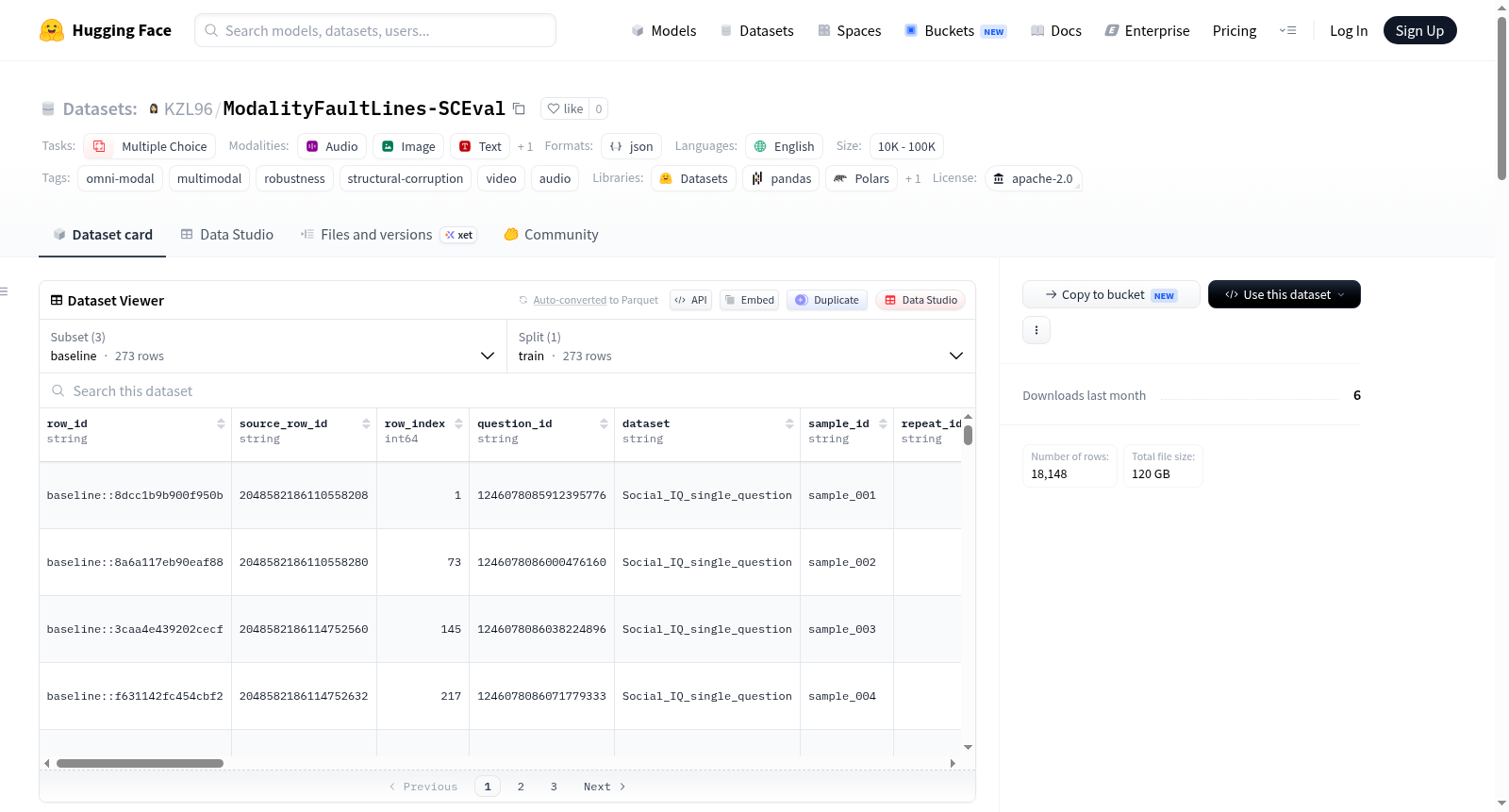
SCEval(Modality Fault Lines)是一个用于评估全模态(omni-modal)推理鲁棒性的人工验证基准数据集。该数据集通过引入结构破坏(structural corruptions)来测试模型在文本、视觉和音频三种模态同时存在时,能否正确识别并利用可靠的信息。每个破坏样本都与一个干净的基线样本配对,使得可以在相同的底层问题、选项和参考答案上进行干净与破坏后的对比。数据集包含三个子集:baseline(273 个干净的三模态问题)、single(29,144 个单模态破坏样本,覆盖 14 种破坏操作和 4 个严重度级别)和 combined(17,875 个双模态/三模态联合破坏样本)。每条记录包含问题文本、选项(A0-A4)、正确答案键、破坏元数据(如破坏模态、操作类型、严重度、变体)以及媒体文件的直接 URL。媒体文件来源于 Social-IQ、OmniBench 和 VALOR 三个基准数据集,覆盖视频和图像。该数据集适用于多模态问答、鲁棒性评估、结构破坏分析等任务。
SCEval (Modality Fault Lines) is a human-validated benchmark dataset for evaluating the robustness of omni-modal reasoning. It introduces structural corruptions to test whether models can correctly identify and utilize reliable information when text, vision, and audio modalities are present simultaneously. Each corrupted sample is paired with a clean baseline sample, allowing comparison between clean and corrupted versions on the same underlying question, options, and reference answer. The dataset includes three subsets: baseline (273 clean tri-modal questions), single (29,144 unimodal corruption samples covering 14 corruption operations and 4 severity levels), and combined (17,875 bimodal/trimodal joint corruption samples). Each record contains question text, options (A0-A4), correct answer key, corruption metadata (e.g., corrupted modality, operation type, severity, variant), and direct URLs to media files. Media files are sourced from three benchmark datasets: Social-IQ, OmniBench, and VALOR, covering videos and images. The dataset is suitable for tasks such as multimodal question answering, robustness evaluation, and structural corruption analysis.
数据集概述
SCEval — Modality Fault Lines 是一个用于评估全模态(omni-modal)推理鲁棒性的人工验证基准数据集,对应论文 Modality Fault Lines: Structural Corruptions Reveal Fragile Omni-Modal Reasoning(EMNLP 2026 Findings)。其核心设计理念是:在文本、视觉和音频三模态均存在的前提下,对某个模态施加受控的结构性损坏,使该模态内部的证据变得不可靠,从而测试模型的鲁棒性。所有损坏样本均与其干净版本配对,同一底层问题、选项和参考答案可直接进行对比。
数据集构成
| 数据分割 | 行数 | 内容说明 |
|---|---|---|
baseline |
273 | 干净的三模态问题,作为所有损坏样本的对照基准。 |
single |
29,144 | 单模态损坏样本,涵盖14种损坏算子,严重度级别为10/30/50/70。 |
combined |
17,875 | 双模态与三模态联合损坏样本,包含18种双模态和11种三模态预设条件。 |
数据文件以 JSONL 格式存储,每行包含一个问题及其完整评估信息,包括问题文本、选项、参考答案、损坏元数据以及媒体文件的直接 URL。媒体目录结构为 <source>/<sample_id>/<modality>/<operator>/<severity>/<variant>/<file>。
媒体资源
媒体文件来源于三个现有基准数据集,共273个基础样本:
- Social_IQ_single_question:视频 + 音频,100个基础样本;
- omnibench:图像 + 音频,77个基础样本;
- valor:视频 + 音频,96个基础样本。
完整媒体资源约112 GB,可通过 snapshot_download 按子目录选择性下载。
关键字段说明
| 字段 | 含义 |
|---|---|
row_id, question_id, sample_id |
标识符,sample_id 用于关联损坏样本与对应干净样本。 |
dataset |
来源基准(Social_IQ_single_question / omnibench / valor)。 |
question, original_question |
损坏后/损坏前的问题文本(文本通道未损坏时二者相同)。 |
options, gold_key, gold_answer_raw |
答案选项(A0–A3)、正确选项键及其完整文本。 |
visual_url, audio_url |
该行实际展示给模型的媒体文件 URL。 |
original_visual_url, original_audio_url |
同一示例的干净媒体文件 URL。 |
corrupted_url |
被损坏的通道对应的媒体 URL,等于 visual_url 或 audio_url。 |
visual_kind |
视觉通道类型:video 或 image。 |
corruption_modality |
被损坏的模态:文本 / 视觉 / 音频。 |
corruption_group, corruption_type |
损坏算子族及具体算子。 |
severity_base |
严重度级别:10、30、50、70。 |
severity_variant |
同一严重度下的多次随机实现标识。 |
is_baseline |
仅在 baseline 分割中为 true。 |
condition_id, condition_label |
仅在 combined 分割中出现,标识联合损坏的预设条件。 |
human_understandable, human_valid, human_must_three_modal |
人工验证结果(是/否)。 |
评估约定
- 损坏样本必须与其同
sample_id的基线样本配对评估,因此baseline分割应与任何损坏分割同时使用。 - 对于随机算子,同一 (模型、模态、算子、严重度) 桶内的多个
severity_variant实现采用最差情况聚合:若任一实现回答错误,该桶计为错误。
许可证与来源
本数据集以 Apache-2.0 许可证发布,损坏媒体基于以下三个现有基准数据集派生,其原始资料仍受原许可证约束:
- Social-IQ(https://github.com/A2Zadeh/Social-IQ)
- OmniBench(https://m-a-p.ai/OmniBench/)
- VALOR(https://github.com/TXH-mercury/VALOR)
使用本数据集时,除引用本工作外,请同时引用上述来源数据集。
引用格式
bibtex @inproceedings{sceval2026, title = {Modality Fault Lines: Structural Corruptions Reveal Fragile Omni-Modal Reasoning}, booktitle = {Findings of the Association for Computational Linguistics: EMNLP 2026}, year = {2026} }