
Data file
收藏DataCite Commons2025-06-01 更新2024-07-28 收录
下载链接:
https://figshare.com/articles/dataset/Data_file/14619279/1
下载链接
链接失效反馈官方服务:
资源简介:
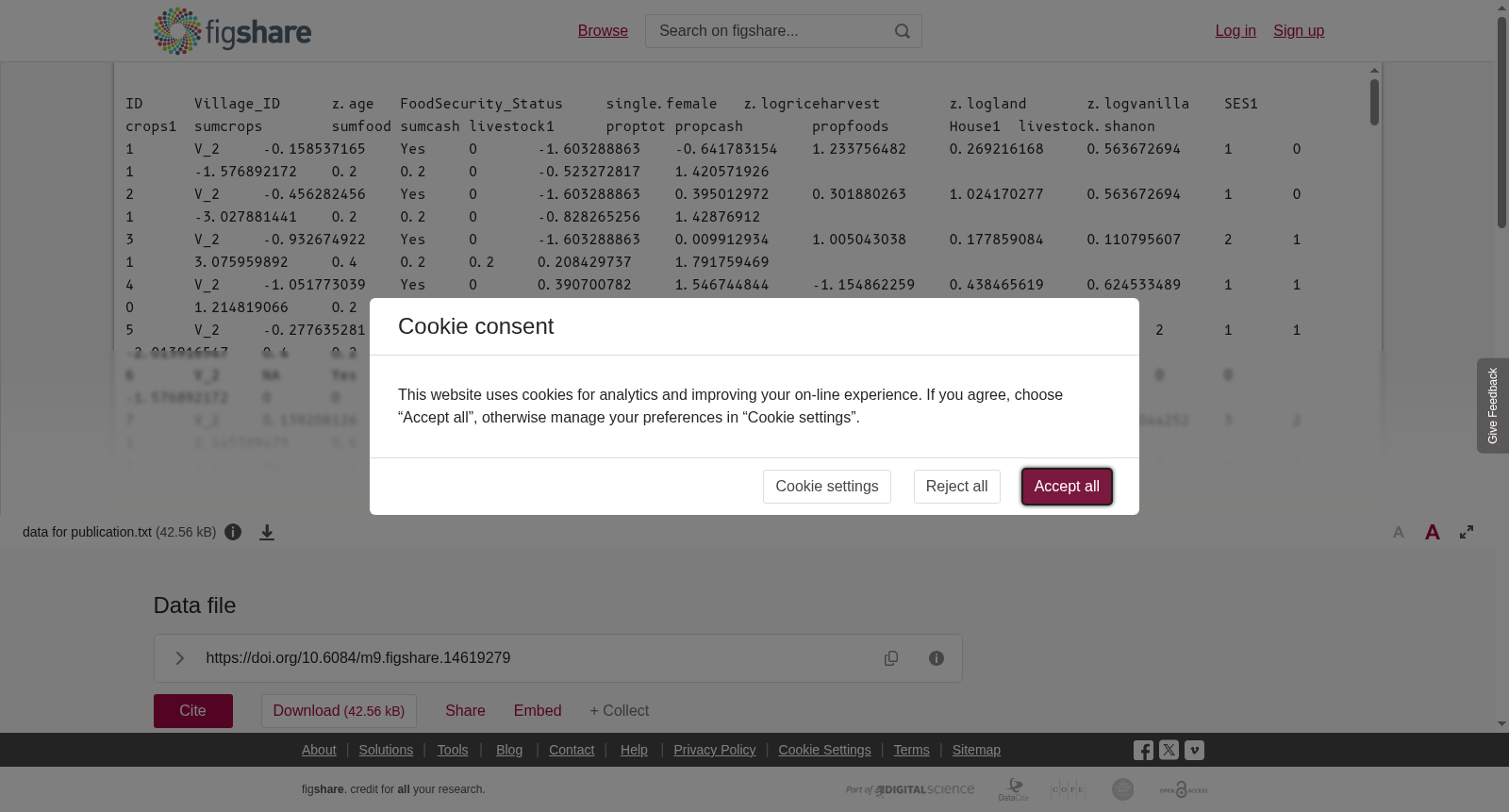
These data are associated with the publication "Food insecurity related to agricultural practices and household characteristics in rural communities of northeast Madagascar", accepted for publication at the journal Food Security, May 2021.<br>The explanation of variables provided is given in a ReadMe file. Only de-identified and processed data are provided, in accordance with our International Review Board ethical protocol. Not all variables collected during the study can be provided publicly to ensure the confidentiality of our participants.<br>Data were collected using the following methods:<b>Study design: </b>The survey team included RJY and NAFR as the primary enumerators, local Malagasy researchers from each village, and AO, CF, and MM. Data were collected during the months of June and August, in Mandena in 2018, and in Manantenina and Matsobe in 2019. In each of the three communities, we conducted social surveys for randomly selected households. In Mandena, a drone image of the village was overlaid with a grid system (100X100m cells), which was used to first randomly sample grids, and then randomly sample households within grids, in proportion to the number of houses in those grids. In Manantenina, a member of the research team who lived in the village provided a complete list of all village households, which was used to randomly sample households. In Matsobe, 2018-2019 census data were used to randomly select households. If no members of the randomly selected household could be found, that household was substituted for an available neighbor.All surveys were administered in the local dialect of Malagasy, and informed consent was given by all study participants prior to taking the survey. RJY or AFR and/or a local research team member, fluent in the local dialect, conducted the informed consent and survey with the study participant. The survey was conducted using Qualtrics software on Samsung tablets, and had an average duration of 60 minutes to complete. Study participants were compensated with 1,000 Ariary (MGA, approximately 0.30 USD) in mobile phone credit upon survey completion.<b><i>Food insecurity</i></b><b>: </b>Questions about food insecurity were modified from a prior study of agrarian socioeconomics in Malawi (Ward et al. 2018). We asked respondents if they had times when there was not enough food to feed the family over the past three years. We note that in Malagasy culture, when referring to food security generally, the interpretation is whether there was enough rice for the household, since rice is the staple food. To address the causes of food insecurity, options on the survey included small land size, lack of money, the cost of food in the local markets, extreme natural events (i.e., cyclones, droughts, insect or rodent pest outbreaks), as well as allowing the respondent to give any other reason for food insecurity.<b><i>Socioeconomic characteristics</i></b><b>: </b>Standard data on demographics of households were collected using a survey adapted from the Demographic and Health Survey instrument (ICF_International, 2012). These variables included the number of individuals in the household, their ages in years, gender, education level, and main activity (farming, wage labor, etc.), and whether farmers reported other wage-earning activities other than their subsistence farming. To assess material wealth, we also collected data on the ownership of common household assets, such as radio, television, telephone, generator, solar panels, and farming tools including shovels, axes, plows. We asked about the household materials used to build the walls, roof, and floor, including natural products that were collected such as bamboo, raffia, and <i>Ravinala</i>, and purchased materials including wood planks, aluminum sheets, or cement. To create composite asset indicators, we used principal components analysis (PCA) to summarize the data on household assets and household building materials into orthogonal axes that best captured the variance in the data. As an alternative measure, we summed the number of assets the respondent reported. Households were classified as having a single female head if the respondent was female, identified herself as the head of the household, and reported that she was either not married nor living with a partner, or was a widow.<b><i>Agricultural practices</i></b><b>: </b>Questions about agricultural practices included the types of crops grown, how farmers grew rice (low-land flooded paddies, on hillsides, or both), and domestic animal ownership (the number of animals owned for livestock, poultry, and other animals, enumerated between 1-5 or more than 5 individual animals). The size of farm land was assessed by asking farmers about the input of rice that would be required to grow rice on their land, based on a conversion that approximately 15kg is used to farm one ha (pers. comm. with local stakeholders). Rice and vanilla harvests were calculated in kg.To calculate crop diversification, we enumerated the total number of crops the farmers reported growing in the last year, as well as the total number of cash crops (coffee, cloves, cacao, and vanilla). We also calculated the proportion of the top five crops grown by the respondent, based on the five most commonly grown crops across all respondents. We divided these proportions among the top five food and cash crops. Lastly, we used a PCA to summarize the crop data into two axes that best separated farmers according to those that grow similar crops. We quantified variation in domestic animal ownership as the sum of domestic animals owned, as well as the richness and diversity (Shannon diversity index) of all domestic animals owned (cattle, pigs, goats, poultry). We also conducted a PCA of domestic animals owned to use the first PC as a composite score of domestic animal ownership.
本数据集关联的论文为《马达加斯加东北部乡村社区粮食不安全与农业实践及家庭特征的关联》,已于2021年5月被《Food Security》期刊接收发表。<br>变量说明详见配套的ReadMe文件。本数据集仅提供去标识化的处理后数据,符合我们所在国际审查委员会的伦理规程要求。为保护研究参与者的隐私,研究中采集的部分变量无法公开披露。<br>数据采集采用以下方法:<b>研究设计:</b>调查团队由作为主要调查员的RJY、NAFR,来自各村落的本土马达加斯加研究者,以及AO、CF、MM组成。数据采集时间为2018年6月、8月(曼德纳(Mandena)地区)与2019年6月、8月(马南塔尼纳(Manantenina)及马措贝(Matsobe)地区)。我们在三个社区中均针对随机抽取的家庭开展社会调查。在曼德纳地区,研究团队将村落无人机影像与100×100米的网格系统叠加,先随机抽取网格,再根据各网格内的房屋数量比例,随机抽取网格内的家庭作为调查对象。在马南塔尼纳地区,由居住在该村的研究团队成员提供全村所有家庭的完整名单,以此随机抽取调查家庭。在马措贝地区,则利用2018-2019年的人口普查数据随机选取调查家庭。若无法联系到抽中家庭的任何成员,则以该家庭附近的可受访家庭替代。所有调查均使用马达加斯加本土方言开展,所有研究参与者均在调查前签署<b>知情同意(informed consent)</b>书。由RJY或AFR,以及一名熟练掌握本土方言的本土研究团队成员,向研究参与者完成知情同意流程并开展调查。本次调查使用三星平板电脑搭载Qualtrics软件完成,平均耗时60分钟。调查完成后,参与者将获得价值1000马达加斯加阿里亚里(MGA,约合0.30美元)的手机话费作为补偿。<br><b><i>粮食不安全(Food insecurity)</i></b>:粮食不安全相关问题改编自马拉维一项农业社会经济学研究(Ward等人,2018年)。我们向受访者询问了过去三年中是否曾出现过无法为全家提供足够食物的情况。需说明的是,在马达加斯加文化中,提及粮食安全时通常特指家庭是否有足够的大米作为主食,因为大米是当地的主粮。本次调查针对粮食不安全的成因设置了如下选项:耕地面积过小、资金匮乏、本地市场粮价过高、极端自然灾害(如飓风、干旱、昆虫或啮齿类虫害暴发),同时也允许受访者自行补充其他粮食不安全的成因。<br><b><i>社会经济特征(Socioeconomic characteristics)</i></b>:家庭人口统计学相关的标准数据采用改编自《人口与健康调查(Demographic and Health Survey)》工具(ICF国际(ICF_International),2012年)的问卷采集。相关变量包括家庭人口数、家庭成员年龄、性别、受教育水平、主要职业(务农、有偿劳动等),以及农户是否除自给自足农业外还从事其他有偿创收活动。为评估家庭物质财富水平,我们还收集了常见家用资产的拥有情况,包括收音机、电视机、电话、发电机、太阳能板,以及铁锹、斧头、犁等农具。我们同时调查了家庭建筑所用的墙体、屋顶及地面材料,包括采集自自然环境的材料如竹子、拉菲草、旅人蕉(Ravinala),以及购买的材料如木板、铝板或水泥。为构建综合资产指标,我们采用<b>主成分分析(Principal Components Analysis,PCA)</b>将家庭资产及建筑材料数据整合为正交轴,以最优方式捕捉数据的方差变异。作为替代衡量方式,我们也对受访者报告的资产数量进行了加总。若受访者为女性,且自述为家庭户主,同时表明自己未婚且无同居伴侣,或为丧偶状态,则将该家庭归类为女性户主家庭。<br><b><i>农业实践(Agricultural practices)</i></b>:农业实践相关问题涵盖种植作物种类、水稻种植方式(低地淹水稻田、山坡种植或两者兼具),以及家畜拥有情况(家畜、家禽及其他动物的数量,按1-5只及5只以上分类统计)。耕地面积通过询问农户其种植水稻所需的稻种投入量进行估算,换算依据为每公顷耕地约需15kg稻种(与本地利益相关方沟通确认)。水稻和香草的产量以千克为单位计算。为计算作物多样性指数,我们统计了农户报告的去年种植的作物总种类数,以及经济作物(咖啡、丁香、可可及香草)的总种类数。我们还基于所有受访者中种植最广泛的五种作物,计算了受访者种植的前五类作物占比,并将该占比分为粮食作物前五名与经济作物前五名两类。最后,我们采用主成分分析(PCA)将作物数据整合为两个轴,以最优方式区分种植同类作物的农户。我们通过家畜总拥有数量、所有家畜(牛、猪、山羊、家禽)的丰富度及<b>香农多样性指数(Shannon diversity index)</b>来量化家畜拥有情况的差异。我们还对家畜拥有情况开展了主成分分析(PCA),以第一主成分作为家畜拥有情况的综合得分。
提供机构:
figshare创建时间:
2021-05-19
搜集汇总
数据集介绍
背景与挑战
背景概述
该数据集关联于2021年发表在《Food Security》期刊的论文,研究马达加斯加东北部农村地区的粮食不安全问题,涉及农业实践和家庭特征的调查数据。数据收集于2018年和2019年,通过社会调查方法获取,包括随机抽样家庭、使用本地语言进行问卷访谈,并经过匿名化处理以确保参与者隐私。数据集提供已处理的变量信息,适用于社会科学和农业可持续性研究。
以上内容由遇见数据集搜集并总结生成


