
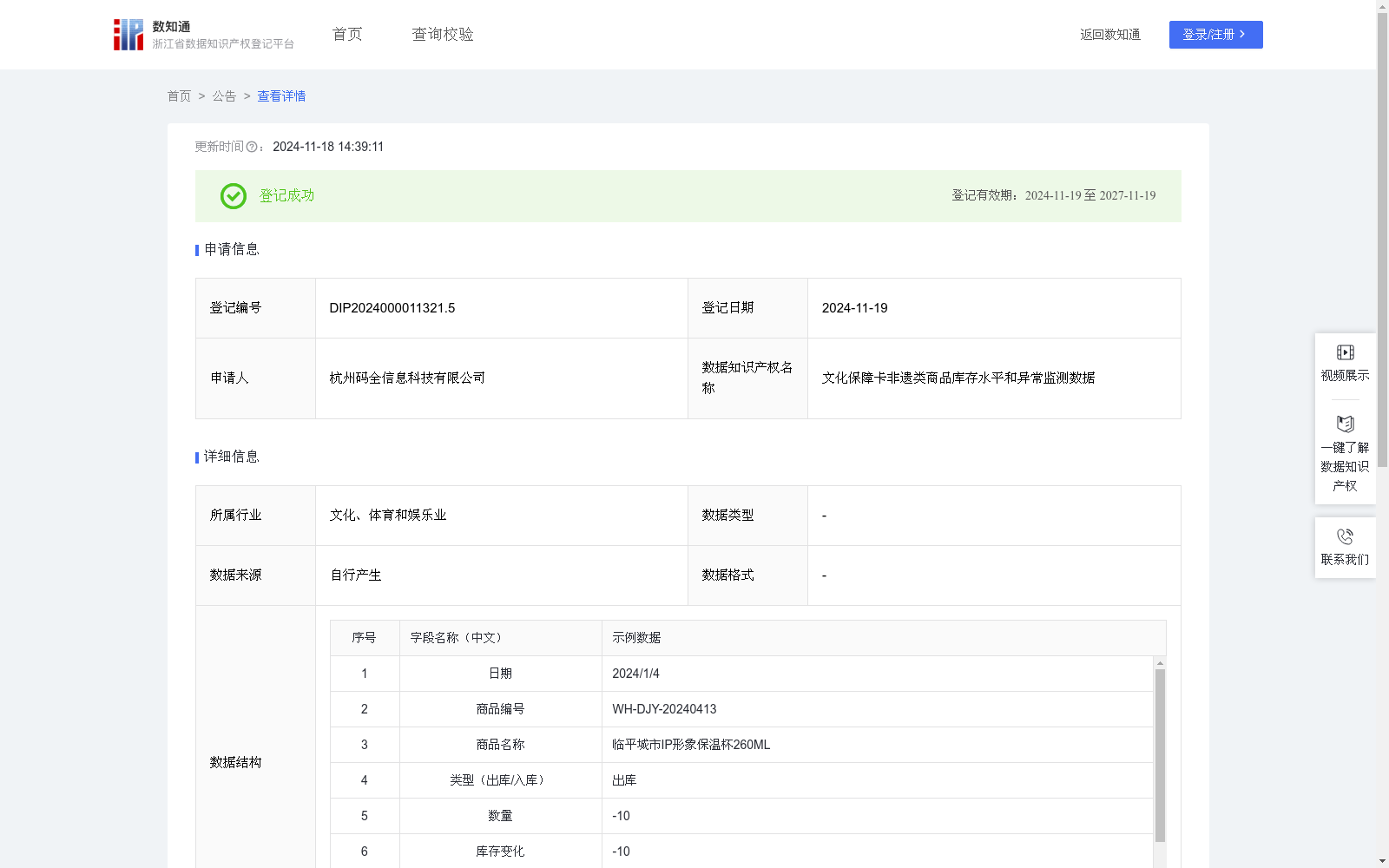
文化保障卡非遗类商品库存水平和异常监测数据
收藏浙江省数据知识产权登记平台2024-11-18 更新2024-11-19 收录
下载链接:
https://www.zjip.org.cn/home/announce/trends/85847
下载链接
链接失效反馈官方服务:
资源简介:
非遗类商品是指与非物质文化遗产相关的商品或服务,包括非遗工艺品、制作技艺的研学课程等。本数据提供了文化保障卡非遗类商品的库存水平和异常监测信息,旨在为不同应用场景提供决策支持:1.库存管理与优化:商品的仓库管理人员可以利用本数据实时监控非遗类商品的库存水平,及时补充低库存商品,减少过剩库存,优化库存结构,从而提高库存周转率和降低持有成本。2.风险预警与异常处理:通过监测库存异常,如库存水平的突然大幅波动,管理人员可以快速识别潜在的风险,如数据录入错误、商品损坏等,并及时采取措施进行处理,减少损失。3.销售与市场策略:销售团队可以基于库存数据进行销售趋势分析,为不同非遗类商品制定更有效的销售策略和促销活动,如针对高库存商品进行促销,或针对低库存商品进行补货和预订。4.供应链管理:商品的供应商可以参考本数据来进一步识别商品的市场需求变化,从而优化其自身的供应链管理,调整生产和供货计划。5.客户满意度提升:客户服务人员可以利用本数据确保热门的非遗类商品的及时供应,减少因缺货导致的客户不满,同时通过及时响应市场变化,提升客户服务质量和客户满意度。1.数据抽取:从公司文化保障卡服务系统里抽取非遗类商品的入库和出库记录,包括日期、商品编号、商品名称、类型(出库/入库)、数量。
2.数据预处理:对抽取的数据进行清洗,确保数据质量,便于后续的加工和分析。
3.数据加工和分析:(1)计算库存变化:使用IF函数计算每条记录的库存变化,如果是入库,则库存变化等于数量;如果是出库,则库存变化等于数量的相反数。(2)计算累计库存量:使用IF和SUM函数嵌套计算每个商品编号的累计库存量,具体步骤为:①为每个商品编号创建一个累计库存量的初始值,设为0;②对于每个商品编号的每条记录,如果该记录是该商品编号的第一条记录,则累计库存量等于该记录的库存变化;如果该记录不是第一条记录,那么累计库存量等于前一条相同商品编号记录的累计库存量加上当前记录的库存变化。(3)库存状态分类:使用IF函数根据累计库存量对每个商品的库存状态进行分类,库存量大于150为“高”,小于50为“低”,否则为“中”。(4)异常监测:设置阈值,当库存量突然大幅度减少(即库存变化超过500),则标记为异常,反之为正常。
Intangible Cultural Heritage (ICH) related commodities refer to goods or services associated with intangible cultural heritage, including ICH handicrafts, study tours for traditional craftsmanship, etc. This dataset provides inventory level and anomaly monitoring information for ICH-related commodities under the Cultural Security Card program, aiming to offer decision-making support for various application scenarios:
1. Inventory Management and Optimization: Warehouse managers can use this dataset to monitor the inventory levels of ICH-related commodities in real time, replenish low-stock goods in a timely manner, reduce excess inventory, optimize inventory structure, thereby improving inventory turnover rate and lowering holding costs.
2. Risk Early Warning and Abnormal Handling: By monitoring inventory anomalies such as sudden and drastic fluctuations in inventory levels, managers can quickly identify potential risks such as data entry errors, commodity damage, etc., and take timely measures to address them, reducing losses.
3. Sales and Marketing Strategy: The sales team can conduct sales trend analysis based on inventory data, formulate more effective sales strategies and promotional activities for different ICH-related commodities, such as running promotions for high-stock goods, or restocking and pre-ordering for low-stock goods.
4. Supply Chain Management: Commodity suppliers can refer to this dataset to further identify changes in market demand for goods, thereby optimizing their own supply chain management and adjusting production and supply plans.
5. Customer Satisfaction Improvement: Customer service staff can use this dataset to ensure timely supply of popular ICH-related commodities, reduce customer dissatisfaction caused by stockouts, and improve customer service quality and customer satisfaction by responding timely to market changes.
1. Data Extraction: Extract inbound and outbound records of ICH-related commodities from the company's Cultural Security Card service system, including date, commodity ID, commodity name, type (inbound/outbound), and quantity.
2. Data Preprocessing: Clean the extracted data to ensure data quality, facilitating subsequent processing and analysis.
3. Data Processing and Analysis:
(1) Inventory Change Calculation: Use the IF function to calculate the inventory change for each record: if it is an inbound record, the inventory change equals the quantity; if it is an outbound record, the inventory change equals the negative value of the quantity.
(2) Cumulative Inventory Calculation: Use nested IF and SUM functions to calculate the cumulative inventory for each commodity ID. The specific steps are:
① Create an initial value of 0 for the cumulative inventory of each commodity ID;
② For each record of each commodity ID: if the record is the first one of this commodity ID, the cumulative inventory equals the inventory change of this record; if the record is not the first one, the cumulative inventory equals the cumulative inventory of the previous record of the same commodity ID plus the inventory change of the current record.
(3) Inventory Status Classification: Use the IF function to classify the inventory status of each commodity based on cumulative inventory: inventory greater than 150 is marked as "High", less than 50 as "Low", otherwise as "Medium".
(4) Anomaly Monitoring: Set a threshold: when there is a sudden and drastic decrease in inventory (i.e., the inventory change exceeds 500), mark it as abnormal; otherwise, mark it as normal.
提供机构:
杭州码全信息科技有限公司
创建时间:
2024-10-13
搜集汇总
数据集介绍
以上内容由遇见数据集搜集并总结生成


